Table of Contents >> Show >> Hide
- What Are Gravitational Waves?
- The Historic Detection: GW150914
- How LIGO Heard the Universe
- Why This Discovery Confirmed Einstein’s Prediction
- Why Black Holes Made the Perfect Cosmic Drum
- A New Era of Astronomy Begins
- The Neutron Star Breakthrough: Seeing and Hearing the Same Event
- What Gravitational Waves Teach Us About the Universe
- Why the Confirmation Took So Long
- The Human Side of a Cosmic Discovery
- Common Misunderstandings About Gravitational Waves
- Experiences Related to the Confirmation of Gravitational Waves
- Conclusion: The Universe Has a New Voice
For more than a century, gravitational waves lived in the strange neighborhood between elegant theory and “please prove it before coffee gets cold.” Albert Einstein predicted them in 1916 as a consequence of his general theory of relativity, but the universe did not exactly make the job easy. These waves are not bright flashes, glowing clouds, or dramatic cosmic fireworks visible through a backyard telescope. They are tiny ripples in spacetime itselfso tiny that detecting them required one of the most sensitive scientific instruments ever built.
Then, at long last, scientists confirmed gravitational waves. The announcement in February 2016 marked one of the biggest breakthroughs in modern physics: the Laser Interferometer Gravitational-Wave Observatory, better known as LIGO, had directly detected ripples from two black holes merging about 1.3 billion years ago. In plain American English: the universe rang like a bell, Earth heard the faintest “chirp,” and Einstein’s century-old prediction walked into the room wearing a victory jacket.
The discovery did more than check a box on a physics wish list. It opened a brand-new way to study the cosmos. Before gravitational-wave astronomy, scientists mainly observed the universe through lightvisible light, radio waves, X-rays, gamma rays, and other electromagnetic signals. LIGO gave astronomy a new sense: not just seeing the universe, but listening to the motion of spacetime itself.
What Are Gravitational Waves?
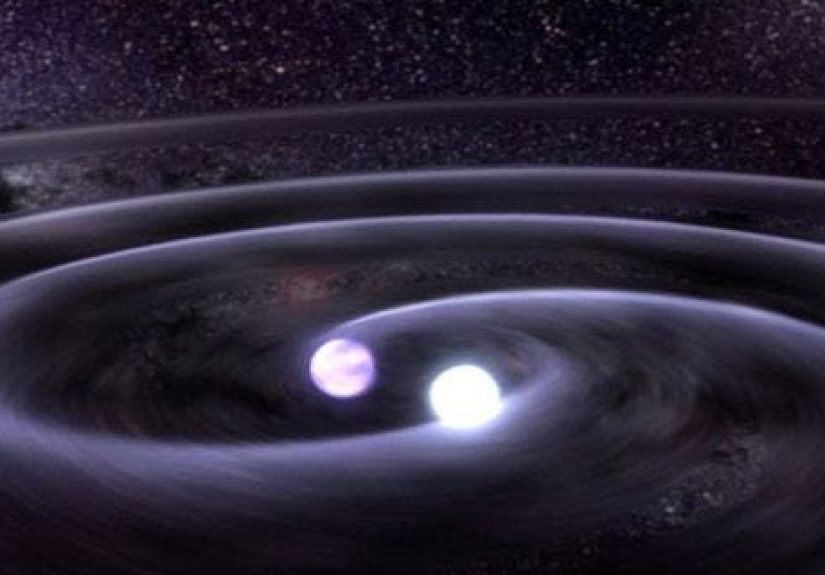
Gravitational waves are ripples in the fabric of spacetime caused by accelerating massive objects. Think of dropping a stone into a pond. Ripples spread outward across the water. Now replace the pond with spacetime, replace the stone with two black holes spinning around each other at terrifying speeds, and replace your peaceful afternoon with a cosmic collision violent enough to make the imagination file a formal complaint.
In Einstein’s general theory of relativity, gravity is not simply a force pulling objects together. Instead, mass and energy curve spacetime, and objects move along those curves. A planet orbits a star not because it is attached by an invisible string, but because the star bends the geometry around it. When extremely massive objects accelerateespecially during events like black hole mergers or neutron star collisionsthey can send waves through spacetime.
These waves stretch and squeeze space as they pass. The effect is unbelievably small by the time the waves reach Earth. LIGO’s first confirmed signal changed the length of its detector arms by a fraction of the width of a proton. That is not “small” in the way a crumb is small. That is “science had to become a magician with lasers” small.
The Historic Detection: GW150914
The first confirmed direct detection of gravitational waves is known as GW150914. The name is not poetic, but it is practical: the signal arrived on September 14, 2015. It was detected by LIGO’s two observatories, one in Hanford, Washington, and the other in Livingston, Louisiana. The fact that both detectors saw the signal nearly simultaneously was crucial. It helped rule out local disturbances, technical glitches, and the usual suspects that make experimental physicists lose sleep.
The signal came from the merger of two stellar-mass black holes. Scientists estimated that the black holes were roughly 36 and 29 times the mass of the sun before they collided. After merging, they formed a black hole of about 62 solar masses. The missing massabout three suns’ worthwas converted into gravitational-wave energy in a fraction of a second. That is the kind of energy bill no utility company is prepared to process.
What LIGO recorded was a brief rising tone often described as a “chirp.” As the two black holes spiraled closer together, they moved faster and faster. The gravitational waves increased in frequency and amplitude until the black holes finally merged. The signal lasted only a tiny fraction of a second, yet it carried information from a catastrophic event that happened around 1.3 billion years before humans were ready to build instruments sensitive enough to notice it.
How LIGO Heard the Universe
LIGO works using laser interferometry. Each LIGO detector is shaped like a giant L, with two long arms stretching about 4 kilometers each. A laser beam is split and sent down both arms. Mirrors reflect the beams back, and scientists compare how the beams line up when they return.
If a gravitational wave passes through Earth, it slightly stretches one arm of the detector while squeezing the other. Then the effect reverses. These changes are far smaller than anything we experience in ordinary life, but they leave a measurable pattern in the laser light. Detecting that pattern requires extreme isolation from vibration, temperature changes, seismic noise, and basically anything else that might shake, wobble, hum, sneeze, or misbehave.
That is why LIGO was such an ambitious project. It was not enough to build a large detector. Scientists had to build a detector capable of measuring distortions in spacetime so tiny they make dust look like boulders. The successful detection showed not only that gravitational waves exist, but also that humans had developed the tools to observe one of the universe’s most subtle signals.
Why This Discovery Confirmed Einstein’s Prediction
Einstein’s general relativity predicted gravitational waves as a natural result of spacetime curvature. Still, prediction and detection are two very different things. Science is not a place where even Einstein gets unlimited store credit. A theory must face observation.
Before LIGO, there had been indirect evidence for gravitational waves. Studies of binary pulsars showed orbital changes consistent with energy being carried away by gravitational radiation. That was important and Nobel-worthy science. But direct detection was the real prize: measuring the waves themselves as they passed through Earth.
GW150914 matched the waveform predicted by general relativity for two black holes spiraling inward, merging, and settling into a final black hole. The agreement between theory and observation was stunning. It was not just “close enough for a Tuesday.” It was a deeply convincing confirmation that Einstein’s equations describe gravity even in extreme environments where spacetime is warped by objects dozens of times more massive than the sun.
Why Black Holes Made the Perfect Cosmic Drum
Black holes are among the most extreme objects in the universe. Their gravity is so strong that not even light can escape once it crosses the event horizon. Because they do not shine like stars, black holes are difficult to observe directly. Scientists usually study them by watching how they affect nearby matter, stars, or light.
Gravitational waves changed that. When two black holes merge, they produce a signal that comes directly from the motion of spacetime around them. This gave scientists a new way to study black holes without needing light at all. In a sense, LIGO did not take a picture of the black holes. It heard their final dance.
The first detection also proved that binary black hole systems exist and can merge within the age of the universe. Before GW150914, scientists had theories and models predicting such systems. After GW150914, they had direct evidence. The universe had been keeping receipts, and LIGO finally found the drawer.
A New Era of Astronomy Begins
The confirmation of gravitational waves launched gravitational-wave astronomy. This field studies the universe through ripples in spacetime rather than through light alone. That matters because some cosmic events are dark, hidden, or difficult to understand using electromagnetic radiation.
Black hole mergers, for example, may produce little or no light. Traditional telescopes can miss them entirely. Gravitational-wave detectors can still capture their signals. This gives astronomers access to events that were previously invisible, turning the universe from a silent movie into something closer to surround sound.
Since the first detection, LIGO and its partner observatories, including Virgo in Europe and KAGRA in Japan, have reported many more gravitational-wave candidates and confirmed events. These detections include mergers of black holes, neutron stars, and possibly mixed systems involving a black hole and a neutron star. Each signal adds another piece to the cosmic puzzle.
The Neutron Star Breakthrough: Seeing and Hearing the Same Event
One of the most important follow-up milestones came in 2017 with GW170817, a gravitational-wave signal from two neutron stars colliding. Unlike black hole mergers, neutron star collisions can produce light. This event was observed both through gravitational waves and across the electromagnetic spectrum by telescopes around the world.
That was the beginning of multi-messenger astronomy in its modern form. Scientists could compare gravitational waves with gamma rays, visible light, X-rays, radio waves, and other signals from the same event. It was like solving a mystery with several witnesses instead of relying on one dramatic but slightly blurry security camera.
The neutron star merger helped confirm that such collisions can create heavy elements, including gold and platinum. So, yes, some of the jewelry on Earth may owe its origin to ancient cosmic collisions. The universe has a flair for drama and accessories.
What Gravitational Waves Teach Us About the Universe
Gravitational waves give scientists a new tool for testing fundamental physics. They allow researchers to examine whether general relativity still holds in extreme conditions. So far, Einstein’s theory has performed impressively well, including in situations involving strong gravity and high-speed collisions.
These waves also help scientists understand how black holes form and grow. Some detected black holes are heavier than earlier models expected. Others may show signs of unusual spin or merger histories. By building a larger catalog of events, researchers can study populations of black holes and neutron stars rather than treating each event as a one-off cosmic surprise party.
Gravitational waves may also help measure the expansion of the universe. Events with both gravitational-wave and light signals can act as “standard sirens,” offering an independent method for estimating cosmic distances. That could become increasingly important as astronomers continue to debate the exact rate of expansion, known as the Hubble constant.
Why the Confirmation Took So Long
If Einstein predicted gravitational waves in 1916, why did confirmation take until 2015? The short answer: because the measurement is absurdly difficult. The longer answer involves decades of theory, engineering, funding, patience, and a willingness to measure reality at scales where reality seems to be whispering from another room.
Early gravitational-wave detection efforts faced enormous technical challenges. Scientists needed mirrors of extraordinary quality, lasers of remarkable stability, vacuum systems stretching kilometers, and advanced methods to separate true cosmic signals from noise. The detectors also had to work in pairs or networks so signals could be confirmed and localized.
Advanced LIGO, the upgraded version of the observatory, made the historic detection shortly after beginning operations. That timing was almost comically dramatic. After decades of preparation, the universe delivered a signal almost immediatelyas if it had been waiting politely near the door with a black hole merger gift basket.
The Human Side of a Cosmic Discovery
Scientific breakthroughs often look neat in textbooks, but they are messy, human stories while they are happening. The confirmation of gravitational waves required thousands of scientists, engineers, technicians, data analysts, and students. It took international collaboration, long-term public funding, and the courage to pursue an experiment that many people once considered nearly impossible.
The 2017 Nobel Prize in Physics recognized Rainer Weiss, Barry Barish, and Kip Thorne for decisive contributions to the LIGO detector and the observation of gravitational waves. But the achievement also belonged to a vast scientific community. LIGO was not a lone genius story. It was a “many brilliant people refusing to quit” story.
That matters because modern science often depends on large collaborations. The detectors are enormous, the data analysis is complex, and the discoveries require cross-checking by teams around the world. The romance of science is still there, but sometimes it wears a hard hat, writes code, and attends committee meetings.
Common Misunderstandings About Gravitational Waves
Are gravitational waves the same as gravity?
No. Gravity is the effect of mass and energy curving spacetime. Gravitational waves are ripples in spacetime caused by accelerating massive objects. They are related to gravity, but they are not simply “gravity moving around” in the everyday sense.
Can gravitational waves hurt Earth?
The waves detected by LIGO are far too weak by the time they reach Earth to harm us. They pass through planets, people, buildings, and snack cabinets without noticeable effects. LIGO detects them only because its instruments are extraordinarily sensitive.
Did LIGO prove Einstein was completely right about everything?
No scientific result proves a theory in an absolute forever-and-ever sense. What LIGO did was strongly confirm a major prediction of general relativity under extreme conditions. Einstein passed an incredibly difficult test, but scientists continue looking for places where relativity and quantum physics may need a deeper framework.
Experiences Related to the Confirmation of Gravitational Waves
For many people, the announcement that scientists had confirmed gravitational waves felt different from ordinary science news. It was not just another headline about a distant object with a catalog name that sounds like a printer error. It felt like a door opening. People who had not thought about general relativity since school suddenly wanted to know what spacetime was, why black holes chirped, and whether Einstein had somehow managed to keep winning arguments a century after writing them down.
One of the most memorable experiences connected to the discovery was hearing the actual converted sound of GW150914. Strictly speaking, gravitational waves are not sound waves traveling through air. But the frequency of the detected signal could be shifted or represented in a way human ears could hear. The result was a quick chirp: rising, brief, and strangely modest. After all the talk of colliding black holes, warped spacetime, and three solar masses converted into energy, the sound itself was almost shy. It was the cosmic equivalent of a polite “ping” from the most dramatic event imaginable.
In classrooms, the discovery gave teachers a rare gift: a scientific event that was both historically important and emotionally easy to explain. Students could understand the basic idea with simple analogiesripples in a pond, a trampoline bending under weight, two dancers spinning faster as they move closer together. Then, once curiosity was awake, teachers could lead them toward deeper ideas: spacetime, interferometry, signal processing, black holes, and the power of mathematical prediction.
For science communicators, gravitational waves became a perfect example of why patience matters. The discovery was not made because someone had a lucky afternoon with a telescope. It came after decades of effort. Generations of researchers worked on the problem, often knowing that success might arrive long after their first papers, first prototypes, or first sleepless nights in the lab. That experience is an antidote to the myth that science moves only through sudden genius. Sometimes it moves by tightening one screw, improving one mirror, debugging one line of code, and checking one more source of noise.
The public reaction also showed that people still care deeply about big questions. In a world overflowing with quick content, short videos, and notifications demanding attention like tiny digital toddlers, millions of people paused to learn about spacetime. The discovery reminded readers that science can still create awe. It can make the universe feel larger and more intimate at the same time: larger because black holes are merging across cosmic distances, and more intimate because their faint signal can pass through Earth and be measured by instruments humans built.
There is also a personal lesson in the gravitational-wave story. Some goals are so difficult that they look unreasonable until they are achieved. LIGO’s success shows the value of building carefully toward something that may not pay off immediately. It is a story about trust in evidence, trust in teamwork, and trust in the idea that reality has more to reveal if we learn how to ask better questions. That may be the most human part of the whole discovery. Scientists did not force the universe to speak. They built a better way to listen.
Conclusion: The Universe Has a New Voice
The confirmation of gravitational waves was not just a win for Einstein, although it was certainly a very good day for Team Relativity. It was a turning point in astronomy. LIGO’s detection of GW150914 proved that ripples in spacetime are real, that black holes can merge, and that humans can measure cosmic events through gravity itself.
Since then, gravitational-wave astronomy has grown from a historic first into a powerful field of discovery. Each new detection helps scientists understand black holes, neutron stars, heavy elements, cosmic expansion, and the behavior of gravity under extreme conditions. The universe is no longer something we only see. It is something we can hear through the deep vibrations of spacetime.
At long last, scientists confirmed gravitational wavesand in doing so, they gave humanity a new way to explore the dark, violent, beautiful machinery of the cosmos. Not bad for a tiny chirp.