
Table of Contents >> Show >> Hide
Note: Public information on the Chinese Feilong-2 is limited and comes largely from model displays, manufacturer claims, and defense reporting rather than the kind of detailed official fact sheets available for the B-21 Raider. That makes this comparison useful, but not perfectly symmetrical.
Put the B-21 Raider and the Chinese Feilong-2 drone side by side, and the first thing to say is this: they may look like cousins at the flying-wing family reunion, but they were not built to do the exact same job. One is America’s next-generation stealth bomber, designed to survive in the nastiest air-defense environments on Earth. The other is a Chinese unmanned combat aircraft concept that has been marketed as a stealthy strike-and-surveillance platform. So yes, they can be compared. But it is not exactly a pickup truck versus pickup truck situation. It is more like a heavyweight prizefighter versus a very sharp, very ambitious robot falcon.
That said, the comparison matters because both aircraft reflect a bigger military trend: future airpower is leaning hard into stealth, long-range strike, digital upgrades, and unmanned or highly networked operations. The B-21 Raider represents the U.S. Air Force’s effort to keep penetrating advanced defenses with a bomber that can carry both conventional and nuclear weapons. The Feilong-2, at least in public descriptions, appears aimed at giving China a stealthy unmanned strike option that could support reconnaissance, precision attack, and possibly saturation-style operations in contested regions.
Why This Matchup Gets Attention
Part of the buzz comes from appearances. Both designs are associated with stealthy shaping, internal payload concepts, and long-range strike language. That naturally invites headlines and hot takes. But the B-21 Raider vs. Chinese Feilong-2 drone debate gets more interesting when you look past the silhouette and ask the real questions: Which one is more survivable? Which one is more flexible? Which one has the stronger industrial backing? And which one looks more likely to matter in actual combat rather than just in a glossy presentation deck?
What the B-21 Raider Brings to the Fight
A real program, not a paper promise
The B-21 Raider is not a mystery mock-up. It is an active U.S. Air Force program with official fact sheets, flight testing, production activity, and a defined role in America’s future bomber force. The Air Force says the B-21 is a dual-capable penetrating strike stealth bomber that will carry both conventional and nuclear munitions. It is intended to become the backbone of a future bomber fleet paired with the B-52, while gradually replacing the B-1 and B-2 in key roles.
Northrop Grumman describes the aircraft as combining range, payload, and survivability, with the ability to penetrate the toughest defenses and strike targets anywhere in the world. The company also emphasizes open architecture, which matters because modern combat aircraft are increasingly judged not just by what they are today, but by how fast they can be upgraded tomorrow. In plain English: the B-21 is being built to age gracefully, which is rare in defense and even rarer in life.
Stealth plus strategic mission depth
The B-21’s biggest edge is not that it is stealthy. Lots of programs claim stealth. Its real advantage is that it is being designed as a strategic penetrating bomber for the highest-end threat environment. That means long range, high survivability, heavy mission flexibility, and the ability to participate in conventional strike and nuclear deterrence. The Air Force has repeatedly framed it as a critical part of the air leg of the nuclear triad, which instantly puts it in a different category from most drones.
It also helps that the program appears to be moving forward in a more concrete way than many skeptics expected. The Air Force announced in February 2026 that the program delivered aircraft on schedule in 2025 and remains on track for aircraft on the ramp at Ellsworth Air Force Base in 2027. The service and Northrop Grumman also announced an agreement to increase production capacity by 25 percent, while recent reporting points to low-rate initial production already underway.
Costly, yes, but built for national-level missions
No one will ever call the B-21 cheap unless they are joking or billing the taxpayer from another galaxy. The Air Force lists an average unit procurement cost of $550 million in base year 2010 dollars, $639 million in base year 2019 dollars, and $692 million in base year 2022 dollars, with a minimum planned inventory of 100 aircraft. But those numbers reflect a platform meant for national-level deterrence and deep-strike missions, not just tactical drone work. It is expensive because its mission set is expensive. Fancy stealth does not come from the discount aisle.
What We Know About the Chinese Feilong-2 Drone
Public data is thin, and that matters
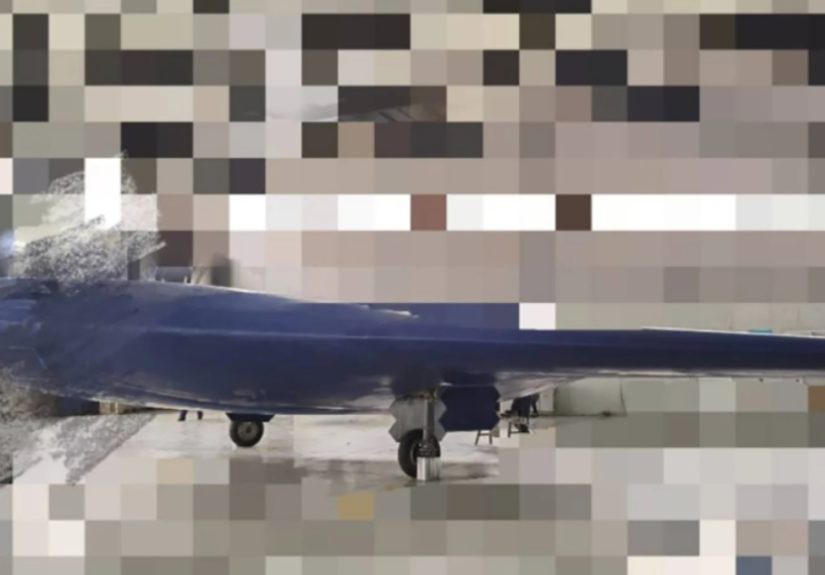
The Feilong-2, also called the FL-2 or Flying Dragon-2, is much harder to assess because public reporting is thinner and less standardized. Janes reported in 2019 that the UAV had been exhibited in model form and was being developed by Xi’an-based Zhong Tian Guide Control Technology Company. Janes described it as a hybrid configuration formed from a flying wing with two canted vertical tailplanes.
Additional defense reporting has described the FL-2 as a turbofan-powered multirole MALE UCAV intended for precision strikes and ISR. Asian Military Review reported that the Fei Long-2 was presented as a multirole high-subsonic unmanned platform with a proposed maximum takeoff weight of about 22,000 kilograms and an internal payload capacity around 6,000 kilograms. Popular Mechanics, covering the same wave of claims in 2021, noted that the aircraft was being pitched by its developer as a bomber-like long-range combat drone with performance claims that echoed the B-21 comparison.
What the concept suggests
If those public descriptions are roughly accurate, the Feilong-2 appears designed to fill a different niche from the B-21. It looks more like a stealthy unmanned strike and reconnaissance platform than a true strategic bomber. That could still make it dangerous. A drone with reduced observability, internal payload, and long range could be useful for ISR, precision strikes against high-value targets, electronic support missions, or operating as part of a larger unmanned network. It could also fit neatly into broader Chinese anti-access and area-denial strategies in the Western Pacific.
But the key phrase here is could be. Unlike the B-21, the Feilong-2 does not have the same level of public official detail showing test progress, production acceleration, basing plans, or force integration timelines. That does not mean it is fake. It means outside analysts have less verified material to work with, which makes sweeping conclusions risky. In defense analysis, “we do not know enough yet” is not a boring answer. It is usually the smart one.
B-21 Raider vs. Chinese Feilong-2 Drone: Head-to-Head
1. Mission role
The B-21 wins on mission depth. It is designed from the start as a penetrating bomber for strategic conventional and nuclear operations. The Feilong-2 appears intended as an unmanned strike and ISR aircraft. That is serious, but it is not the same mission category. Comparing them directly is a little like comparing a submarine to a torpedo boat because both touch water.
2. Survivability in high-end air defense environments
The B-21 likely has the advantage because its entire design philosophy centers on surviving and penetrating advanced air defenses. U.S. official descriptions repeatedly highlight survivability and operation in tomorrow’s high-end threat environment. The Feilong-2 may incorporate stealth features, but the public record does not offer the same depth of evidence for how mature or effective those features are in practice.
3. Flexibility and upgrade path
The B-21 again looks stronger because the Air Force and Northrop Grumman openly emphasize digital engineering and open architecture. That matters for everything from sensors and communications to weapons and software updates. Feilong-2 reporting suggests a flexible multirole concept, but public documentation is nowhere near as robust. When one side shows official upgrade philosophy and the other side mostly shows marketing language, the scoreboard is not subtle.
4. Risk tolerance and attritability
This is where the Feilong-2 concept becomes more interesting. Because it is unmanned, it could offer commanders options in missions that would be politically or operationally riskier for a crewed bomber. If China can build such systems at meaningful scale, an unmanned stealth strike platform could be used more aggressively for probing, decoy work, reconnaissance, or high-risk attacks. The B-21 is vastly more capable in strategic terms, but nobody treats a crewed stealth bomber as casually as a drone. For obvious reasons. Pilots tend to have opinions.
5. Program maturity
The B-21 clearly leads. It has flown, entered testing, added a second test aircraft, moved through low-rate initial production, and is on track for operational aircraft at Ellsworth in 2027. By contrast, Feilong-2 is still discussed in public primarily through models, concept descriptions, and claims from coverage surrounding its development. That is the difference between “arriving” and “being talked about at the airport.”
So Which One Is Better?
If the question is which platform is more formidable as a strategic military asset today, the answer is the B-21 Raider. It has a clearer mission, stronger evidence of maturity, more transparent official support, and a central role in U.S. long-range strike and nuclear deterrence planning. It is not just stealthy; it is embedded in a full doctrine, industrial system, and modernization pathway.
If the question is whether the Feilong-2 matters, the answer is also yes. Even with limited public detail, the concept points to where Chinese airpower thinking is going: more unmanned systems, more stealth shaping, more long-range strike options, and more effort to complicate U.S. and allied defenses. It may not be a true peer to the B-21, but it does not need to be. In a real conflict, a stealthy drone that performs ISR, targeting, deception, or localized strike missions could still create major headaches. Ask any air-defense operator whether they enjoy surprises. They do not.
Final Take
The smartest conclusion in the B-21 Raider vs. Chinese Feilong-2 drone debate is this: the aircraft represent different answers to the same strategic problem. The United States is building a survivable, crewed, long-range stealth bomber to guarantee deep strike and deterrence against top-tier adversaries. China appears to be exploring stealthy unmanned systems that could deliver ISR and strike effects with more flexibility and less human risk. These are not mirror images, but they are part of the same future battlefield story.
Right now, the B-21 looks more real, more mature, and more strategically significant. The Feilong-2 looks more like an intriguing signal of where Chinese unmanned aviation may be headed. One is a major pillar of a superpower’s bomber force. The other is a glimpse into how stealth drones could become more central to great-power competition. In short, the B-21 is the heavyweight champion with an official record and a scheduled next fight. The Feilong-2 is the mysterious contender whose highlight reel is still mostly trailer footage.
Extended Perspective: 500 More Words on the Real-World Experience of This Rivalry
What makes the B-21 Raider vs. Chinese Feilong-2 drone topic so fascinating is not just the hardware. It is the experience of what these machines say about modern military competition. A decade ago, stealth bombers and stealth drones often lived in separate mental boxes. Bombers were strategic, rare, and politically significant. Drones were useful, persistent, and often discussed as tools for surveillance or precision strikes in lower-risk environments. That neat division is fading fast.
The B-21 experience, from an American defense perspective, is about building confidence that crewed stealth bombers still matter in an age of dense air defenses, satellite surveillance, cyber warfare, and long-range missiles. Every official update about testing, production, basing, or digital engineering sends a message: the United States is not giving up on the idea that a crewed aircraft can still reach the hardest targets and hold them at risk. That matters not just to U.S. war planners, but to allies who watch American force posture as a measure of credibility.
The Feilong-2 experience feels different. It reflects the growing realization that unmanned systems are no longer just sidekicks. In military thinking, stealth drones can now be imagined as scouts, decoys, shooters, jammers, and force multipliers rolled into one. Even if the Feilong-2 never becomes the exact aircraft its strongest claims suggest, the concept itself is telling. China wants observers to think in terms of dispersed, hard-to-track, lower-risk strike networks. That idea alone can shape planning on the other side of the Pacific.
There is also a psychological experience to this rivalry. The B-21 symbolizes deliberate, methodical military power: expensive, polished, and built to last decades. The Feilong-2 symbolizes experimentation and asymmetric pressure: maybe cheaper, maybe riskier, but potentially fielded in ways that complicate traditional defense planning. One side says, “We can still punch through your front door.” The other side hints, “We may send a swarm through the windows, vents, and Wi-Fi router while you are watching the door.” That is not an official doctrine statement, obviously, but it captures the mood.
For analysts, journalists, and even casual aviation nerds, the experience of following these programs also reveals a media lesson. Official transparency and speculative reporting do not carry the same weight. The B-21 has enough public milestones that observers can build a grounded picture, even if many details remain classified. The Feilong-2 sits in a murkier zone where concept art, reporting, ambition, and national signaling all blend together. That does not make the story less important. It just means readers should bring curiosity and skepticism in equal doses.
In the end, the lived reality of this comparison is not about choosing a single winner in a one-on-one duel that probably never happens. It is about understanding how air warfare is changing. Future conflict may feature crewed stealth bombers opening the path, unmanned aircraft expanding the battlespace, and both sides trying to blind, confuse, and outrange each other. The B-21 and the Feilong-2 sit on different points along that spectrum, but together they show where the future is headed: farther, stealthier, smarter, and a lot less forgiving for anyone caught relying on yesterday’s playbook.






 Close
Close