
Table of Contents >> Show >> Hide
- Why C Gets the Green Reputation
- What “Greenest” Actually Means
- Why C Often Uses Less Energy
- Where the Headline Needs a Reality Check
- Where C Truly Shines as a Green Choice
- How to Make C Even Greener
- So, Is C the Greenest Programming Language?
- Experiences From the Real World: When “Green C” Feels True
If programming languages had campaign slogans, C’s would probably be: “Less drama, fewer layers, more work per watt.” It is not flashy. It does not arrive with a giant runtime, a pep talk, and six abstraction muffins. It shows up, rolls up its sleeves, talks directly to the machine, and gets on with the job.
That reputation is not just nostalgia from programmers who still think terminals look better in green text. C has long been associated with speed, small binaries, and tight control over memory. And in the conversation about sustainable software, those traits matter. The less time a CPU spends grinding through overhead, the less energy it usually burns. That is the heart of the argument for C as the “greenest” programming language.
Still, this is where we should resist turning a clever headline into a religious doctrine. C is often one of the most energy-efficient choices, but not because the letter “C” secretly stands for “carbon-neutral.” It wins when the workload, compiler, data layout, and engineering discipline all line up. In other words, C is green in the same way a bicycle is green: wonderfully efficient, unless you strap a refrigerator to it and pedal uphill in flip-flops.
Why C Gets the Green Reputation
The strongest argument for C is simple: it usually creates lean, ahead-of-time compiled native code with very little runtime baggage. That means fewer layers between your intent and the hardware. No large managed runtime needs to warm up. No garbage collector needs to suddenly stop the party and rearrange the furniture. No interpreter has to translate each move while the processor taps its foot.
For energy efficiency, that matters because energy use is tied closely to execution time, memory traffic, and average power draw. A program that finishes quickly and touches memory intelligently will often consume less total energy than one that keeps the machine busy longer. C has historically been excellent at that style of work because it gives programmers direct control over loops, arrays, structs, allocation strategy, and data locality.
That does not mean C always wins every benchmark. It does mean C is usually in the serious contender category whenever raw efficiency matters. If you are writing an operating system component, firmware, driver, database engine, codec, compression library, or performance-critical inner loop, C is still very much the language equivalent of bringing running shoes to a race where everyone else packed a sofa.
What “Greenest” Actually Means
It is not just about watts
When people discuss green software, they sometimes reduce the topic to power draw alone. Real systems are messier. Total energy consumption depends on how long the program runs, how intensively it uses the CPU, how often it misses cache, how much memory it allocates, and what else the runtime is doing behind the scenes. A language can look elegant on a whiteboard and still behave like a space heater in production.
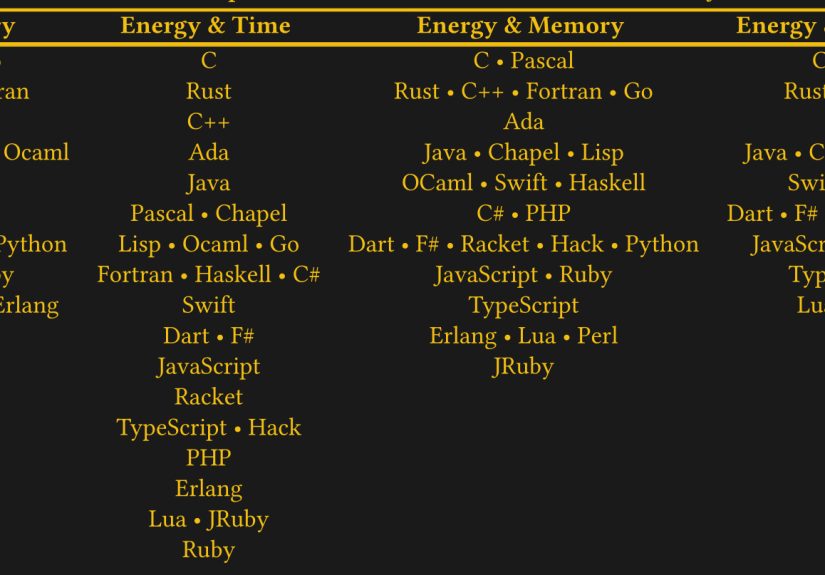
That is why serious comparisons focus on three practical measures: execution time, energy consumed, and memory usage. C tends to score well because it often pairs fast execution with modest memory overhead. When a program keeps data close, avoids unnecessary allocations, and compiles to efficient machine instructions, the hardware spends less time fetching, translating, cleaning up, and apologizing.
Fast is often greener, but not always
One of the most useful lessons from energy-efficiency research is that faster code is often greener code, but not automatically. Sometimes a language or implementation runs a little longer while drawing less power. Sometimes a runtime makes up ground after warm-up. Sometimes a highly optimized library in a higher-level language crushes a mediocre C implementation written by a sleep-deprived mortal. The real world enjoys nuance almost as much as programmers dislike it.
So the claim “C is the greenest programming language” is best understood as a strong general tendency, not an eternal law of nature. C usually begins with structural advantages. Whether it keeps them depends on the code.
Why C Often Uses Less Energy
1. It compiles ahead of time to native code
C is typically compiled directly into native machine code before execution. That gives it a major head start. The CPU is not spending extra cycles interpreting source instructions or waiting for just-in-time compilation to optimize hot paths at runtime. The code shows up ready to work.
This matters especially in short-lived programs, command-line tools, system utilities, embedded applications, and serverless-style workloads where startup time is part of the bill. If the program starts quickly, runs quickly, and exits quickly, that is often good news for both latency and energy use.
2. It gives precise control over memory
Memory is where a lot of software quietly loses its environmental manners. Poor allocation patterns, bloated objects, fragmented heaps, and cache-unfriendly access can force the processor to wait on slower parts of the memory hierarchy. That waiting is not peaceful meditation. It is wasted work.
C gives developers unusually direct control over layout and lifetime. Arrays are contiguous. Structs are explicit. Allocation can be manual and deliberate. That makes it easier to design compact data structures and predictable access patterns. When data is arranged well, the cache can do its job. When the cache does its job, the CPU does not have to keep wandering off to main memory like someone who forgot why they opened the fridge.
3. C benefits from extremely mature compiler tooling
C has been optimized for decades by some of the most battle-tested compiler toolchains in existence. GCC, Clang, and vendor compilers know a great deal about how to transform loops, inline functions, vectorize arithmetic, tune for size, and exploit architecture-specific features. This is not a trivial advantage. Compiler maturity is one of the main reasons C keeps punching above its weight in energy conversations.
A well-structured C program can benefit from inlining, interprocedural optimization, profile-guided optimization, and auto-vectorization without requiring the programmer to rewrite everything in mystical assembly poetry. In performance-sensitive code, those gains can translate into fewer cycles, fewer instructions retired, and lower overall energy use.
4. It can be very small
Small code is not always faster code, and faster code is not always smaller code. But in many practical environments, compact binaries and modest runtime requirements are part of the energy story. On microcontrollers, IoT devices, and edge systems, every kilobyte matters. A language that can run comfortably in constrained environments without dragging a full managed runtime behind it has a real advantage.
That is one reason C remains dominant in firmware, kernels, drivers, bootloaders, real-time systems, and embedded libraries. These are places where power budgets are strict, memory is limited, and “just add another abstraction layer” is the sort of idea that gets stared at in complete silence.
Where the Headline Needs a Reality Check
Algorithms beat language slogans
A bad algorithm in C can still waste more energy than a good algorithm in Python, Java, Rust, Go, or almost anything else. Big-O complexity is not canceled by low-level bravado. If one program performs vastly less work, it may be greener even if it is written in a less efficient language on paper.
This is why mature higher-level ecosystems sometimes close the gap. A Python program that calls efficient C-backed numeric libraries can outperform a naïve C implementation written from scratch. A Java service that stays hot for days may overcome startup overhead and deliver excellent throughput. A .NET application compiled ahead of time can cut startup cost and memory footprint significantly. The language name on the box matters, but the implementation inside the box matters more.
Programmer freedom can become programmer chaos
C’s power comes with sharp edges. Manual memory management, pointer arithmetic, undefined behavior, aliasing issues, and accidental cache-unfriendly structures can erase the very benefits developers came for. In the worst cases, code that was meant to be lean becomes brittle, hard to optimize safely, and expensive to maintain.
This is the hidden catch in the green-C argument: the language gives you the opportunity to write highly efficient software, but it does not guarantee that you will. C is like a race car without lane assist. In skilled hands, glorious. In careless hands, educational.
Developer energy counts too
There is also a broader sustainability angle: human time. If a team can deliver a correct, maintainable service in a higher-level language much faster, the overall system may be more sustainable even if the runtime is a bit less efficient. Engineering is not just a contest to see who can save the last five joules while spending five extra months debugging buffer overflows.
That does not weaken C’s case. It just places it in context. The greenest choice for a tiny embedded controller may absolutely be C. The greenest choice for a fast-moving business application may be a higher-level language with a few native extensions in the hot path. Real optimization starts when ideology ends.
Where C Truly Shines as a Green Choice
Embedded systems and firmware
This is C’s home turf. On small devices, batteries, sensors, and controllers, low overhead is not optional. It is the job description. C lets developers work close to the metal, minimize hidden allocations, control device interactions, and fit within strict memory and power budgets.
Operating systems and systems software
Kernels, drivers, file systems, networking stacks, and runtime libraries still lean heavily on C because hardware-facing code rewards predictability and tight control. When you need direct access to memory, registers, interrupt handling, and small-footprint execution, C remains one of the most practical choices available.
Performance-critical libraries
Even when developers write applications in Python, Ruby, JavaScript, Java, or other higher-level languages, the fast paths often end up in native code. Compression, graphics, crypto, parsers, scientific kernels, and databases frequently rely on C or C-adjacent implementations because the energy cost of overhead becomes painfully obvious at scale.
How to Make C Even Greener
Measure before you brag
The greenest C program is not the one with the most confident comments. It is the one you actually measured. Profile execution time. Inspect memory use. Benchmark realistic workloads. Look at cache misses, branch behavior, and hot functions. The processor does not care how strongly you feel that your loop is elegant.
Write for locality, not just cleverness
Simple contiguous arrays often beat fancy pointer-heavy structures. Loop ordering matters. Blocking matters. Reusing data while it is still in cache matters. A plain, boring loop that walks memory in a friendly order can be greener than a stylish abstraction that bounces around RAM like a caffeinated squirrel.
Use compiler optimizations wisely
Optimization levels, vectorization, architecture tuning, and profile-guided builds can all improve energy efficiency. But they are not magic stickers. Use them carefully, verify the result, and understand the tradeoffs between speed, size, portability, and correctness.
Reduce unnecessary work
Avoid repeated allocations in hot paths. Eliminate redundant copies. Minimize data movement. Inline only when it helps. Do not over-engineer. The cleanest path to greener software is still the oldest one: do less work.
So, Is C the Greenest Programming Language?
In many benchmark-driven, systems-level, and resource-constrained scenarios, C has earned the title. It is often among the most energy-efficient languages because it combines native compilation, low runtime overhead, compact memory use, and excellent compiler support. That is a strong case, and it is grounded in reality rather than mythology.
But the most honest version of the headline is slightly less dramatic and much more useful: C is often the greenest programming language when efficiency is the main goal and the code is written well. That may not fit as neatly on a T-shirt, but it does fit reality.
So yes, C deserves its green reputation. Just remember that it does not win by existing. It wins when programmers pair the language’s low-level strengths with good algorithms, smart memory layout, careful measurement, and a refusal to mistake folklore for engineering.
Experiences From the Real World: When “Green C” Feels True
One of the most telling experiences with C usually happens after a team builds a prototype in a higher-level language and then rewrites only the hot path in C. Suddenly the machine sounds calmer. Startup gets snappier. CPU usage drops. Memory charts stop looking like mountain ranges. Nobody on the team has changed the business logic, but the system starts behaving as if it drank less espresso. That is when the “C is greener” argument stops being theory and starts feeling physical.
A classic example is data processing. Imagine a tool that scans logs, parses records, and computes aggregates. In a scripting language, it might be quick to build and perfectly fine for small runs. Then the input grows from megabytes to gigabytes, and the runtime begins stretching like a Monday morning meeting that should have been an email. Rewriting the parsing loop, buffer management, and aggregation core in C often changes the story. The same workload finishes faster, with fewer temporary objects, less memory churn, and less time spent in runtime housekeeping.
Another common experience appears in embedded work. On a small device, there is nowhere to hide. A little inefficiency is not “just a bit slower.” It can mean shorter battery life, more heat, missed timing deadlines, or code that no longer fits. C feels green here not because of marketing but because you can see the budget in front of you. You know how much RAM you have. You know how long the device sleeps. You know how many cycles a loop burns. In that environment, a language with low overhead is not merely elegant; it is merciful.
There is also a humbling experience that comes with C: the moment you realize the language does not save you from sloppy thinking. A careless allocation pattern, a pointer-heavy structure, or a cache-hostile traversal can make “efficient” C code perform embarrassingly badly. Many developers learn this the hard way. They expect C to be fast because it is C, then discover that a simple change in data layout does more for performance than an afternoon of heroic micro-optimizations. It is a useful lesson. Green software is often less about clever syntax and more about respecting how memory really works.
Compiler behavior is another eye-opener. Developers sometimes assume performance comes entirely from hand-tuned tricks, but modern C compilers do a remarkable amount of heavy lifting when the code is written clearly enough for them to help. A loop that becomes vectorized, a function that gets inlined at the right moment, or a build tuned for the target CPU can make the difference between “pretty good” and “why is this suddenly twice as fast?” That experience tends to convert people from cargo-cult optimization to measurement-driven engineering.
And then there is the final, slightly comic truth: the greener C program is often the less dramatic one. Not the version with macros stacked to the ceiling. Not the version that looks like it was written during a lightning storm. Usually it is the version with straightforward loops, contiguous data, modest abstractions, and a programmer who profiles first and boasts later. That is the real lived experience behind the headline. C can absolutely be the greenest programming language. But in practice, its greenest form is rarely the most theatrical. It is the one that quietly does less, moves less, allocates less, and finishes sooner.







 Close
Close