Table of Contents >> Show >> Hide
- The Short Answer: Usually Legal in Some Ways, Illegal in Others
- Why This Issue Is So Complicated
- When a Neighbor’s Backyard Camera Is More Likely to Be Legal
- When the Camera May Cross the Legal Line
- Common Legal Theories That Come Up in Camera Disputes
- What You Can Do If You Think the Camera Is Too Invasive
- What You Should Not Do
- Real-World Experiences: How Backyard Camera Disputes Usually Play Out
- Conclusion
If your neighbor’s security camera seems to be staring directly into your backyard, your first reaction is usually not calm, measured legal analysis. It is more like: Why is that thing looking at my grill, my dog, and my Saturday afternoon? Fair question.
The short answer is: maybe, but not without limits. In the United States, a neighbor can often place a security camera on their own property and capture areas that are visible from ordinary viewpoints. But that does not mean they have a blank check to monitor your private life like they are running a low-budget wildlife documentary called Humans of the Fence Line.
Whether a neighbor can legally point a security camera at your backyard depends on several factors: where the camera is installed, what it records, whether it captures audio, whether it peers into spaces with a strong expectation of privacy, and what your state or local laws say. In other words, this is one of those deeply annoying legal questions where the honest answer is, “It depends.”
This guide breaks down what homeowners should know, when a backyard camera may be legal, when it may cross the line, and what you can do if you think the surveillance has gone too far.
The Short Answer: Usually Legal in Some Ways, Illegal in Others
In many situations, a neighbor can legally install an outdoor security camera on their own house, garage, or fence line. If that camera mainly watches their driveway, side yard, gate, or back doorand your backyard happens to fall within part of the framethat is often treated as lawful residential security use.
But legality gets shakier when the setup feels less like general security and more like targeted surveillance. A camera that is intentionally aimed over a privacy fence, zoomed toward your patio furniture, angled into bedroom windows, or paired with audio recording may create a much stronger privacy problem. The law tends to become less forgiving when the camera is used to monitor people, not property.
So if you are asking, “Can my neighbor point their security camera at my backyard?” the best practical answer is this: they may be allowed to capture some of what is visible outdoors, but they are not automatically allowed to invade spaces where you reasonably expect privacy.
Why This Issue Is So Complicated
There Is No One-Size-Fits-All Federal Rule
There is no single national law that neatly says, “Yes, backyard cameras are fine,” or “No, neighbors can never point cameras at adjacent property.” Instead, the legal analysis usually pulls from a mix of privacy law, state recording law, civil claims such as intrusion upon seclusion, local ordinances, and sometimes criminal statutes covering voyeurism or hidden recording.
That means two camera setups that look almost identical can be treated very differently depending on the state, the angle, the technology involved, and how intrusive the recording really is.
Privacy Outdoors Is Real, but Not Unlimited
Many people assume that because a backyard is “my property,” it is always legally private. That is not quite how the law works. Outdoor spaces often get less privacy protection than the inside of a home, especially if they are visible from neighboring property, upper-story windows, common areas, or public vantage points.
Still, that does not mean your backyard becomes a legal reality show the second you step outside. A fenced yard, a secluded patio, or an area used for family activities may support a stronger argument that you had a reasonable expectation of privacyespecially if the camera is unusually invasive, persistent, or intentionally aimed to capture intimate activity.
Think of it this way: a camera that incidentally catches the corner of your lawn is one thing. A camera that appears engineered to monitor your hot tub, outdoor shower, or back windows is a very different animal.
Audio Can Change Everything
Video gets most of the attention, but audio recording is often where neighbor camera disputes become legally dangerous. Federal law and many state laws treat the recording of conversations differently from ordinary video. Some states are more forgiving when one party to a conversation consents. Others require the consent of all parties for certain confidential communications.
That means a backyard camera with a microphone can create bigger problems than a video-only device. If the camera is picking up private conversations from your yard, patio, deck, or inside an open window, the neighbor may be stepping into eavesdropping territory. The microphone, in many cases, is the legal troublemaker wearing a tiny invisible cape.
When a Neighbor’s Backyard Camera Is More Likely to Be Legal
A camera is generally more likely to be lawful when it has a legitimate home-security purpose and is not obviously designed to spy. Common examples include:
- A fixed camera covering a back gate, alley, driveway, or shed
- A wide-angle camera that includes part of your yard only incidentally
- A doorbell or floodlight camera capturing shared outdoor approaches
- A visible camera used to deter trespassing, theft, or vandalism
- A system with privacy masking or limited motion zones
Courts and lawmakers often care about context. If the camera placement makes sense for property protection, and if it is not hidden or aggressively targeted, the owner has a stronger argument that the device is being used for ordinary security rather than harassment.
This is especially true in suburban settings where camera fields of view naturally overlap. Property lines do not stop pixels. A camera watching one fence line may also see another. The law usually understands that some overlap is unavoidable.
When the Camera May Cross the Legal Line
Now for the part people really want to know: when does a security camera become a privacy problem instead of a security tool?
1. It Appears Intentionally Targeted at Private Areas
If the camera is trained on spaces where you would reasonably expect privacysuch as a bedroom window, enclosed patio, hot tub, outdoor changing area, or secluded part of the yardthe setup becomes harder to defend. A camera that captures more than it needs to for security may support a claim that the owner is intruding on private affairs.
2. It Uses Zoom, Motion Tracking, or Other Enhanced Features
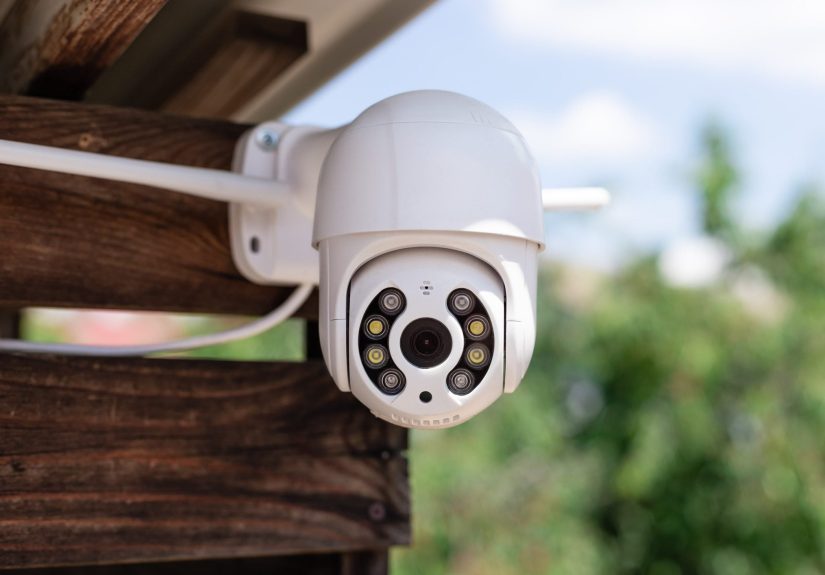
A fixed, wide-angle camera is one thing. A pan-tilt-zoom camera that follows movement, zooms into your windows, or records in a way that feels deliberate and personalized can look much more invasive. Technology matters. The more the system behaves like active monitoring instead of passive observation, the more suspicious it looks.
3. It Records Audio Without Proper Consent
This is one of the biggest red flags. A neighbor may think, “It is just my smart camera,” while state law is thinking, “That microphone may be a problem.” If the device captures private conversations, especially in a state with stricter consent rules, that can turn an irritating setup into a potential legal violation.
4. It Is Hidden or Secretive
Visible security cameras are common. Hidden cameras are far more likely to raise legal alarms, especially if they appear placed to observe people rather than property. Secret recording tends to look less like crime prevention and more like voyeurism, and judges are not known for loving that vibe.
5. It Is Part of Harassment or Stalking
Even if a camera might be legal in isolation, the surrounding behavior matters. If the neighbor has a history of intimidation, confrontation, threats, repeated complaints, or retaliatory conduct, the camera may be treated as part of a broader harassment pattern. In that context, a backyard camera can become evidencenot just hardware.
Common Legal Theories That Come Up in Camera Disputes
When people challenge a neighbor’s backyard camera, the dispute often falls into one or more of these categories:
Invasion of Privacy / Intrusion Upon Seclusion
This is the classic civil claim in many states. The basic idea is that someone intentionally intruded, physically or electronically, into a private matter in a way that would be highly offensive to a reasonable person. A camera pointed at deeply private backyard activity may fit that theory better than one aimed at a visible property line.
Voyeurism or Hidden Recording Statutes
Some states have criminal laws aimed at secret recording, peeping, or video voyeurism. These laws often focus on highly private settingssuch as bathrooms, bedrooms, changing areas, or a person’s residence. They do not automatically ban all outdoor filming, but they can apply when a camera is used to secretly capture private conduct.
Eavesdropping or Wiretap Laws
If the device captures sound, you may be looking at audio-recording law rather than ordinary camera law. This is one reason two seemingly identical camera disputes can end very differently: one camera records silent video, the other records every barbecue conversation on the block.
Harassment, Nuisance, or HOA Violations
Some conflicts are resolved outside a major privacy lawsuit. A homeowner association may have rules on exterior devices or nuisance conduct. Local ordinances may address surveillance, lighting, or nuisance behavior. And sometimes the best path is not a dramatic courtroom speechit is a boring but effective letter from the HOA or city code office. Boring, in legal life, can be beautiful.
What You Can Do If You Think the Camera Is Too Invasive
If you suspect your neighbor’s camera is improperly pointed at your backyard, try to respond strategically instead of emotionally. Marching over the fence and yelling at a lens is satisfying only in movies.
1. Document What You See
Take photos or video showing the camera’s location, angle, and any visible movement. Note whether it appears fixed or adjustable. Keep dates and times. If the camera visibly changes direction or seems to track activity, document that too.
2. Figure Out Whether It Records Audio
Look up the model if you can identify it. Many smart security cameras have built-in microphones by default. Knowing whether the device captures audio can dramatically change the legal analysis.
3. Talk to the Neighbor First
Yes, really. Not every backyard camera dispute begins with malicious intent. Sometimes the camera was installed by a contractor, aimed carelessly, or left on factory settings. A calm request to adjust the angle, disable audio, or add privacy zones may solve the problem faster than anything else.
4. Ask for Practical Fixes
Specific solutions often work better than broad accusations. You can ask whether they will:
- Reposition the camera
- Use privacy masking
- Disable audio recording
- Limit motion detection zones
- Aim the device at their own gate or structure instead
5. Check Local Rules
City ordinances, county rules, condo regulations, HOA bylaws, and lease terms may all matter. Even if state law is vague, local restrictions may provide a cleaner route to resolution.
6. Escalate When Necessary
If the camera appears to be pointed into windows, hidden, recording private conversations, or part of ongoing harassment, consider contacting local law enforcement, code enforcement, your HOA, or a licensed attorney in your state. A short consultation can tell you whether you may have a privacy claim, harassment claim, or request for injunctive relief.
What You Should Not Do
Do not damage the camera. Do not trespass to remove it. Do not cut wires, spray paint the lens, or turn the situation into a neighborhood action movie. That can create legal problems for you, which is not ideal when you started as the annoyed person with a tomato garden and a privacy concern.
You also should not assume that a fence alone proves illegality. A privacy fence helps your argument, but it is not magic. Likewise, you should not assume that “it is outside, so nothing is private.” That is too simplistic. Backyard surveillance disputes are fact-heavy, and small details matter.
Real-World Experiences: How Backyard Camera Disputes Usually Play Out
In real life, most disputes about a neighbor pointing a security camera at a backyard do not start with a dramatic constitutional showdown. They start with ordinary neighborhood friction. One family installs a new floodlight camera after a package theft. The next family looks up one evening, sees a blinking light aimed near the fence, and suddenly every cookout feels like an audition tape.
A common scenario goes like this: the camera owner insists the device is there to protect their shed, back gate, or parked car. The neighbor on the other side is not convinced because the angle seems too high, too wide, or just a little too interested in the patio where their kids play. Nobody feels fully wrong, which is exactly why the conflict drags on.
Another very typical experience involves audio. People often focus on what the camera can see, but the bigger surprise is what it can hear. A homeowner buys a modern smart camera without realizing the microphone is active by default. The family next door later learns that ordinary backyard conversations may have been captured. What began as a routine security purchase suddenly feels much more invasive.
Then there are the escalation stories. A neighbor gets asked, politely, to tilt the camera down a few inches. Instead of adjusting it, they add another camera. Or they say the famous last words of neighborhood disputes: “I can do whatever I want on my property.” That sentence has a remarkable ability to turn a solvable issue into a months-long feud involving screenshots, certified letters, HOA complaints, and an impressive amount of passive-aggressive landscaping.
Some disputes resolve surprisingly well. Once both sides talk, the camera gets repositioned, privacy zones are enabled, and everyone goes back to pretending they enjoy mowing. These are the good endingsthe ones where technology causes a problem, and technology also fixes it.
Other situations are more serious. For example, a camera that appears to follow movement, points at back windows, or is installed after a conflict can feel threatening even if the owner calls it “security.” In those cases, the emotional toll matters. People stop using their decks. They keep curtains closed. Kids feel watched. The backyard stops being an extension of the home and starts feeling like contested territory.
That is why these disputes are not only about gadgets. They are about control, boundaries, and the simple expectation that home should feel like home. A backyard does not need to be a legal fortress to deserve respect. Most people are not asking for invisibility. They are asking for a reasonable line between a neighbor protecting property and a neighbor monitoring private life.
In the end, the strongest practical lesson from real-world backyard camera conflicts is this: the more a camera looks like a normal security tool, the easier it is to defend. The more it looks like targeted surveillance, the more likely it is to trigger legal trouble, community backlash, or both. And in neighborhood life, both can last much longer than the camera battery.
Conclusion
So, can your neighbor point their security camera at your backyard? Sometimes yesbut not without legal and practical limits. A camera that incidentally captures part of your yard while monitoring your neighbor’s own property may be lawful. A camera that intentionally watches private backyard activity, records conversations, peers into windows, or becomes part of harassment is much more likely to cross the line.
The safest rule of thumb is simple: security cameras can protect property, but they should not become tools for spying on neighbors. If a camera feels too intrusive, start by documenting the facts, asking for a reasonable adjustment, and checking your local and state rules. And if the setup is clearly invasive, hidden, or recording audio, treat it seriously and get legal guidance in your state.
Your backyard should not feel like a stage set for someone else’s surveillance system. A little security is normal. A front-row seat to your private life is not.