Table of Contents >> Show >> Hide
- Who Is Elizabeth Gadd?
- The Signature Style: Tiny Human, Giant World
- Why Canadian Landscapes Shape the Mood
- Wanderlust Without the Noise
- The Art of Self-Portrait Landscape Photography
- Light, Weather, and the Magic Hour Obsession
- Composition: How the Eye Wanders Through the Frame
- Why Her Photos Feel Peaceful Instead of Performative
- The Role of Real Landscapes in the Age of AI
- Responsible Wanderlust: Loving Nature Without Crushing It
- Lessons Photographers Can Learn From This Style
- Why This Work Resonates With Viewers
- Experience Section: What It Feels Like to Chase Wanderlust Through a Lens
- Conclusion
Some photographs politely ask for your attention. Elizabeth Gadd’s images do not ask; they open a foggy forest door, hand you a warm jacket, and make you wonder why your hiking boots are still in the closet. The Canadian self-portrait photographer, originally from British Columbia, has built a visual world where lone figures stand inside forests, mountains, fields, rivers, coastlines, and snow-dusted valleys as if they have wandered into a dream and decided to stay for tea.
Her work is often described through one irresistible word: wanderlust. But this is not the glossy, airport-ad kind of wanderlust where everyone owns matching luggage and somehow never sweats. Gadd’s landscape photography feels quieter, more intimate, and more honest. Her images capture the emotional pull of wild placesthe way a mountain can make a person feel tiny, safe, brave, and mildly underdressed all at once.
Based on real landscapes rather than artificial fantasy, her photography blends self-portraiture, travel, nature, and visual storytelling. The result is a body of work that has inspired photographers, hikers, dreamers, and anyone who has ever looked at a misty road and thought, “Well, I guess I live in a poem now.”
Who Is Elizabeth Gadd?
Elizabeth “Lizzy” Gadd is a Canadian artist, photographer, and videographer known for ethereal self-portraits set in dramatic outdoor environments. Originally from British Columbia, she has often described mountains, forests, fields, and oceans as central to her sense of home and creative identity. Her work frequently features a solitary human figure placed within a vast natural setting, creating a peaceful conversation between person and place.
What makes her story especially compelling is that she is self-taught. Instead of following a traditional classroom path into photography, she learned through experimentation, persistence, and the kind of creative trial-and-error that usually involves many awkward photos, a few accidental masterpieces, and at least one moment of asking a camera, “Why are you like this?”
A major turning point in her development came through a 365 photography project, a year-long challenge that pushed her to create consistently. This daily practice helped her discover the style that would become her signature: portraits and self-portraits immersed in wild landscapes, designed to show human interaction with nature in a positive, peaceful way.
The Signature Style: Tiny Human, Giant World
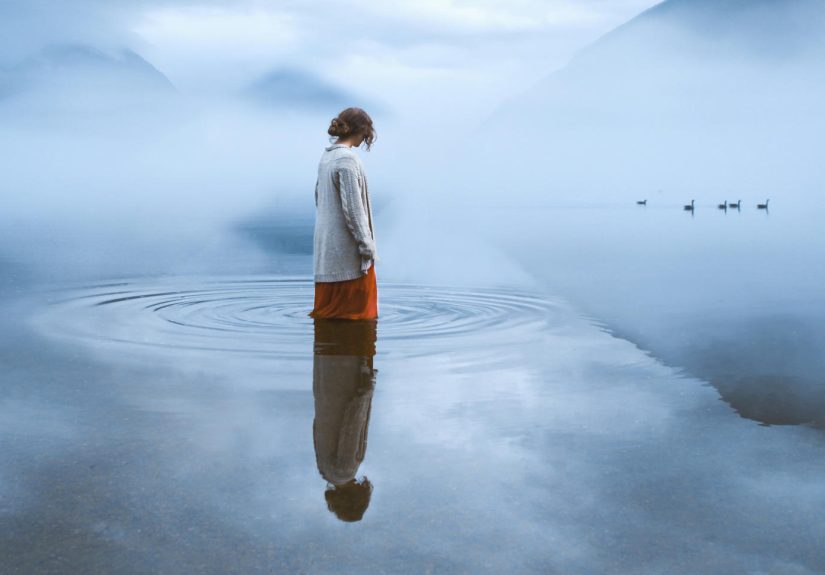
Gadd’s images often place a lone figure in the middle of a sweeping landscape. Sometimes the person is facing away from the camera, wrapped in a cloak, standing in water, walking through fog, or pausing before mountains. The figure is not always the “main subject” in the usual portrait sense. Instead, the person becomes a bridge between viewer and environment.
This approach gives her work emotional scale. The mountains feel taller because someone stands beneath them. The forest feels deeper because someone is entering it. The ocean feels more mysterious because someone is listening to it. In her best-known images, the human presence does not dominate nature; it belongs to it.
That is why the photos feel less like travel trophies and more like visual diary entries. They are not shouting, “Look where I went!” They are whispering, “Look what this place made me feel.” That distinction is the difference between ordinary landscape photography and meaningful storytelling.
Why Canadian Landscapes Shape the Mood
Canada is almost unfairly gifted when it comes to natural scenery. British Columbia alone offers rainforests, rugged coastlines, alpine lakes, snow-covered peaks, misty valleys, and forests so green they look like they have a subscription to premium moss. Alberta adds the Rocky Mountains, glacier-fed lakes, open skies, and dramatic weather that can turn a simple photo walk into a cinematic survival montage.
For a photographer like Gadd, these environments are more than backdrops. They shape the entire emotional language of the image. A foggy British Columbia forest suggests solitude and introspection. A turquoise mountain lake creates wonder and clarity. A snowfield adds silence. A windswept ridge gives the image a feeling of courage, movement, and adventure.
Canadian landscape photography often benefits from this natural contrast. The country’s geography allows artists to move from dense woodland to open alpine terrain, from ocean edges to frozen waterfalls, from golden autumn fields to blue-hour mountain scenes. That variety gives photographers a rich visual vocabularyone that Gadd uses with a quiet, unmistakable voice.
Wanderlust Without the Noise
The word “wanderlust” can be overused, especially on social media, where it sometimes appears next to a latte, a suitcase, and a caption written from a hotel lobby. But in Gadd’s photography, wanderlust feels deeper. It is not simply the desire to travel; it is the desire to connect with place.
Her images suggest that adventure does not have to be loud. It can be slow, foggy, patient, and personal. The adventure might be waking before sunrise, hiking through wet grass, waiting for clouds to move, or standing very still while nature decides whether it is feeling photogenic today.
This slower version of wanderlust is powerful because it resists the pressure to consume destinations. Instead of presenting landscapes as items to check off a list, the photos encourage viewers to linger. They make the viewer imagine the cold air, the damp sleeves, the crunch of snow, the smell of cedar, and the very real possibility that snacks were forgotten in the car.
The Art of Self-Portrait Landscape Photography
Self-portraiture in wild places is not as simple as standing somewhere pretty and pressing a button. It requires planning, composition, patience, and a willingness to run back and forth between camera and frame like a very artistic squirrel.
In landscape self-portraiture, the photographer must think about two subjects at once: the person and the environment. The figure needs to be visible enough to matter, but not so dominant that the landscape becomes wallpaper. Clothing color, body position, distance from camera, light direction, and weather conditions all influence the final mood.
Gadd’s work succeeds because the human figure usually feels integrated into the scene. The subject is not pasted onto nature; the subject is participating in it. This is one reason her images often feel cinematic without feeling artificial. They have drama, but not melodrama. They have mystery, but not confusion. They invite curiosity without needing a giant neon arrow labeled “symbolism goes here.”
Light, Weather, and the Magic Hour Obsession
Landscape photographers are famously obsessed with light. Sunrise, sunset, golden hour, blue hourthese are not just times of day; they are sacred appointments. Miss one, and the mountains may still be there, but they will look slightly disappointed in you.
Gadd’s style often relies on atmospheric light: soft fog, glowing horizons, muted skies, filtered forest light, and the gentle drama of overcast weather. This kind of lighting supports the emotional quality of her work. Harsh midday sun can flatten a scene or make it feel too literal, while softer light adds texture, mystery, and depth.
Weather also plays an important role. Mist can separate layers of forest. Snow can simplify a composition. Rain can create shine and intimacy. Clouds can act like a giant softbox, proving once again that nature was doing lighting design long before photographers started charging for presets.
Composition: How the Eye Wanders Through the Frame
Strong landscape photography rarely happens by accident. It depends on visual structure. Leading lines, foreground layers, natural frames, scale, balance, and negative space help guide the viewer’s eye. In Gadd’s images, a path may lead toward a figure, a river may pull the viewer into the distance, or a mountain ridge may frame the subject like a quiet stage.
Foreground elements are especially useful in landscape storytelling. Grass, rocks, flowers, branches, water, or snow can create depth and make the viewer feel physically present. Instead of looking at a flat scene, the audience feels as if they could step into itpreferably wearing waterproof boots, because beautiful places are often damp and rude about it.
Scale is another major tool. By placing a small figure against a massive landscape, the image communicates awe immediately. The viewer understands the emotional message before analyzing the technique: nature is immense, and we are part of it, not above it.
Why Her Photos Feel Peaceful Instead of Performative
Many travel images are built around achievement. The person reached the summit. The person found the hidden waterfall. The person somehow packed a linen outfit for a glacier. Gadd’s photographs feel different because they are less about conquest and more about coexistence.
The figures in her images are usually calm. They are not jumping, flexing, or waving triumphantly from a cliff edge. They are standing, walking, listening, resting, or simply existing. That stillness gives the work emotional maturity. It makes the landscape feel like a companion rather than a trophy.
This peaceful quality is central to the appeal of her photography. In a fast, overstimulated digital world, quiet images can feel almost rebellious. They remind viewers that not every beautiful moment has to be loud enough to trend.
The Role of Real Landscapes in the Age of AI
As AI-generated imagery becomes more common, real landscape photography carries a different kind of weight. Gadd’s work is especially meaningful because it emphasizes real places, real weather, real patience, and real physical presence. The magic comes not from inventing a fantasy world, but from noticing the fantasy already present in the world we have.
That does not mean editing is absent. Like many professional photographers, artists may adjust color, contrast, exposure, and mood to match their creative vision. But the foundation remains rooted in lived experience: hiking, waiting, composing, feeling the air, and responding to conditions that cannot be controlled with a prompt box.
For viewers, this matters. A real landscape carries memory. It suggests effort. It asks us to protect the wild places that inspire us. And frankly, nature has been producing unbelievable visuals for several billion years. It deserves at least a little credit.
Responsible Wanderlust: Loving Nature Without Crushing It
Beautiful outdoor photography can inspire people to travel, hike, and explore. That inspiration is wonderfuluntil everyone shows up at the same fragile meadow wearing the same hat. Responsible nature photography matters because images influence behavior.
Photographers and travelers should stay on marked trails, respect wildlife distance, avoid damaging plants, follow local rules, and think carefully before revealing exact locations that may be environmentally sensitive. The goal is simple: leave the place as magical for the next person as it was for you.
This responsibility fits naturally with the spirit of Gadd’s work. Her images portray connection, not exploitation. They celebrate the beauty of matching human presence with natural rhythm. That message is more important than ever as iconic landscapes face crowding, climate pressure, and social media attention.
Lessons Photographers Can Learn From This Style
1. Put Emotion Before Gear
Expensive equipment can help, but emotion is what makes a photograph memorable. A technically perfect image with no feeling is just a very sharp postcard. Before shooting, ask what the scene feels like. Is it lonely, peaceful, wild, hopeful, mysterious, or joyful? Let that emotion guide the composition.
2. Use a Human Figure for Scale
Adding a person to a landscape can transform the viewer’s understanding of size and mood. The figure does not need to pose dramatically. Sometimes a simple stance, turned back, or walking motion is enough to create story.
3. Wait for the Right Conditions
Great landscape images often require patience. Fog, light, clouds, and wind do not operate on a photographer’s schedule, which is deeply inconsiderate but visually useful. Arrive early, stay longer, and give the scene time to change.
4. Compose With Layers
Foreground, middle ground, and background create depth. A person in the middle distance, framed by trees and backed by mountains, gives the eye a natural route through the image.
5. Let Nature Stay Bigger Than the Subject
The most powerful wanderlust photography often avoids making the human the hero. Instead, it shows a relationship. The person is there to help us feel the landscape, not to defeat it in single combat.
Why This Work Resonates With Viewers
Gadd’s photography resonates because it taps into a shared human longing: the desire to feel restored by the natural world. Many people spend their days surrounded by screens, traffic, deadlines, notifications, and chairs that were clearly designed by someone with no spine. Her images offer visual relief.
They also invite imagination. Viewers can project themselves into the scene. They can imagine standing at the edge of a lake, walking through a wet forest, or watching fog roll over a valley. The photos become emotional postcards from a quieter version of life.
That is the power of magnificent landscape photography. It does not merely show us where to go. It reminds us how we want to feel when we get there.
Experience Section: What It Feels Like to Chase Wanderlust Through a Lens
Anyone who has tried landscape photography knows the final image hides a lot of comedy. The photograph may look peaceful, but behind it there may be cold fingers, muddy knees, a tripod leg slowly sinking into wet ground, and a photographer whispering encouraging nonsense to the clouds. This is part of the experience. In fact, it may be the experience.
Imagine setting out before sunrise in the Canadian Rockies. The car is quiet, the coffee is heroic, and the road curves between dark silhouettes of mountains. You arrive at a lake while the world is still blue. Nothing dramatic has happened yet. The water is still. The peaks are half-hidden. You set up the camera and wait. For ten minutes, the scene looks almost ordinary. Then a thin line of light appears along the ridge. The snow catches it first. The lake follows. Suddenly, the whole place changes its mind about being ordinary.
That is the addictive part of landscape photography. You are not just taking pictures; you are witnessing transformation. The same scene can become five different worlds in half an hour. Fog lifts. Wind moves. Shadows stretch. A bird crosses the frame at exactly the wrong time, then exactly the right time. Nature edits itself continuously, and the photographer’s job is to stay awake enough to notice.
For self-portrait landscape photography, the experience becomes even stranger and more personal. You are both the person behind the camera and the person inside the story. You choose the frame, press the timer or remote, hurry into position, and try to look serene while internally counting seconds. The final image may suggest calm solitude. The making of it may involve sprinting over rocks in boots and hoping no hikers appear to witness your interpretive dash.
But that physical involvement creates intimacy. Standing inside the landscape changes the way you photograph it. You notice the coldness of the water, the direction of the wind, the slope of the ground, the smell of pine, the sound of your own breath. The photo becomes tied to memory. It is not just “a mountain at sunrise.” It is the morning your socks got wet, your hands froze, and the light arrived anyway.
This is why work like Elizabeth Gadd’s feels sincere. It carries the evidence of presence. The viewer may not know every detail behind the image, but the emotional truth comes through. The figure in the landscape is not decoration; it is proof of encounter.
For travelers, this style of photography can change the way a trip unfolds. Instead of rushing from viewpoint to viewpoint, you begin looking for feeling. You ask which bend in the trail feels quiet, which patch of forest feels ancient, which overlook makes you want to stand still. You stop treating the camera like a collecting device and start using it as a listening tool.
The best experiences often happen when the plan fails. Maybe the famous viewpoint is crowded, so you wander down a lesser-known trail. Maybe the sky is cloudy, so you photograph the forest instead of the sunset. Maybe rain ruins the “perfect” shot and gives you reflections, mist, and mood you could never have scheduled. Wanderlust photography rewards flexibility. It likes people who can say, “Well, this is not what I expected,” and then make something beautiful anyway.
There is also a humbling lesson in photographing magnificent landscapes: you are not in charge. You can prepare, research, charge batteries, pack lenses, check weather, and still be outsmarted by fog. That humility is healthy. It keeps the work honest. It reminds photographers that nature is not a studio prop. It is alive, changing, and gloriously indifferent to your content calendar.
In the end, the experience of capturing wanderlust is not only about producing an image. It is about becoming more attentive. You learn to read light, respect distance, notice small details, and move more gently through wild places. You learn that a landscape does not have to be famous to be magnificent. Sometimes a quiet field, a roadside forest, or a small stream behind a trailhead can hold the exact kind of magic you were trying to fly across the world to find.
That may be the most valuable lesson in this kind of photography: wanderlust is not just a hunger for elsewhere. It is a way of seeing. Elizabeth Gadd’s magnificent landscape images remind us that the world is still full of doors disguised as trails, weather, water, and light. All we have to do is step carefully, look closely, and remember to bring snacks.
Conclusion
Canadian Photographer Captures Wanderlust In Magnificent Landscapes is more than a beautiful title; it describes a visual philosophy. Elizabeth Gadd’s work shows how self-portraiture and landscape photography can create images that feel peaceful, adventurous, emotional, and deeply connected to nature. Her Canadian roots, love of wild places, and patient creative process have shaped a style that continues to inspire photographers and travelers around the world.
Her images remind us that magnificent landscapes are not simply places to visit. They are places to feel, respect, and remember. In a noisy digital age, that quiet message may be the most powerful composition of all.