Table of Contents >> Show >> Hide
- What Is Spacetime, Exactly?
- The Core Idea of General Relativity (Without the Headache)
- So, Is Spacetime a “Thing” or Just Math?
- What General Relativity Predicts (And How We Know It’s Not Just Vibes)
- Real-World Example: Why GPS Would Drift Without Relativity
- Black Holes, Spacetime, and “No, It’s Not a Cosmic Drain”
- Common Misconceptions That Deserve a Friendly Timeout
- Why This Matters Beyond Physics Class
- of Spacetime Experiences: Making Relativity Feel Real
- Conclusion: Spacetime Is the Stage, the Script, and Sometimes the Special Effects
If you’ve ever stared at a sci-fi movie and thought, “So… space bends, time stretches, and somehow everyone still makes it to lunch?” you’re in the
right place. The general theory of relativity (GR) is Einstein’s 1915 upgrade to gravity, and it’s one of the weirdest things humans
have ever been correct about. It explains why apples fall, why clocks tick differently on mountains, why light can “curve,” and why the universe can
literally send us faint vibrations called gravitational waves.
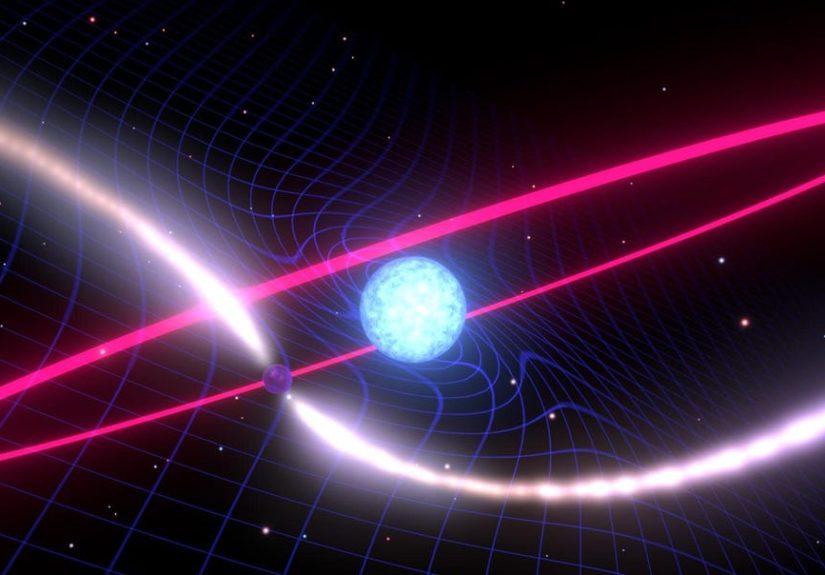
The big headline: gravity isn’t a spooky invisible tug acting across empty space. In general relativity, gravity is what happens when
spacetimethe combined geometry of space and timegets curved by mass and energy. Stuff (and even light) follows the straightest
possible paths through that curved geometry, which we perceive as “gravity.”
What Is Spacetime, Exactly?
“Spacetime” sounds like a marketing term for a fancy vacuum cleaner. But it’s a genuinely useful idea: instead of treating space (where things are) and
time (when things happen) as separate, relativity treats them as a single 4-dimensional structure. An “event” isn’t just a location; it’s a location
plus a time. That package deal is spacetime.
Space and Time: The Ultimate Combo Meal
In everyday life, space feels like a big 3D stage and time feels like a universal clock ticking the same for everyone. Relativity says: not quite.
Different observersespecially those moving differently or sitting in different gravitational fieldscan disagree about time intervals and distances.
Yet they still agree on deeper relationships defined by the geometry of spacetime.
Think of spacetime as the “rulebook” that tells you what counts as a straight line (a geodesic) and how clocks and rulers behave. In flat
spacetime, those rules look like the physics you learned in basic classes. In curved spacetime, the rules changebecause the geometry changed.
The Core Idea of General Relativity (Without the Headache)
General relativity can be summarized in a sentence that’s famous among physics students because it’s both elegant and mildly terrifying:
Mass-energy tells spacetime how to curve, and curved spacetime tells matter how to move.
The Elevator Thought Experiment
One of Einstein’s key insights is the equivalence principle. Imagine you’re inside a windowless elevator:
- If the elevator is sitting still on Earth, you feel your weight.
- If the elevator is in deep space but accelerating upward at 9.8 m/s², you also feel “weight.”
From inside, those two situations can look the same. That suggests gravity and acceleration are deeply linked. General relativity takes that link
seriously and builds gravity from geometry rather than treating it like a traditional force.
Curvature: Not Just a “Rubber Sheet” Trick
You’ve probably seen the rubber sheet analogy: put a bowling ball on a stretched sheet, it makes a dip, and marbles roll around it. That’s a decent
first picture, but it has limits:
- It uses Earth’s gravity to explain gravity (which is… awkward).
- It suggests “downward” in a literal direction, when curvature in GR is more abstract.
- It doesn’t capture how time is part of the curvature story.
In GR, the curvature is in the spacetime geometry itselfespecially in how time and space intervals are measured near mass and energy.
So, Is Spacetime a “Thing” or Just Math?
This is the sneaky philosophical question hiding under the physics. In practice, spacetime is a model that makes stunningly accurate predictions.
Whether it’s a “thing” like atoms are a thing depends on what you mean by “real.” But here’s the honest working-scientist answer:
If something has measurable effectslike changing clock rates, bending light, shifting orbits, and carrying waves we can detectthen treating it as a
real physical structure is incredibly useful. General relativity treats spacetime geometry as dynamic, not just a fixed stage. Matter and energy affect
it, and it affects what matter and energy do.
What General Relativity Predicts (And How We Know It’s Not Just Vibes)
1) Gravitational Time Dilation: Clocks Don’t Agree
Near a massive object, time runs differently than far away. In everyday terms: clocks deeper in a gravitational field tick a tiny bit slower. This is
not a metaphorit’s measurable. Modern atomic clocks are so precise they can detect time dilation over surprisingly small height differences.
It’s tempting to say, “So time is slower down there,” like time is wading through syrup. A better way to say it is: spacetime geometry near mass means
the proper time along different paths differs. Your wristwatch isn’t broken; the geometry is doing geometry things.
2) Light Bending and Gravitational Lensing
If spacetime is curved, “straight lines” (geodesics) aren’t straight in the way you’d draw them on paper. Light follows geodesics too, so light can
appear to bend around massive objects. This creates gravitational lensing, where galaxies and clusters distort and magnify the light
of objects behind them.
Lensing isn’t just pretty pictures. It’s a powerful tool: it can reveal mass distributions (including dark matter), magnify distant galaxies, and even
produce multiple images of the same object.
3) Orbital Effects: When Newton Needs an Edit
Newton’s gravity works brilliantly for most everyday and even most planetary scenarios. But when gravity is strong or precision is extreme, GR adds
corrections. One famous example is the precession of Mercury’s orbit. Mercury’s closest-approach point (perihelion) shifts over time
in a way that Newtonian physics can’t fully account for, but GR can.
The lesson isn’t “Newton was wrong.” It’s “Newton was a fantastic approximation,” and general relativity explains why that approximation works so well
and where it stops being enough.
4) Frame-Dragging: Spinning Masses Twist Spacetime
GR predicts that a rotating mass (like Earth) slightly drags spacetime around with it. This is called frame-dragging. It’s a tiny
effect for Earth, but it’s real and was tested by the Gravity Probe B mission using ultra-precise gyroscopes in orbit.
This is the kind of result that feels like the universe is showing off: “Not only do I curve spacetimeif I spin, I swirl it too.”
5) Gravitational Waves: Spacetime Can Ripple
General relativity predicts that accelerating massive objects can create ripples in spacetime called gravitational waves. These waves
travel at the speed of light and carry energy away from violent cosmic events like merging black holes or neutron stars.
For a long time, gravitational waves were like a legendary creature: everyone had a sketch, nobody had a photo. Then detectors like LIGO measured them
directlyopening a new way of “listening” to the universe, not just looking at it.
Real-World Example: Why GPS Would Drift Without Relativity
Here’s the part where relativity stops sounding like a philosophy seminar and starts sounding like customer support for your phone.
GPS satellites carry atomic clocks. Because satellites are higher up in Earth’s gravitational field and also moving fast, their clocks tick at slightly
different rates compared with clocks on the ground. Both special relativity (motion) and general relativity (gravity) matter. If the system didn’t
account for those effects, GPS errors would grow rapidly and your navigation would wander off like a confused tourist.
In other words: relativity is quietly helping you find coffee. You’re welcome, spacetime.
Black Holes, Spacetime, and “No, It’s Not a Cosmic Drain”
Black holes are solutions to Einstein’s equations where gravity becomes so strong that regions of spacetime are effectively cut off from the outside by
an event horizon. The popular image is a giant vacuum cleaner in space. The reality is less dramatic and more precise:
- A black hole doesn’t “suck” more than other objects of the same mass from far away.
- What makes it special is how spacetime behaves near it, and the presence of a horizon.
- Close in, tidal effects and curvature can be extreme.
Black holes matter for spacetime discussions because they showcase the theory at its most intensewhere geometry is not a gentle curve but a dramatic
reshaping of the rules.
Common Misconceptions That Deserve a Friendly Timeout
“Spacetime is a fabric floating in something else.”
In GR, spacetime isn’t a sheet sitting inside a bigger container. It’s the container. Asking “what is spacetime inside of?” is usually a sign we’re
importing everyday intuition into a place it doesn’t fit.
“Gravity is an illusion.”
Gravity is not imaginary. What changes is the interpretation: in GR, free-fall motion is “natural” motion in curved spacetime. You still feel gravity
when you’re prevented from following your natural geodesic path (like when the ground pushes up on you).
“General relativity explains everything.”
It explains gravity extremely well, but it doesn’t fully merge with quantum mechanics in a complete theory of quantum gravity. That’s not a failure;
it’s a frontier. The theory is still one of the most successful scientific frameworks ever built.
Why This Matters Beyond Physics Class
General relativity reshaped how we understand the cosmos:
- Cosmology: it provides the framework for modern models of the expanding universe.
- Astrophysics: it explains compact objects, neutron stars, black holes, and high-gravity environments.
- Technology: it influences precision timing and satellite navigation (hello again, GPS).
- Observation: it predicts lensing and gravitational wavesboth now essential tools for discovery.
If Newton gave us a reliable map of the “everyday gravity” neighborhood, Einstein handed us the GPS coordinates for the whole cityplus the weird
alleyways where time and space don’t behave politely.
of Spacetime Experiences: Making Relativity Feel Real
Most of us won’t ride a rocket at a noticeable fraction of the speed of light, and we probably won’t hang out near a black hole (even if the views are
reportedly fantastic and the parking is… questionable). But you can build intuition for spacetime through experiences that are surprisingly
down-to-Earthsometimes literally.
One experience is the “clock mindset.” The next time you look at your phone’s time, imagine that time isn’t a universal background hum but something
measured along your path through spacetime. You, your phone, a GPS satellite, and an atomic clock in a lab are all “counting” time in slightly
different ways depending on motion and gravity. You don’t feel it because the differences are tiny at human scalesbut they’re not zero. The fun twist
is that the universe isn’t asking permission; it’s applying geometry.
Another experience is watching how people react to gravitational lensing images. Even without equations, your brain recognizes something uncanny: light
from a distant galaxy arriving along multiple routes, stretched into arcs, duplicated into mirrored shapes, or arranged into an Einstein ring. It feels
like a cosmic optical illusion, but it’s actually an everyday rule (light follows geodesics) meeting an extraordinary landscape (curved spacetime). If
you’ve ever seen a warped reflection in a spoon and immediately understood “curved surface changes straight lines,” you’ve got the right instinctjust
upgrade “spoon” to “galaxy cluster.”
A third experience is the elevator thought experimentexcept you can do it in real life without terrifying your building manager. Stand still and feel
your weight: that upward push from the floor is your body being nudged off a free-fall path. Now think about the moments you don’t feel that
pushlike the brief lightness at the top of a jump, or the drop of an amusement ride. Those sensations are your body sampling what “following a
geodesic” feels like. It’s a tiny, safe peek at the deep GR idea that free fall is not “being pulled,” but “moving naturally.”
Then there’s the emotional experience of hearing a gravitational-wave “chirp” for the first time. It’s not a sound wave in air; it’s a translation of
spacetime vibrations into audio. But it hits people anyway: two massive objects spiraling together so violently that the universe itself quiversand we
built instruments sensitive enough to notice. It’s the rare science moment where the data feels like a story.
Finally, there’s the learning experienceprobably the most relatable one. At first, spacetime sounds abstract. Then you see how it stitches together
time dilation, lensing, orbits, and waves into one consistent picture. It’s like discovering that a bunch of weird plot points were foreshadowing the
same twist all along. The twist is geometry. The universe is a math nerd, and it’s not sorry about it.
Conclusion: Spacetime Is the Stage, the Script, and Sometimes the Special Effects
The general theory of relativity is our best description of gravity as the geometry of spacetime. It explains why time can tick differently, why light
can bend, why orbits subtly shift, why rotating planets can twist nearby spacetime, and why the universe can send ripples across billions of light-years.
Spacetime isn’t just “where things happen”it’s a dynamic structure that responds to mass-energy and guides motion in return.
And the next time someone says relativity is too theoretical, you can calmly point out that their phone’s navigation system is basically a daily prayer
to Einstein, answered in satellite signals.