
Table of Contents >> Show >> Hide
- What “Realistic” Actually Means (So You Don’t Chase Perfection Forever)
- Supplies That Make This Easier (Not Fancier)
- Quick Eye Anatomy for Artists (No Med-School Tuition Required)
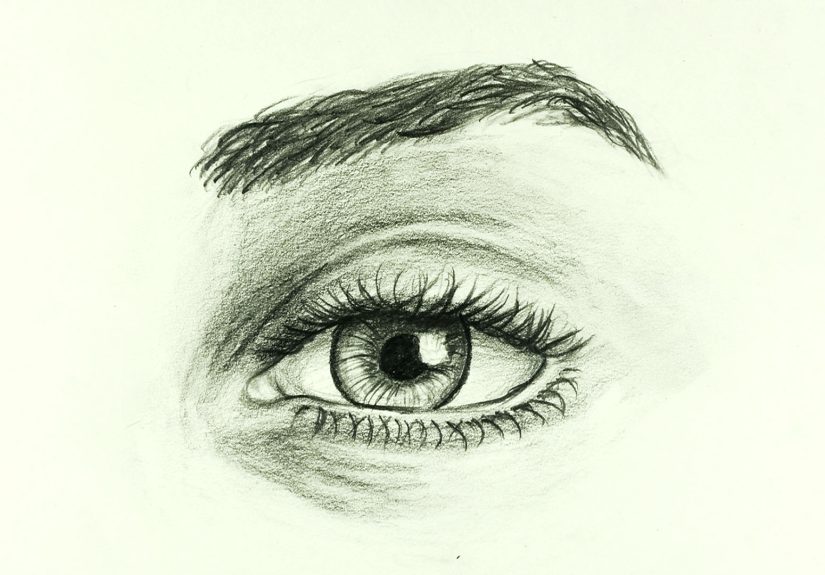
- How to Draw a Realistic Female Eye: 15 Steps
- Step 1: Pick a reference and decide the light direction
- Step 2: Lightly map the overall eye angle and placement
- Step 3: Block in the almond shape (but make it anatomical)
- Step 4: Add the inner corner (tear duct area)
- Step 5: Place the irispartly covered by the upper lid
- Step 6: Draw the pupil and reserve the highlight
- Step 7: Establish the darkest darks (pupil, lash line, deep crease)
- Step 8: Shade the iris base value (don’t start with the tiny details yet)
- Step 9: Build iris texture with directional strokes
- Step 10: Shade the sclera (the “white”) like a sphere
- Step 11: Add the upper eyelid thickness and the crease fold
- Step 12: Place the cast shadow from the upper lid onto the eyeball
- Step 13: Shade the surrounding skin (values first, “pretty” later)
- Step 14: Draw eyelashes in groups, with direction and taper
- Step 15: Refine edges, lift highlights, and add the final “wet” sparkle
- Common Mistakes (and Quick Fixes)
- Pro Tips for a More Feminine, Realistic Look (Without Stereotypes)
- Conclusion
- Extra Practice Notes: What Artists Commonly Experience (and How to Push Through)
- References Consulted (No Links, Just Transparency)
Drawing a realistic female eye is basically a tiny, high-stakes movie: drama (eyelid folds),
special effects (highlights), and a suspicious amount of time spent shading something the size of a jellybean (the iris).
The good news? You don’t need magical talent. You need a plan, a reference photo, and the willingness to draw the same curve
twelve times until it stops looking like a sleepy potato.
This guide walks you through 15 clear steps to draw a realistic female eye with believable structure, soft skin transitions,
and eyelashes that don’t look like a row of tiny forks. We’ll keep it practical, a little funny, and very focused on realism.
What “Realistic” Actually Means (So You Don’t Chase Perfection Forever)
Realism isn’t “every pore, every lash, every molecule.” Realism is correct shapes + convincing light.
If the forms are right and the values (light/dark) make sense, viewers will believe iteven if you didn’t draw 273 individual lashes.
Also: “female eye” isn’t one universal shape. People have different eyelids, lashes, brows, and crease depth.
When artists say “female eye,” they usually mean stylistic choices that often read as feminine:
softer edges, slightly fuller lashes, and smoother value transitions. Use what fits your subject.
Supplies That Make This Easier (Not Fancier)
Core tools
- Pencils: HB, 2B, 4B (add 2H if you’re heavy-handed)
- Kneaded eraser: for lifting highlights and softening lines
- Blending stump or tissue: for smoothing graphite (don’t overdo it)
- Paper: medium tooth drawing paper (super slick paper can fight you)
- Sharpener: sharp pencils = cleaner lash strokes
Optional, but very helpful
- Mechanical pencil for clean construction lines
- White gel pen (or a bright eraser) for final sparkle highlights
Whatever you use, the real “upgrade” is a good reference photo with clear lighting and crisp detail.
Your eye can’t draw what it can’t see.
Quick Eye Anatomy for Artists (No Med-School Tuition Required)
For realism, think of the eye as a sphere sitting in a socket, wrapped by eyelids like a blanket that forgot it was supposed to be neat.
The eyelids have thickness, they overlap the eyeball, and they cast shadows. Most “flat” eye drawings happen because the artist forgets the 3D part.
- Iris: colored ring (it’s not a flat sticker; it has subtle texture)
- Pupil: the dark opening (its value is usually one of the darkest spots)
- Sclera: the “white” of the eye (rarely pure whiteusually shaded by the lid)
- Tear duct / inner corner: small forms and wet highlights add realism
- Upper lid crease: fold above the lid that helps “read” as a real eye
Realistic eyes look alive because the values follow the forms: rounded eyeball, overhanging brow area, and lid shadows.
Nail that, and you’re 80% there.
How to Draw a Realistic Female Eye: 15 Steps
Step 1: Pick a reference and decide the light direction
Choose a high-resolution photo. Before you draw, identify: Where is the light coming from? Top left? Front? Side?
This controls every shadow and highlight. If you skip this, you’ll “invent lighting” later, which is like trying to build a house after you’ve already painted it.
Step 2: Lightly map the overall eye angle and placement
Draw a faint guideline showing the tilt of the eye. Even a “straight-on” eye is often slightly angled.
Keep this super lightthink “ghost line,” not “permanent marker confession.”
Step 3: Block in the almond shape (but make it anatomical)
Sketch the upper and lower lid shapes. The top lid is usually a stronger curve; the bottom lid is subtler.
Avoid perfectly symmetrical “football eyes.” Real lids have little irregularities and a slightly sharper inner corner.
Step 4: Add the inner corner (tear duct area)
Draw the inner corner shape as its own small form. It’s not just a point; it’s a tiny structure with planes.
If you treat it like a triangle sticker, the eye looks cartoonish fast. Keep edges soft and watch the reference carefully.
Step 5: Place the irispartly covered by the upper lid
Draw the iris as a circle (or an ellipse if the eye is angled). In many natural poses, the upper lid overlaps the top of the iris.
If you show the full iris with lots of white above it, your subject will look permanently surprised.
Step 6: Draw the pupil and reserve the highlight
Put the pupil inside the iris, usually centered but sometimes slightly off depending on gaze direction.
Mark the highlight shape and keep it clean. A crisp highlight sells “wet eye” realism better than a thousand extra lines.
Step 7: Establish the darkest darks (pupil, lash line, deep crease)
Lightly at first, then build up: the pupil is typically very dark, the upper lash line is often one of the strongest dark accents,
and the crease can be dark where the fold turns away from light. Starting with dark anchors helps your value range feel intentional.
Step 8: Shade the iris base value (don’t start with the tiny details yet)
Add a mid-tone base to the iris, leaving the highlight untouched. Then darken the outer rim (limbal ring) if your reference shows it.
This creates depth immediately. Use gentle pressureiris texture should emerge through layering, not brute force.
Step 9: Build iris texture with directional strokes
Use sharp pencil strokes radiating outward (and sometimes inward) to mimic natural iris patterns.
Vary thickness and spacing. Overly uniform “sunbeam lines” look fakereal irises are messy in a beautiful, organized way.
Step 10: Shade the sclera (the “white”) like a sphere
The sclera is rarely pure white. Shade lightly with a soft gradient: darker near the upper lid (shadow),
slightly darker near the corners, and lighter toward the center area that catches more light. Keep it subtlethis is soft realism, not smoky eye makeup for the eyeball.
Step 11: Add the upper eyelid thickness and the crease fold
Give the upper lid a thin edge where it overlaps the eyeball. Then sketch the crease above it, following the eye’s curve.
For a feminine look, the crease is often softly blended rather than sharply outlinedunless makeup or strong lighting makes it crisp.
Step 12: Place the cast shadow from the upper lid onto the eyeball
This is the realism cheat code. The upper lid casts a shadow on the top of the iris/sclera area.
Without this shadow, the eye can look pasted on. Blend gently; keep the transition believable for your chosen light direction.
Step 13: Shade the surrounding skin (values first, “pretty” later)
Shade the planes around the eye socket: above the crease, under the brow region, and beneath the lower lid.
Think in gradients. Skin around eyes usually has soft transitions, but there are still structure changesespecially at the crease and under the lower lid.
Step 14: Draw eyelashes in groups, with direction and taper
Lashes originate from the lid and fan outward. They taper at the tip. Draw them in small clusters rather than identical spikes.
Upper lashes generally appear thicker and cast more shadow; lower lashes are fewer, shorter, and lighter (unless makeup changes that).
If you’re going for a realistic feminine feel, focus on graceful arcs and varied lengthno “fence posts.”
Step 15: Refine edges, lift highlights, and add the final “wet” sparkle
Clean up smudges, sharpen the darkest darks, and lift tiny highlights with a kneaded eraser. Add a subtle highlight on the lower lid waterline area if it’s visible.
Then revisit the iris: darken around the pupil or outer rim if needed to increase depth. Stop before you overwork itrealism loves restraint.
Common Mistakes (and Quick Fixes)
Mistake 1: Outlining everything
Heavy outlines flatten the eye. Fix it by letting value changes define edges. Keep most lines soft, especially around skin.
Mistake 2: Perfect symmetry
Real eyes are not perfectly mirrored shapes. Slight asymmetry reads as believable. “Perfect” often reads as “plastic.”
Mistake 3: Eyeball is bright white
A pure-white sclera makes the eye look like a ping-pong ball. Add gentle shadows under lids and near corners.
Mistake 4: Eyelashes drawn like straight needles
Lashes curve, overlap, and clump. Vary length and direction. Draw fewer lashes, better.
Mistake 5: The iris looks flat
Add a darker outer rim, a subtle value shift, and preserve a clean highlight. Texture comes from layering, not scratching random lines.
Pro Tips for a More Feminine, Realistic Look (Without Stereotypes)
- Softer transitions: blend crease and under-eye shadows smoothlyespecially in gentle lighting.
- Lash emphasis (subtle): slightly stronger upper lash line and a few longer lashes can read as feminine.
- Watch the brow area: you don’t need a full eyebrow, but hinting at brow shadow/texture helps realism.
- Makeup changes everything: eyeliner sharpens edges; mascara increases lash thickness; eyeshadow changes value shapes.
The most “realistic” approach is always the same: copy what you see and follow the light. Style choices come after structure.
Conclusion
A realistic female eye is a small drawing with big responsibilities. But if you build it in layersstructure first, then values, then texture
you’ll get a believable eye that looks three-dimensional and alive.
Keep your lines light early, let shadows describe form, and remember: eyelashes are not tiny swords. They are delicate, tapered curves with attitude.
Extra Practice Notes: What Artists Commonly Experience (and How to Push Through)
Most people don’t struggle with “drawing an eye.” They struggle with drawing the same eye five times without rage-cleaning their desk and announcing a new career in accounting.
If that’s you, welcome to the clubmembership is free, and the snacks are graphite dust.
One of the most common experiences is the “It looked great until I added eyelashes” phenomenon. Lashes feel like the finishing touch, so we charge in confidently…
and suddenly the eye looks like it’s wearing a party supply store fringe. The fix isn’t “try harder lashes.”
It’s to pause and remember three things: lashes start at the lid, they curve, and they taper. Also, they clump.
Drawing lashes in small groupsrather than evenly spaced singlesalmost instantly improves realism.
Another classic moment: the iris spiral of doom. You add texture, then more texture, then even more texture,
and now your iris looks like a coupon for a hypnosis show. When artists hit this wall, the best move is surprisingly simple:
step back and ask, “Do my values read?” If the pupil isn’t the deepest dark, or the upper lid shadow isn’t present,
no amount of iris detail will save it. Realism is a value game wearing a detail costume.
Many beginners also experience a weird fear of shading the sclera (the “white”), as if the Eye Police will show up.
But once you start noticing that the eyeball is shaded by the lid and socket, it becomes easier to draw it like a sphere.
A light gradient under the top lid and slightly darker corners can transform the entire drawing.
Then there’s the emotional roller coaster of getting one eye right and the second one wrong.
Even when you’re only drawing one eye for practice, you’re training consistency. A helpful habit is to create a tiny checklist:
- Is the iris partly covered by the top lid?
- Is the highlight clean and in the right spot?
- Do I have a cast shadow from the upper lid?
- Did I shade the “white” like a sphere instead of leaving it blank?
- Are lashes tapered and grouped (not evenly spaced spikes)?
Finally, artists often discover that the biggest improvement comes from a boring-sounding habit: doing a few quick studies.
Ten-minute eye sketches teach you structure and proportion. Longer studies teach you patience and control.
Rotate between both. The quick ones train your eye; the slow ones train your hand.
If you want a simple practice plan: pick one reference photo and draw the same eye three times.
First pass: only shapes. Second pass: values. Third pass: details and lashes. You’ll be shocked how much better the third eye looks
and you didn’t even need a magic pencil, just a smarter process.
References Consulted (No Links, Just Transparency)
This article was informed by a mix of U.S.-based art education platforms, art supply brands, and medical/vision resources to keep the structure and shading logic accurate.
Sources include: National Eye Institute (NIH), MedlinePlus (NIH/NLM), Cleveland Clinic, Mayo Clinic, Nationwide Children’s Hospital, The Virtual Instructor, Dick Blick Art Materials,
Prismacolor, Craftsy, Skillshare, Pencil Kings, Instructables, Proko, and Art Prof.






 Close
Close