Table of Contents >> Show >> Hide
- What Is a Staghorn Fern, Exactly?
- Quick Start: The Ideal Conditions
- Mounted vs. Basket vs. Pot: Which Setup Is Best?
- How to Water a Staghorn Fern Without Overthinking It
- Feeding Your Fern: Fertilizer Without the Drama
- Pruning, Cleaning, and the “Do Not Touch” List
- Mounting a Staghorn Fern: Step-by-Step
- Repotting or Re-Mounting: When (and When Not) to Intervene
- Propagation: How to Make More Staghorn Ferns
- Common Problems and How to Fix Them
- Outdoor Care: Can You Grow Staghorn Ferns Outside?
- FAQ: The Questions Every Staghorn Fern Owner Asks (Usually While Holding a Watering Can)
- Grower Experiences: What People Learn After the First “Fern Panic”
- SEO Tags
Staghorn ferns are the houseplant equivalent of hanging modern artexcept this sculpture is alive, dramatic, and occasionally demands a soak like it just ran a marathon. If you’ve ever wanted a plant that looks like it could moonlight as a woodland chandelier, Platycerium is your fern.
This guide covers everything you need to grow a healthy staghorn fern: choosing the right setup (mounted vs. basket), dialing in light and watering, feeding without overdoing it, troubleshooting the “Is it dead or just… brown?” moments, and propagating pups so you can multiply your plant collection without adopting more furniture.
What Is a Staghorn Fern, Exactly?
Staghorn ferns (genus Platycerium) are epiphytic fernsmeaning they naturally grow on trees and branches rather than in soil. They aren’t parasites; they’re more like polite squatters, using a host for support while gathering water and nutrients from rainfall, humid air, and organic debris that collects around them.
Meet the Two Fronds (and Why One Turns Brown on Purpose)
- Shield (basal) fronds: These sit at the base, eventually turning tan/brown and papery. They protect roots, help the plant attach to its mount, and catch moisture and nutrients. Brown shields are often normal and not a panic-worthy plot twist.
- Fertile fronds: These are the showy “antlers.” They photosynthesize, absorb water, and may develop spore patches on the undersides when mature.
Quick Start: The Ideal Conditions
If you remember nothing else, remember this: staghorn ferns want bright, indirect light, good airflow, warmth, humidity, and moisture followed by partial drying. They like consistency, not soggy surprises.
Light
Indoors, place your staghorn fern near a bright window with filtered light (east or north exposure is often great). Too little light leads to slow growth; harsh direct sun can scorch frondsespecially if the plant is dry.
Temperature
Most staghorn ferns are happiest in typical indoor temperatures. Keep them away from cold drafts and protect them from prolonged chill. If you grow yours outdoors seasonally, bring it in before cool nights become the norm.
Humidity
Humidity is the secret sauce. A staghorn fern can survive average indoor humidity, but it thrives with morethink bathrooms with bright light, kitchens, or a humidifier nearby. Grouping plants together also helps create a more humid microclimate.
Airflow
These ferns love fresh air. Good airflow helps prevent rot and fungal problemsespecially for mounted plants that stay damp longer.
Mounted vs. Basket vs. Pot: Which Setup Is Best?
Staghorn ferns are flexible, but your care routine changes depending on how they’re grown.
Option 1: Mounted (Classic “Living Wall Art”)
Mounted staghorns are secured to wood, cork, or a plaque with sphagnum moss or similar material around the root area. This mirrors how they grow in nature and looks amazing on walls.
Best for: People who like the look of mounted plants and don’t mind carrying a “fern shield” to the sink for watering day.
Option 2: Wire Basket (Easy-ish Middle Ground)
A wire basket lined with coconut coir or moss provides airflow and drainage while giving roots a place to anchor. This is a popular choice for larger plants.
Best for: Larger specimens and growers who want easy drainage and less wall mounting hardware.
Option 3: Pot (Works, but Don’t Treat It Like a Typical Potted Plant)
You can grow a staghorn in a pot, but it must be very free-draining and airy. Overly dense potting mixes and frequent watering invite rot.
Best for: Beginners who want stability while learning, or anyone rehabbing a plant before mounting.
How to Water a Staghorn Fern Without Overthinking It
Watering is where most staghorn ferns get into trouble. The goal is: thoroughly wet the root area, then let it partially dry. Constant wetness is the enemy.
How Often Should You Water?
Frequency depends on light, temperature, airflow, humidity, and how it’s mounted or potted. Use the plant as your guide rather than a rigid calendar.
- Mounted plants: Often need soaking more regularly than basket or pot plants because the moss dries faster.
- Indoors in winter: Growth slows, and watering usually decreases.
- Hot, bright, dry conditions: Watering usually increases.
The Best Watering Methods
-
Soak method (mounted or basket):
Remove the plant and soak the root/moss area in a tub or sink for about 10–20 minutes. Let it drain thoroughly before rehanging. This is the most reliable way to hydrate the moss evenly.
-
Thorough drench (basket or pot):
Water until it runs through freely. Don’t leave it sitting in water.
-
Misting (bonus, not a substitute):
Mist fronds to support humidity, especially in dry indoor airbut don’t rely on misting alone to water the root zone.
Water Quality Tips
Staghorn ferns can be a bit sensitive to salts and minerals that build up over time. If your tap water is very hard, consider using rainwater or filtered water occasionally and flushing the mount/basket well during watering.
Signs You’re Overwatering vs. Underwatering
- Overwatering: sour smell, blackened mushy areas near the base, persistent wet moss, sudden droop with softness (not just thirst).
- Underwatering: fronds look limp or curled, tips brown and crispy, mount dries extremely fast, plant perks up after soaking.
Feeding Your Fern: Fertilizer Without the Drama
In nature, staghorn ferns survive on modest nutrients from debris and rainfall. Indoors, they appreciate light feeding during active growth.
Best Fertilizer Type
A balanced fertilizer (think “even numbers” like 10-10-10 or 20-20-20 used at a diluted strength) is commonly recommended. You’re aiming for gentle, steady supportnot a protein shake for plants.
How Often to Fertilize
- Spring and summer: Light feeding about monthly is typical for younger or actively growing plants.
- Fall and winter: Reduce frequency as growth slows.
- Large, mature plants: Often need less frequent feeding than smaller, fast-growing specimens.
Easy Fertilizing Methods
- Add diluted fertilizer to the soak water occasionally.
- Apply a diluted liquid fertilizer during watering (basket/pot).
- For some setups, a small amount of slow-release fertilizer can be used carefullygo light to avoid salt buildup.
Pruning, Cleaning, and the “Do Not Touch” List
Don’t Remove the Brown Shield Fronds
Those papery brown shields are doing a job: protecting the base, anchoring the plant, and catching moisture/nutrients. Removing them can stress the plant and expose tender growth.
Don’t Wipe Off the Silvery “Dust”
Many staghorn ferns have a fuzzy, silvery coating on the fronds. It helps reduce moisture loss and protect against harsh light. Wiping it off is like stripping the plant’s sunscreen and expecting it to smile about it.
What You Can Remove
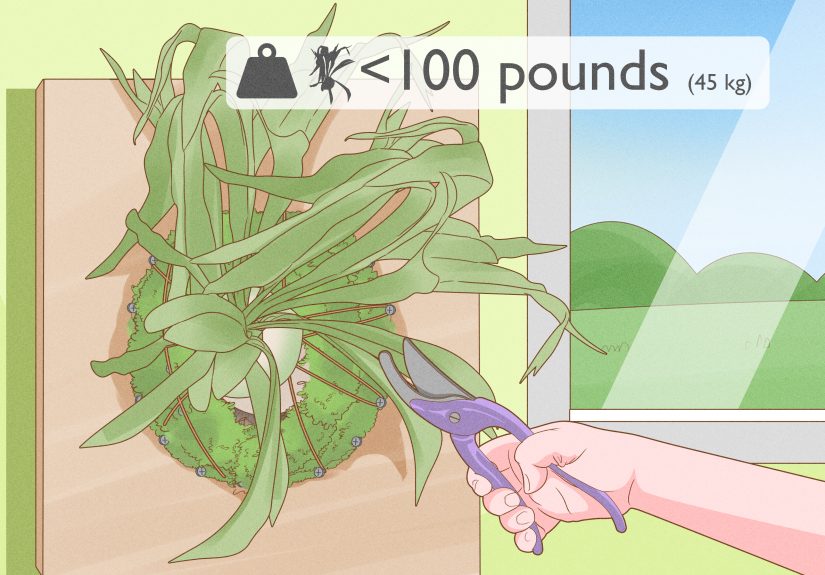
- Fully dead, broken, or diseased fertile fronds (use clean snips).
- Old fertile fronds that are completely brown and crisp (if they detach easily).
Mounting a Staghorn Fern: Step-by-Step
If you want the iconic mounted look, here’s a straightforward method.
What You’ll Need
- A mount: sealed wood board, cork bark, or plaque
- Long-fiber sphagnum moss (or a similar airy medium)
- Fishing line, plastic-coated wire, or plant-safe ties
- Optional: a small hook/hanger, screws, and wall anchor
- Clean scissors and gloves
Steps
- Soak the moss until fully hydrated, then squeeze it so it’s dampnot dripping like a sad sponge.
- Position the plant with the shield fronds against the mount and the antler fronds pointing outward/upward.
- Pack damp moss behind/around the root area (not covering the antler fronds).
- Secure firmly using line or wire. Keep ties snug enough to prevent wobbling but not so tight they cut into plant tissue.
- Hang in bright, indirect light with good airflow and easy access for soaking.
Repotting or Re-Mounting: When (and When Not) to Intervene
Staghorn ferns don’t want frequent disruption. Re-mount or refresh the medium only when needed.
When to Re-Mount
- The mount is rotting or breaking down.
- The moss has compacted into a dense, water-holding brick.
- The plant has outgrown its setup and can’t stay stable.
How to Re-Mount Safely
Work gently around the base. Don’t peel off shield fronds to “clean it up.” Support the plant, keep roots intact as much as possible, and secure it on fresh moss and a sound mount.
Propagation: How to Make More Staghorn Ferns
Propagation is where staghorn ferns go from “cool plant” to “why do I suddenly have five of these?” The most practical method at home is dividing pups (offsets).
Propagation by Pups (Offsets): The Best Method for Most People
Many staghorn ferns produce pupsbaby plants that grow from the base. Once a pup is large enough to handle and has its own roots, you can separate it.
When to Divide
Spring through early summer is often easiest because the plant is actively growing and recovers faster.
How to Separate a Pup
- Soak the plant first so roots and moss are pliable.
- Locate a pup with visible roots (or a clear attachment point).
- Use a clean knife to cut between the pup and mother plant, taking some roots with the pup if possible.
- Mount or basket the pup in damp sphagnum moss, securing it snugly.
- Aftercare: Keep humidity higher than usual, avoid harsh sun, and water carefully until new growth resumes.
Propagation by Spores: Possible, But Slow
Staghorn ferns produce spores (not seeds). Spore propagation is fascinating but typically slow and finickymore of a “plant science project” than a weekend DIY. If you’re curious, start with clean containers, sterile medium, consistent moisture, warm temperatures, and patience measured in geological time.
Common Problems and How to Fix Them
Problem: Brown Shield Fronds
Likely cause: Normal aging. Shield fronds often brown as they mature.
Fix: Don’t remove them. Let the plant layer new growth over old shields.
Problem: Black, Mushy Base or Sour Smell
Likely cause: Rot from staying too wet, poor airflow, or dense medium.
Fix: Reduce watering frequency, improve airflow, ensure thorough drainage after soaking, and consider re-mounting with fresh airy moss if the medium is degraded.
Problem: Crispy Tips or Curling Fronds
Likely cause: Underwatering, low humidity, or too much direct sun.
Fix: Increase soak frequency slightly, boost humidity, and move to brighter indirect light instead of direct sun.
Problem: Pale Growth and Slow “No-Drama” Living
Likely cause: Not enough light or nutrients.
Fix: Increase light gradually (still indirect), and feed lightly during the growing season.
Problem: Pests (Scale, Mealybugs)
Likely cause: Common houseplant pests that love sheltered nooks.
Fix: Isolate the plant, dab pests with alcohol on a cotton swab, and repeat weekly until controlled. Improve airflow and check undersides of fronds.
Outdoor Care: Can You Grow Staghorn Ferns Outside?
In warm, humid climates, staghorn ferns can thrive outdoors in bright shade or dappled light. In cooler regions, many growers move them outside for the warm season and bring them indoors when temperatures drop.
- Outdoor placement: Bright shade under a tree canopy or covered patio often works well.
- Weather caution: Avoid cold snaps, harsh direct sun, and soaking rains that keep the plant wet for days.
FAQ: The Questions Every Staghorn Fern Owner Asks (Usually While Holding a Watering Can)
Is my staghorn fern dying if the base is brown?
Not necessarily. Brown shield fronds are often normal. Worry more about mushy black areas, foul smell, or rapidly collapsing tissue.
Should I water the fronds or just the moss?
Staghorns can absorb moisture through fronds and the base. Soaking the root/moss area thoroughly is key, and light misting can support humidity.
Can I use regular potting soil?
Not recommended. These are epiphytesdense soil holds too much water. Use airy materials like sphagnum moss, coir, bark, or a very chunky mix designed for epiphytes.
How fast do staghorn ferns grow?
Generally slow to moderate, depending on light, warmth, humidity, and feeding. They can become very large over time, especially in ideal conditions.
Grower Experiences: What People Learn After the First “Fern Panic”
Ask ten staghorn fern growers what they wish they’d known earlier and you’ll get ten versions of the same lesson: staghorns reward observation more than schedules. A lot of first-timers water on a strict weekly routine, then feel betrayed when the base starts to soften. Experienced growers tend to do the opposite: they check how the moss feels, how quickly it dries in that specific spot, and whether the plant looks perky after a soak. The “right” watering frequency is often different from house to housesometimes even from wall to wall.
Another common experience: the day you realize the brown shield fronds are not a tragedy, they’re a feature. Many people admit they tried to peel them off for a cleaner look (because the plant seemed to be wearing a crunchy old costume). Afterward, they noticed the plant looked stressed or the base felt more exposed. Over time, growers learn to treat shield fronds like a protective roof: not pretty to everyone, but very effective. The staghorn usually layers fresh green shields on top, and the older ones quietly keep doing their job underneath.
Mounted staghorn owners also talk about the “soak logistics” phasefiguring out how to water without turning the living room into a splash zone. Some end up soaking in the bathtub, others use a large storage bin, and a surprisingly high number do the “kitchen sink shuffle” while whispering motivational quotes to the fern. The practical trick many settle on is simple: soak, then let it drain longer than you think it needs. That extra drain time reduces rot risk dramatically, especially in lower-light seasons.
Light is another repeating theme. People who struggle often keep their plant too dim because they’re afraid of sun scorch. Growers who succeed usually provide bright indirect lightclose enough to a window that the plant grows steadily, but protected from harsh midday rays. A common story is moving the fern a few feet closer to a window and suddenly getting sturdier fronds and more consistent growth. The plant didn’t need a pep talk; it needed better lighting.
Propagation stories tend to start with “I didn’t plan to…” followed by “and now I have three.” Once pups show up, growers often wait until the pup has enough size and roots to handle separation without trauma. Those who divide too early report slow recovery; those who wait a bit longer usually get a smoother transition. The most successful post-division care people mention is higher humidity, gentler light for a couple of weeks, and resisting the urge to overwater “to help it.” In other words, the same theme again: consistency beats panic.
Finally, a lot of experienced growers describe staghorns as plants that teach patience. They don’t always give instant feedback, and they don’t grow like a pothos that practically waves at you every morning. But once you get the basics rightlight, airflow, thorough watering with drying time, and modest feedingthe plant becomes remarkably steady. And yes, it will keep looking like a magnificent antlered gremlin on your wall. That’s the point.