
Table of Contents >> Show >> Hide
- What Is a Gemstone?
- Start With Visual Identification
- Use a 10x Loupe or Microscope
- Understand Mohs Hardness
- Look at Streak, But Be Careful
- Measure Specific Gravity
- Use Refractive Index for Better Identification
- Check for Fluorescence
- Know Common Gemstone Look-Alikes
- Identify Treatments and Enhancements
- Basic Gem Identification Tools
- How to Identify Gemstones Step by Step
- What Not to Do When Identifying Gemstones
- Quick Reference: Common Gemstone Clues
- When Should You Get a Gemstone Appraised?
- Real-World Experiences: Practical Lessons From Identifying Gemstones
- Conclusion
Finding a mysterious stone in a ring box, estate-sale tray, or dusty drawer can feel like opening a tiny treasure chest. Is it amethyst? Glass? A sapphire pretending to be humble? A quartz crystal with excellent public relations? Learning how to identify gemstones is part science, part observation, and part “please do not scratch Grandma’s ring with a pocketknife.”
The good news: you do not need a full gemological laboratory to make smart first observations. The better news: once you understand color, hardness, luster, transparency, inclusions, refractive behavior, and common treatments, you can narrow the possibilities dramatically. The realistic news: some gemstones and imitations look so similar that even trained professionals rely on instruments and lab reports. Gem identification is not about guessing harder; it is about collecting clues in the right order.
This guide explains how to identify gemstones at home safely, what tools are useful, which tests are reliable, and when it is time to call a professional gemologist. Bring a loupe, a clean cloth, and a healthy suspicion of anything described as “museum quality” on a folding table next to used toaster ovens.
What Is a Gemstone?
A gemstone is a natural, synthetic, or organic material valued for beauty, rarity, durability, or cultural meaning. Many gemstones are minerals, such as ruby, sapphire, emerald, garnet, quartz, and topaz. Others are organic gems, including pearl, amber, coral, and jet. Some jewelry stones are not technically gems at all but simulants, meaning they look like a gem without sharing the same chemistry or structure. Cubic zirconia, for example, can imitate diamond, but it is not diamond.
Before identifying a gemstone, remember three important categories:
- Natural gemstones: Formed in nature without human creation, though they may be cut, polished, or treated.
- Synthetic gemstones: Lab-created stones with the same chemical and physical properties as their natural counterparts, such as lab-grown sapphire or lab-grown diamond.
- Imitation gemstones: Materials that only resemble another gem, such as colored glass sold to look like emerald.
That distinction matters. A synthetic ruby is still ruby. Red glass is not. Both may be pretty; only one should be priced like a ruby.
Start With Visual Identification
1. Observe the Gemstone’s Color
Color is usually the first clue, but it should never be the only one. Many gemstones occur in multiple colors. Sapphire is famous for blue, but it can also be pink, yellow, green, purple, orange, or colorless. Garnet is often red, yet it can appear orange, green, purple, or nearly black. Quartz can be purple as amethyst, yellow as citrine, smoky brown, rose pink, or colorless.
Gemologists describe color using three qualities:
- Hue: The basic color family, such as blue, green, red, or violet.
- Tone: How light or dark the color appears.
- Saturation: The intensity or vividness of the color.
For example, a fine sapphire is not simply “blue.” It may be a medium-dark, strongly saturated blue with a velvety appearance. A pale watery blue stone could be aquamarine, blue topaz, glass, or a very light sapphire. Color opens the door, but more tests must walk through it.
2. Check Transparency
Transparency tells you how light passes through the stone. A gemstone may be transparent, translucent, or opaque. Transparent stones allow you to see through them clearly, like many diamonds, sapphires, aquamarines, and topaz. Translucent stones transmit light but not sharp detail, like some jade, opal, moonstone, or chalcedony. Opaque stones block light, such as turquoise, lapis lazuli, hematite, and many jasper varieties.
Hold the gemstone near a light source, not directly against a hot bulb. Look for whether light travels through evenly, glows from the edges, or stops completely. This simple observation helps separate stones that may share similar colors but behave very differently.
3. Study Luster
Luster describes how a gemstone reflects light from its surface. Diamond has an adamantine luster, which appears bright, sharp, and almost metallic in its intensity. Quartz has a vitreous, or glassy, luster. Pearls have a soft pearly luster. Jade may look waxy or greasy. Turquoise often appears waxy to dull unless polished.
Luster can be surprisingly useful. A purple stone with glassy luster might be amethyst. A purple stone with a dull, plasticky shine might be dyed material or imitation. A stone that looks “too shiny in the wrong way” deserves a closer look. Your eyes may not know the technical term yet, but they often notice when something is acting suspicious.
Use a 10x Loupe or Microscope
A 10x jeweler’s loupe is one of the best beginner tools for gemstone identification. It helps you see inclusions, surface wear, bubbles, scratches, chips, facet edges, and growth patterns. Clean the stone first with a soft cloth so you are not identifying fingerprints as “rare geological features.”
What to Look For Under Magnification
- Gas bubbles: Round bubbles often suggest glass, though some natural stones may contain fluid inclusions that require expert interpretation.
- Needle-like inclusions: Fine needles can appear in ruby, sapphire, quartz, and other gems.
- Color zoning: Uneven bands or patches of color may help identify natural growth or treatment patterns.
- Facet wear: Softer stones often show rounded facet junctions or scratches after wear.
- Doubling: Some gems show doubled facet edges when viewed through the stone because of birefringence.
Inclusions are not always flaws. They can be fingerprints from nature. In some cases, inclusions help separate natural gems from synthetic gems and glass imitations. A flawless-looking stone is not automatically better; sometimes it simply means you need better magnification or a lab report.
Understand Mohs Hardness
The Mohs hardness scale measures how resistant a mineral is to scratching. Talc is 1, gypsum is 2, calcite is 3, fluorite is 4, apatite is 5, feldspar is 6, quartz is 7, topaz is 8, corundum is 9, and diamond is 10. This scale is useful because different gemstones resist wear differently.
For jewelry, hardness matters. Diamond, ruby, and sapphire can handle everyday wear better than opal, pearl, turquoise, or apatite. However, hardness testing can damage a stone. Do not scratch-test finished jewelry unless you are willing to lower its value and possibly your family’s opinion of you.
Safe Ways to Use Hardness Clues
Instead of scratching the gem, inspect it for existing wear. A ring worn daily for years that still has crisp facet edges may contain a hard stone such as sapphire, ruby, spinel, topaz, or diamond. A heavily scratched surface may point toward softer gems or glass. Be careful: durability also depends on toughness, cleavage, setting style, and how the jewelry was worn. Diamond is extremely hard, but it can still chip along cleavage directions if struck.
Look at Streak, But Be Careful
Streak is the color of a mineral’s powder when rubbed across unglazed porcelain. It is useful in mineral identification but usually not recommended for cut gemstones because it can damage the stone. For rough stones, streak may help distinguish metallic-looking minerals such as hematite, which leaves a reddish-brown streak, from similar-looking materials.
For jewelry gemstones, skip the streak test unless you are working with rough specimens and know the risk. A streak plate is not a magic truth machine; it is a ceramic surface with commitment issues.
Measure Specific Gravity
Specific gravity compares the weight of a gemstone to an equal volume of water. In plain English: some gems feel heavier than others even when they are the same size. For example, zircon often feels surprisingly heavy, while amber feels light. Specific gravity can help separate look-alike stones, especially when combined with refractive index and visual observations.
A basic hydrostatic weighing setup can estimate specific gravity, but the process requires accuracy. Dirt, air bubbles, mounted stones, and poor measurements can produce misleading results. Still, even a simple “heft” test in the hand may offer a clue. A large amber bead should not feel like a fishing sinker. If it does, something is probably off.
Use Refractive Index for Better Identification
Refractive index, often shortened to RI, measures how much a gemstone bends light. This is one of the most important gemological tests because many gem species have known RI ranges. A refractometer is the standard tool for measuring it. With practice, it can help distinguish quartz from topaz, garnet from spinel, or glass from many natural gems.
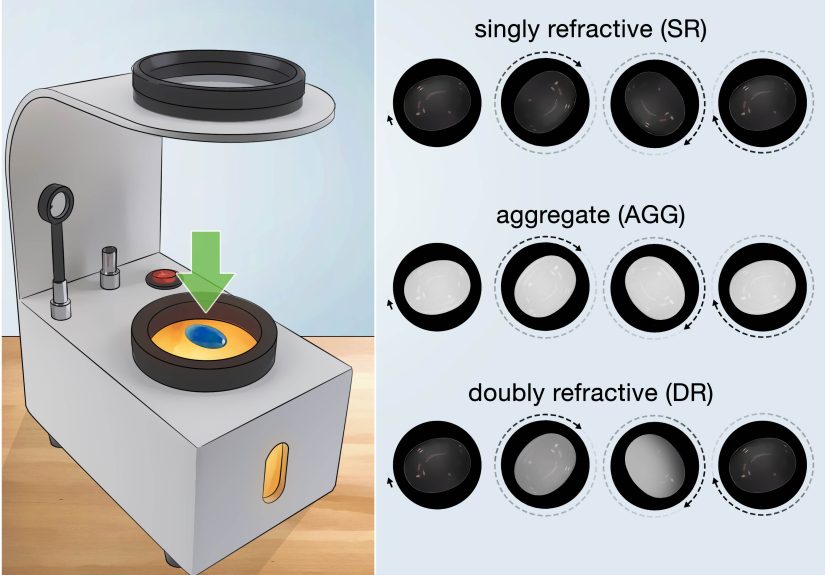
Some stones are singly refractive, meaning light travels through them in one direction. Others are doubly refractive and split light into two rays. This property can create visible doubling inside the stone. A dichroscope can also reveal pleochroism, where a gem shows different colors from different viewing directions. Tanzanite, iolite, and some sapphires are famous for this kind of optical personality.
Check for Fluorescence
Some gemstones fluoresce under ultraviolet light. Ruby may glow red under long-wave UV. Certain diamonds fluoresce blue. Some synthetic stones and treated materials also react strongly. Fluorescence can be helpful, but it is not a standalone identification method. Many natural stones do not fluoresce, and many imitations do.
Use both long-wave and short-wave UV only with proper eye protection and safe equipment. Never stare into UV light. Gem identification is fun; eyeball damage is not part of the hobby kit.
Know Common Gemstone Look-Alikes
Diamond vs. Cubic Zirconia vs. Moissanite
Diamond, cubic zirconia, and moissanite can all appear bright and colorless. Cubic zirconia is usually heavier than diamond and may show more rounded facet wear over time. Moissanite often displays strong fire and may show doubling under magnification. Diamond testers, moissanite testers, magnification, and professional grading reports are the best way to separate them confidently.
Ruby vs. Garnet vs. Red Glass
Ruby is red corundum and has a Mohs hardness of 9. Garnet is a group of minerals with several varieties and typically shows different optical behavior. Red glass may show bubbles, swirl marks, and lower durability. Under a loupe, glass often gives itself away like a bad poker player.
Emerald vs. Green Glass vs. Green Beryl
Emerald is green beryl colored mainly by chromium, vanadium, or both. It often contains visible inclusions, sometimes called a jardin, meaning “garden.” Green glass may have bubbles and a less natural internal structure. Green beryl can resemble emerald but usually has lighter color and different value considerations.
Sapphire vs. Spinel vs. Tanzanite
Blue sapphire, blue spinel, and tanzanite can overlap visually. Sapphire is corundum and very durable. Spinel is singly refractive and often highly brilliant. Tanzanite is softer than sapphire and can show strong pleochroism, often shifting between blue, violet, and burgundy tones depending on viewing direction.
Identify Treatments and Enhancements
Many gemstones are treated to improve color, clarity, or durability. Heat treatment is common for ruby and sapphire. Emeralds are often filled with oil or resin to reduce the visibility of fractures. Blue topaz is commonly irradiated and heated. Some gems are dyed, coated, bleached, impregnated, or fracture-filled.
Treatments are not automatically bad. They simply need to be disclosed because they can affect value, durability, and care. A treated gemstone may still be natural, beautiful, and worth buying. The problem begins when a treated, synthetic, or imitation stone is sold as something it is not.
Signs a Gemstone May Be Treated
- Color concentrated in cracks or surface-reaching fractures
- Unusual flash effects inside fractures
- Patchy or unnatural color distribution
- Surface coating visible near facet edges
- Unexpectedly low price for a supposedly rare gem
Some treatments are impossible to confirm at home. When value matters, request documentation from a respected gemological laboratory.
Basic Gem Identification Tools
A beginner does not need every instrument in a professional lab. Start with simple tools and upgrade only when your curiosity becomes financially dangerous.
- 10x loupe: Essential for inclusions, scratches, bubbles, and facet wear.
- Gem tweezers: Help handle loose stones safely.
- White light source: Useful for judging color consistently.
- Polariscope: Helps determine single or double refraction.
- Dichroscope: Shows pleochroic colors in some gems.
- Refractometer: Measures refractive index.
- UV lamp: Checks fluorescence reactions.
- Digital scale: Useful for carat weight and specific gravity estimates.
- Microscope: Ideal for deeper inclusion study.
How to Identify Gemstones Step by Step
Step 1: Clean the Stone
Use a soft lint-free cloth. If the gemstone is durable and not glued, filled, or delicate, mild soapy water may be safe. Avoid ultrasonic cleaners unless you know the stone and treatment status. Opal, pearl, emerald, turquoise, amber, and fracture-filled gems need extra caution.
Step 2: Record Basic Observations
Write down color, transparency, luster, shape, cut, size, and setting style. Photograph the stone in daylight and under indoor lighting. Different lighting can dramatically change appearance, especially in color-change gems such as alexandrite or some garnets.
Step 3: Inspect With a Loupe
Look for inclusions, bubbles, scratches, chips, doubled facet edges, color zoning, and signs of coating or filling. Do not panic if you see inclusions. Nature is not a factory, and frankly, that is why gems are interesting.
Step 4: Compare Hardness Clues
Check whether the surface is easily scratched or worn. Consider the stone’s use. A gem in a daily-wear ring gives more durability clues than a pendant that spent twenty years living peacefully in a jewelry box.
Step 5: Test Optical Properties
If you have instruments, measure refractive index, observe single or double refraction, and check pleochroism. These results can narrow your list quickly. A blue stone with sapphire-like color but an RI outside sapphire’s range is probably not sapphire.
Step 6: Consider Treatments and Origin Claims
Ask whether the stone has been heated, dyed, filled, coated, stabilized, irradiated, or grown in a lab. Origin claims such as “Kashmir sapphire,” “Burmese ruby,” or “Colombian emerald” should come with credible lab documentation when the price depends on the claim.
Step 7: Get a Professional Report When Value Matters
If the gemstone is expensive, inherited, insured, or being sold, professional identification is worth it. A qualified gemologist or independent laboratory can test the stone with advanced instruments and issue a report identifying the material, treatments, and sometimes origin.
What Not to Do When Identifying Gemstones
Some popular online gemstone tests are unreliable or risky. The “fog test” for diamonds, for instance, can be affected by temperature, surface cleanliness, and stone type. The “water test” is not a dependable way to separate valuable gems from imitations. Scratch tests can permanently damage jewelry. Fire tests are especially bad because heat can crack stones, alter treatments, burn settings, and turn a harmless afternoon into a tiny insurance claim.
Avoid these mistakes:
- Do not scratch a cut gemstone to “prove” hardness.
- Do not use acids or harsh chemicals.
- Do not heat a stone with a lighter.
- Do not assume color equals identity.
- Do not trust price alone as proof of authenticity.
- Do not buy expensive gems without documentation.
Quick Reference: Common Gemstone Clues
| Gemstone | Common Clues | Caution |
|---|---|---|
| Diamond | Very high brilliance, extreme hardness, sharp facet edges | Can be confused with moissanite or cubic zirconia |
| Ruby | Red corundum, hard, may show inclusions or fluorescence | Often heated; glass-filled rubies exist |
| Sapphire | Corundum in many colors, excellent durability | Heat treatment is common |
| Emerald | Green beryl, often visibly included | Oil or resin filling is common |
| Amethyst | Purple quartz, glassy luster, affordable | Can be imitated by glass |
| Opal | Play-of-color, softer surface, delicate beauty | Can crack from dryness, heat, or impact |
| Turquoise | Opaque blue to green, waxy luster, often veined | Frequently stabilized, dyed, or imitated |
When Should You Get a Gemstone Appraised?
Identification and appraisal are related but not identical. Identification tells you what the stone is. Appraisal estimates value for insurance, resale, estate, or legal purposes. A gemologist may identify the stone, while an appraiser evaluates the finished jewelry, metal, craftsmanship, market demand, condition, and documentation.
Get a professional appraisal if the gemstone is part of an engagement ring, antique piece, estate collection, insurance policy, or potential resale item. Also get documentation if the seller claims rarity, untreated status, famous origin, or exceptional quality. A beautiful stone can be emotionally priceless, but insurance companies prefer paperwork over vibes.
Real-World Experiences: Practical Lessons From Identifying Gemstones
One of the most useful experiences in gemstone identification is learning that first impressions are often wrong. A bright blue stone in an old ring may look like sapphire at first glance, especially if it sits in a fancy setting. Under magnification, however, the story can change. You may see rounded facet edges, tiny bubbles, and a color that looks too even, all of which can point toward glass. That does not make the ring worthless emotionally, but it changes the identification completely.
Another common experience involves amethyst and glass. Purple stones are everywhere in vintage jewelry, and many are genuine quartz. But some are molded glass, especially in inexpensive costume pieces. A loupe can reveal mold marks, bubbles, or surface wear. Amethyst usually has a cool, natural variation in color, sometimes with zoning. Glass often looks flatter, though high-quality glass can still be convincing. The lesson is simple: affordable gems are still worth identifying properly because assumptions can go both ways.
Emerald teaches patience. Many beginners expect valuable emeralds to look perfectly clean, like green ice cubes from a billionaire’s freezer. In reality, natural emeralds commonly have inclusions. A heavily included emerald may be real, while a flawless green stone may be synthetic, glass, or another gem entirely. The trick is not to judge by clarity alone. Look at color, inclusions, RI if possible, and treatment signs. Emeralds are also often filled, so cleaning them aggressively can be a costly mistake.
Opal offers another practical lesson: beauty does not equal toughness. A lively opal with rainbow flashes can be breathtaking, but opal is softer and more sensitive than sapphire or diamond. When identifying opal, check for play-of-color, body tone, cracks, crazing, and whether the stone might be a doublet or triplet. A doublet has a thin layer of opal attached to a backing; a triplet adds a protective clear cap. These assembled stones can be attractive and wearable, but they should not be represented as solid opal.
Estate jewelry also teaches the value of context. A ring stamped with a quality metal mark and showing fine craftsmanship may deserve closer examination than a loose stone from a novelty bin. However, settings can deceive. Genuine diamonds can be set in modest mountings, and imitations can be placed in gold. Context is a clue, not a verdict. The most reliable approach is to combine observation, tools, documentation, and professional testing when needed.
Finally, every gemstone hobbyist eventually learns humility. There will be stones that refuse to identify themselves politely. Blue topaz, aquamarine, glass, synthetic spinel, and treated materials can overlap visually. Red stones can be ruby, spinel, garnet, tourmaline, glass, or something else entirely. The smartest identifier is not the person who guesses fastest; it is the person who knows when to stop guessing and ask for better evidence.
Conclusion
Learning how to identify gemstones starts with careful observation and ends with evidence. Color, transparency, luster, inclusions, hardness clues, specific gravity, refractive index, fluorescence, and treatment signs all help build a stronger identification. No single clue should carry the whole case. Gemstones are too varied, too treated, and occasionally too sneaky for that.
For casual curiosity, a loupe, good lighting, and a methodical checklist can tell you a lot. For buying, selling, insuring, or confirming a valuable stone, professional gemological testing is the safest path. Think of home identification as detective work and the lab report as the judge’s signature. Both have their place, but only one settles the argument when serious money is involved.
Note: This article is for educational purposes. For valuable, inherited, treated, or unusual gemstones, consult a qualified gemologist or independent gemological laboratory before making financial, insurance, or resale decisions.






 Close
Close