Table of Contents >> Show >> Hide
- The Simple Rule: Compare Room Temperature to Melting Point and Boiling Point
- What Counts as Room Temperature?
- Which Elements Are Liquid at Room Temperature?
- A Quick Table of the Famous Liquids and the Near-Misses
- Why Gallium and Cesium Keep Confusing People
- How to Predict the State of an Element Without Memorizing Everything
- The Best Step-by-Step Method for Any Exam or Homework Question
- Common Mistakes People Make
- Safety Note: These Are Not Casual Hobby Liquids
- Why This Topic Matters More Than It Seems
- Final Takeaway
- Experiences With This Topic: What Learning It Usually Feels Like in Real Life
- SEO Tags
If the periodic table has ever looked like a giant seating chart for atoms, this question is one of its sneakiest pop quizzes: which elements are liquid at room temperature? It sounds simple, but chemistry loves a loophole. “Room temperature” is not one magic number, pressure matters, and a few elements hover so close to the liquid line that they practically tap on the glass and ask to be let in.
The good news is that the logic is wonderfully clean. You do not have to memorize the entire periodic table like a sleep-deprived wizard. You just need to know how to compare room temperature with an element’s melting point and boiling point. Once you know that trick, figuring out whether an element is a solid, liquid, or gas becomes much less mysterious and much more satisfying.
In this guide, you will learn the fast rule, the famous exceptions, the near-misses, and the easy patterns that help you make smart guesses without turning chemistry into a dramatic guessing game.
The Simple Rule: Compare Room Temperature to Melting Point and Boiling Point
Here is the whole strategy in one neat package:
- If room temperature is below the melting point, the element is a solid.
- If room temperature is above the boiling point, the element is a gas.
- If room temperature falls between the melting point and boiling point, the element is a liquid.
That is the master key. No dramatic soundtrack required.
Example of the logic in action
Suppose an element melts at 10°C and boils at 80°C. At 25°C, that element would be a liquid because 25°C sits neatly between 10°C and 80°C. If another element melts at 100°C, it would still be solid at 25°C. If a third boils at -34°C, it would already be a gas by the time it reaches room temperature.
This is the easiest way to answer questions about liquid elements on the periodic table. You are not guessing based on vibes. You are comparing numbers.
What Counts as Room Temperature?
This is where chemistry starts acting like a technical editor. In everyday life, room temperature usually means somewhere around 20°C to 25°C (about 68°F to 77°F). In some scientific contexts, people use 25°C as a convenient standard. In other situations, they may mean something closer to 20°C to 22°C.
That difference matters because a few elements sit just above 25°C, which means they are almost liquid at room temperature but not quite. So when someone asks, “Which elements are liquid at room temperature?” the safest answer is the conservative one: mercury and bromine.
If the room gets warmer, the conversation gets more interesting. Chemistry loves a technicality almost as much as lawyers do.
Which Elements Are Liquid at Room Temperature?
At normal room temperature and ordinary pressure, only two elements are clearly liquid:
- Mercury (Hg)
- Bromine (Br)
That is the list. Not a top ten. Not a secret bonus round. Just two.
Mercury
Mercury is the only metal that is liquid at room temperature. It is shiny, dense, and famous for forming round silver beads that look like tiny runaway mirrors. Its melting point is well below room temperature, so it stays liquid under ordinary indoor conditions.
Mercury used to be common in thermometers, barometers, and switches, but its toxicity means it is handled much more carefully today. In other words, it is chemistry-famous and safety-famous at the same time.
Bromine
Bromine is the only nonmetal that is liquid at room temperature. It is a reddish-brown liquid with a strong, irritating vapor, so it is not exactly the element you want casually hanging out on your kitchen counter. Bromine’s melting point is below room temperature, but its boiling point is above room temperature, which places it squarely in the liquid zone.
If you remember just one line, make it this one: mercury is the only liquid metal at room temperature, and bromine is the only liquid nonmetal at room temperature.
A Quick Table of the Famous Liquids and the Near-Misses
| Element | Symbol | Melting Point | Boiling Point | State at 25°C | Why People Talk About It |
|---|---|---|---|---|---|
| Mercury | Hg | -38.83°C | 356.73°C | Liquid | The only metal that is liquid at room temperature |
| Bromine | Br | -7.2°C | 58.8°C | Liquid | The only nonmetal that is liquid at room temperature |
| Cesium | Cs | 28.5°C | 671°C | Usually solid | Melts just above room temperature |
| Gallium | Ga | 29.76°C | 2400°C | Usually solid | Can melt in a warm hand or hot room |
| Francium | Fr | About 30°C | About 680°C | Predicted near-liquid range | Too rare and radioactive for everyday observation |
| Rubidium | Rb | 39.3°C | 688°C | Solid | Near-room-temperature metal, but not close enough for most rooms |
Note: These values are commonly rounded for readability, and pressure still matters. But for normal classroom and everyday chemistry discussions, this table gets you where you need to go.
Why Gallium and Cesium Keep Confusing People
If mercury and bromine are the official room-temperature liquids, why do gallium and cesium keep showing up in the conversation? Because their melting points are tantalizingly close to room temperature.
Gallium melts at about 29.76°C. That means it is usually solid in a normal room, but it can melt in a warm hand or on a hot day. Gallium has become the class clown of chemistry demos because people love watching a metal quietly give up and turn liquid.
Cesium melts at about 28.5°C, which is also just above room temperature. The difference is that cesium is extremely reactive, so it is not the sort of thing you want to treat as a fun desk ornament. It is less “cool science party trick” and more “absolutely not without serious precautions.”
So if you see a chart saying some elements are liquid “near room temperature,” that is where gallium and cesium come in. If the chart says “liquid at room temperature,” the answer is still mercury and bromine.
How to Predict the State of an Element Without Memorizing Everything
If you do not have a data table in front of you, periodic trends can still help you make an educated guess.
1. Many metals are solids because metallic bonding is strong
Most metals are solid at room temperature because their atoms stick together strongly in metallic lattices. That is why iron, copper, aluminum, gold, and silver are all solid under normal conditions. Mercury is unusual, which is why it gets so much attention.
2. Small nonmetals on the right side are often gases
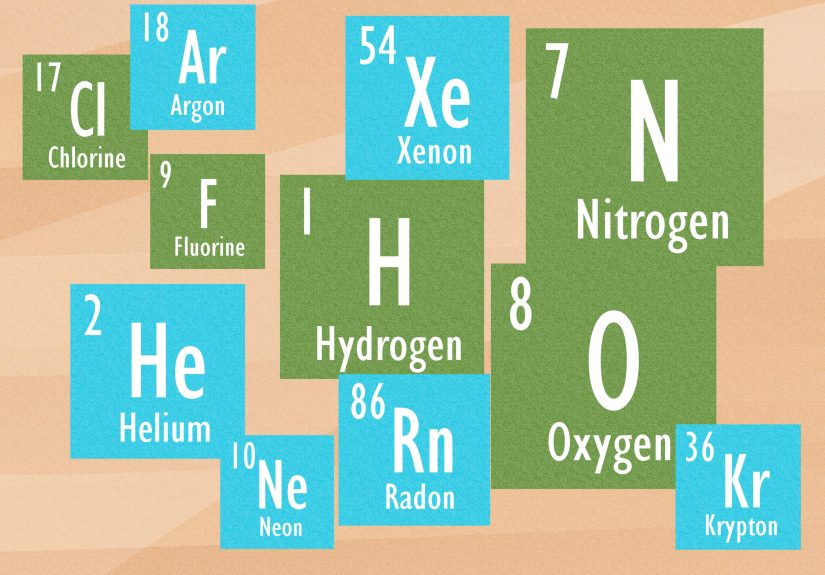
Hydrogen, nitrogen, oxygen, fluorine, chlorine, and the noble gases are gases at room temperature because their particles are held together relatively weakly. They do not need much energy to escape into the gas phase.
3. Bromine sits in the middle of the halogen trend
The halogens show a helpful pattern. Fluorine and chlorine are gases, bromine is a liquid, and iodine is a solid at room temperature. Their melting and boiling points increase as you move down the group, which is why bromine lands in that wonderfully odd middle spot.
4. Near-room-temperature metals deserve side-eye
If a metal is known for a very low melting point, it may be one of the famous edge cases. Gallium, cesium, rubidium, and francium are the names worth recognizing. They are the chemistry equivalent of people standing in the doorway, technically not inside yet, but definitely no longer outside either.
The Best Step-by-Step Method for Any Exam or Homework Question
When you are asked to identify whether an element is solid, liquid, or gas at room temperature, use this sequence:
- Check the room temperature being used. If none is given, assume about 25°C unless your course says otherwise.
- Find the element’s melting point.
- Find the element’s boiling point.
- Compare the room temperature to both values.
- Decide the state:
- below melting point = solid
- between melting and boiling = liquid
- above boiling point = gas
- If the value is very close, mention that the answer depends on the exact temperature or pressure.
This method works not just for elements, but for compounds too. It is one of the handiest little tools in introductory chemistry.
Common Mistakes People Make
Confusing “room temperature” with “warm enough to melt in your hand”
Gallium is the classic victim here. Yes, it can melt in your hand. No, that does not make it a true room-temperature liquid in the standard chemistry sense.
Ignoring boiling point
Some students check only the melting point and stop there. That can backfire. An element might melt below room temperature but boil below room temperature too, which means it would actually be a gas. You need both numbers.
Forgetting pressure matters
Most classroom answers assume ordinary pressure, about 1 atmosphere. Change the pressure enough, and phase behavior can change too. For everyday chemistry questions, though, standard pressure is usually assumed unless the problem says otherwise.
Trusting memory over data
The periodic table is full of surprises. When in doubt, look up the melting and boiling points rather than relying on a hazy memory from a textbook page you met three semesters ago.
Safety Note: These Are Not Casual Hobby Liquids
It is tempting to hear “liquid elements” and imagine something exotic and collectible. Chemistry would like a word.
Mercury is toxic, bromine is corrosive and hazardous, and cesium is wildly reactive. Even gallium, which is safer than those headline-grabbers, is still a real chemical substance, not a toy. The smart move is to appreciate these elements as fascinating examples of phase behavior, not as candidates for your coffee-table science collection.
Why This Topic Matters More Than It Seems
Learning how to know which elements are liquid at room temperature is not just about memorizing trivia for a chemistry quiz. It teaches you how physical properties work together. It forces you to think about phase changes, particle behavior, and periodic trends all at once.
It also gives you a better instinct for the periodic table. Instead of seeing 118 boxes, you start noticing patterns: which elements are gases, which are stubborn solids, which are near-room-temperature oddballs, and why those patterns make sense. That is when chemistry stops feeling like a list and starts feeling like a story with rules.
Final Takeaway
When you want to determine whether an element is liquid at room temperature, do not guess and do not rely on chemistry folklore. Use the phase rule that actually works: compare room temperature to the element’s melting point and boiling point.
At ordinary room temperature, the answer is wonderfully short: mercury and bromine are the elements that are liquid at room temperature. Gallium and cesium are close enough to start arguments, rubidium is warmer-weather material, and francium lives mostly in the realm of prediction and extreme rarity.
So yes, the list of elements liquid at room temperature is tiny. But the logic behind it opens the door to a much bigger understanding of chemistry. Not bad for a question that sounds like it should fit on a flash card.
Experiences With This Topic: What Learning It Usually Feels Like in Real Life
One reason this topic sticks with people is that it often starts with surprise. Many students first hear that mercury is a liquid metal and immediately assume the periodic table must be full of other strange liquids hiding in plain sight. Then comes bromine, which feels even weirder because it is a liquid nonmetal. That moment usually changes how people see the table. It stops being a wall of symbols and starts feeling like a collection of personalities.
In classrooms, this topic also creates a very predictable kind of confusion. Someone always remembers that gallium can melt in your hand and confidently announces that it must be liquid at room temperature. Then the fine print shows up like an uninvited proofreader: gallium melts at just under 30°C, which is above standard room temperature. That tiny gap between 25°C and 29.76°C becomes a memorable lesson in scientific precision. It is a great example of how chemistry rewards careful wording.
Another common experience is realizing that everyday language and scientific language are not always perfect roommates. In casual conversation, people say “room temperature” as if every room on Earth shares one thermostat. In science, that is not good enough. A cool classroom, a warm lab, and a summer apartment can all feel like “room temperature” to humans while still giving different answers for an element that sits near its melting point. That is why this topic quietly trains people to think more clearly about definitions.
There is also a practical side to learning it. Once students understand the melting-point-and-boiling-point method, they stop memorizing random answers and start solving the problem correctly from data. That shift feels small, but it is huge. Instead of thinking, “I hope I remember which element is liquid,” they think, “Give me the numbers and I can figure it out.” That is a more mature chemistry mindset, and it transfers to lots of other topics.
For many readers, this question also becomes one of those oddly satisfying facts they carry around for years. It pops up in trivia, science articles, documentaries, and dinner-table conversations whenever someone wants to sound impressively informed without becoming unbearable. The best part is that the fact is simple, but the reasoning behind it is richer than it looks. That combination makes it memorable.
So the experience of learning this topic is usually a mix of curiosity, correction, and clarity. First, you are intrigued by the idea of liquid elements. Then chemistry politely fixes your assumptions. Finally, you come away with a method that works every time. That is a pretty good deal for one little question about the periodic table.