Table of Contents >> Show >> Hide
- The Pro Rule: Prep Is the Paint Job
- Choose Paint Like a Grown-Up (Even If You’re Not Feeling Very Adult)
- Tools That Make Your Paint Job Look Expensive
- Step-by-Step: Paint Walls Like a Pro
- Troubleshooting: Fix Rookie Mistakes (Even If You’re Not a Rookie)
- Clean Up Like a Pro (Future You Will Be Grateful)
- Real-World Experiences: of “What I Learned the Messy Way”
- Wrap-Up: Your Pro Finish Is Built, Not Brushed On
Painting a wall sounds easy until you’re standing in the paint aisle holding fourteen “almost-the-same” off-whites,
wondering if you should just move instead. Good news: you don’t need a contractor’s licenseor a mysterious paint-stained
hoodieto get crisp lines and smooth coverage. You just need a pro-style process: prep properly, choose the right tools,
and paint with a plan (not vibes).
This guide walks you through how to paint walls like a profrom fixing dents and choosing the right sheen
to rolling without lap marks. Expect clear steps, practical tips, and a few hard-earned “don’t do what I did” moments.
The Pro Rule: Prep Is the Paint Job
Pros don’t paint better because they’re magical. They paint better because they do the boring stuff first. Most “bad paint”
is actually bad prep: dust, grease, glossy patches, loose paint, or little wall craters that look like the moon
once the paint dries.
Step 1: Clear, Cover, and Create a Clean Zone
- Move furniture to the center and cover it (plastic or drop cloth).
- Protect floors with canvas drop cloths for grip and spill control.
- Remove switch plates and outlet covers. (Label the screws so you don’t invent new hardware.)
- Take down curtains, hooks, and anything “temporarily” living on your walls.
Step 2: Repair Dings, Cracks, and Weird Wall Stuff
Fill nail holes with lightweight spackle. For deeper dents, use a patching compound and apply in thin layers so it dries
hard, not gummy. Once dry, sand smooth so your wall feels consistent when you run your hand across it. If you can feel a ridge,
you’ll see it after paintingespecially with higher-sheen paint or bright lighting.
Step 3: Sand Glossy Areas and Feather Edges
If the wall has glossy paint, scuffs, or shiny “handprint zones,” lightly sand to dull the surface and help new paint grip.
Don’t try to sand a hole into the walljust knock down the shine and smooth transitions around patches. Wipe off sanding dust
afterward (dust is a paint repellant disguised as “fine powder”).
Step 4: Clean the Walls (Yes, Even If They “Look” Clean)
Kitchens and hallways collect invisible grime: cooking oils, fingerprints, mystery smudges. Paint doesn’t bond well to grease.
Wash walls with a mild detergent solution and a sponge, rinse with clean water, and let dry completely. If you’re painting a bathroom
or laundry area, make sure the space is dry and well-ventilated before you start.
Step 5: Prime Like You Mean It
Primer isn’t a scam created by Big Paint. It seals porous patches, blocks stains, evens out sheen, and improves adhesion.
Prime repaired areas at minimum. Prime the whole wall if you’re making a dramatic color change, covering stains, painting over
uneven finishes, or switching from oil-based to water-based products. If you’re going dark, consider a tinted primer so you aren’t
doing three “maybe it’ll cover this time” coats.
Choose Paint Like a Grown-Up (Even If You’re Not Feeling Very Adult)
Paint Type: Water-Based Is the Go-To for Walls
Most interior wall paint is water-based (latex/acrylic). It dries faster, cleans up with soap and water, and has less odor than
traditional oil-based paint. Save specialty coatings for special situations: stain-blocking for water marks, mildew-resistant
paint for humid rooms, or bonding primer for tricky surfaces.
Sheen Cheat Sheet: Match the Shine to the Room
Sheen affects both appearance and durability. The shinier it is, the easier it is to cleanand the more it highlights every bump,
patch, and “creative drywall moment.”
- Flat/Matte: Great at hiding imperfections. Best for low-traffic rooms and ceilings.
- Eggshell/Satin: The sweet spot for most living spacesmore washable, still forgiving.
- Semi-gloss/Gloss: Tough and scrub-friendly, but shows flaws. Best for trim, doors, kitchens, and baths.
How Much Paint Do You Need?
A rough rule: one gallon covers about 350–400 square feet per coat on smooth walls, less on textured surfaces. Measure wall area
(length × height), subtract large openings, and plan for two coats for a truly even finish. If you’re using multiple cans of the same
color, “box” the paintmix them together in a larger bucketso tiny color differences don’t create accidental stripes.
Tools That Make Your Paint Job Look Expensive
Brush: Your Cutting-In Superpower
Get a quality 2–2.5 inch angled sash brush (synthetic bristles for water-based paint). Cheap brushes shed bristles like a nervous cat.
You want a brush that holds paint, keeps its shape, and lets you draw a clean line without fighting it.
Roller: Pick the Right Nap, Then Use It Correctly
Roller nap matters. Smooth drywall typically takes a 3/8-inch to 1/2-inch nap. Heavier texture needs thicker nap. A larger roller (like
an 18-inch) plus an extension pole can speed up coverage and help you keep a consistent wet edge.
Tray vs. Bucket and Grid
Trays are fine for small rooms. For bigger jobs, a 5-gallon bucket with a roller grid is steadier and holds more paintmeaning fewer trips
to reload and fewer chances to drip your way across the floor like a confused snail.
Painter’s Tape: Helpful, Not Holy
Tape can protect trim and help with crisp lines, but it isn’t automatic perfection. Press the edge down firmly. For extra-clean lines, some
people “seal” the tape edge with a tiny amount of the wall’s original color (or a clear sealant) before painting the new color. Remove tape
carefully at a 45-degree angledon’t wait until the paint has fully cured, or it can tear and lift.
Step-by-Step: Paint Walls Like a Pro
Step 1: Cut In First (Or Work With a Buddy)
Cutting in means painting the edgescorners, ceiling line, trim linewhere rollers can’t reach. Many painters cut in the whole room first,
then roll. If your paint dries fast (especially in warm or low-humidity conditions), you can also work one wall at a time: cut in, then roll
immediately to blend while everything is fresh.
Step 2: Master the Cutting-In Technique
- Dip the brush about 1/3 of the bristle lengthdon’t bury it like you’re digging for treasure.
- Tap (don’t scrape) excess paint off one side for better control.
- Start about a half-inch away from the edge, then gently push paint into the line.
- Feather the edge outward so the roller can blend into it later.
Step 3: Roll With a Plan (This Is Where “Pro” Happens)
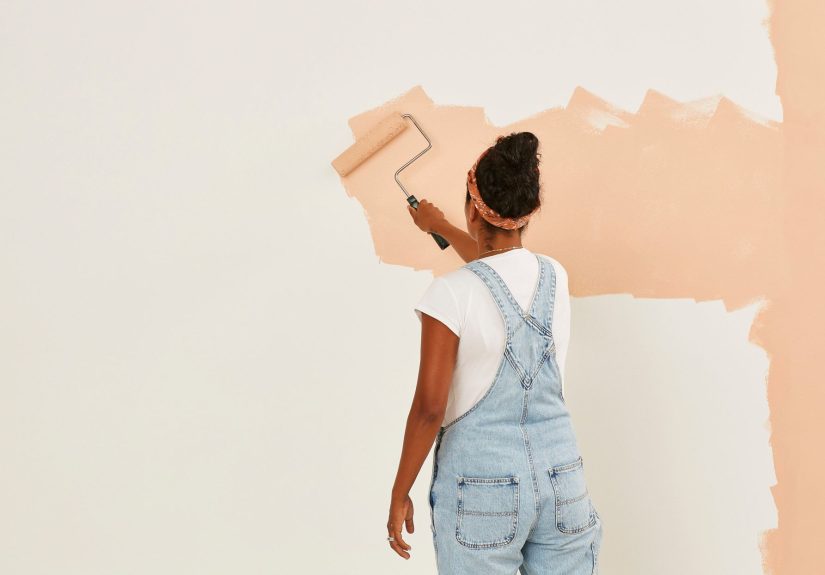
Load your roller evenly and roll off excess on the tray ridges or bucket grid. Then paint in a 2-by-3-foot section. Use a “W” or “M” pattern
to distribute paint, then fill in without lifting the roller too much. Finish with light, vertical passes to even out texture.
The secret to smooth walls is the wet edge: overlap each fresh section into the previous one before it starts drying. Don’t press hard.
Let the roller do the workpressure squeezes paint out and creates lines. If you hear a crispy “bacon sizzle” sound, your roller is too dry and
you need to reload.
Step 4: Watch for “Holidays” and Fix Them Immediately
A “holiday” is a missed spotusually discovered five minutes after you put the ladder away. Use good lighting (a work light angled across the wall is
excellent) and scan as you go. Touch up while the paint is wet so it blends. Dry touch-ups can flash (show a different sheen).
Step 5: Let It Dry, Then Apply the Second Coat
Two coats is where walls start looking rich and even. Follow the paint can’s recoat time, which varies by product, temperature, and humidity. Rushing
the second coat can cause dragging, peeling, or uneven sheen. If your first coat feels dry but still cool or tacky, give it more time.
Step 6: Remove Tape the Right Way
Pull tape back on itself at a 45-degree angle. If the paint has dried and you’re worried about tearing, score lightly along the tape edge with a utility
knife before removing. Slow and steady beats “rip it like a Band-Aid,” unless you enjoy repainting.
Troubleshooting: Fix Rookie Mistakes (Even If You’re Not a Rookie)
Lap Marks (Darker Stripes)
Usually caused by letting edges dry before you overlap. Solution: keep a wet edge, work in smaller sections, and maintain consistent roller loading. If lap
marks dry in, lightly sand and repaint the wall with a steady, continuous rolling pattern.
Roller Lines or Stipple That Looks Patchy
Often from pressing too hard, using the wrong nap, or rolling back into drying paint. Use the correct nap for your wall texture, apply even pressure, and
finish each section with light passes. If the wall still looks uneven after drying, a second coat with improved technique usually fixes it.
Drips and Sags
Too much paint, especially near edges and corners. Catch them while wet and smooth out with your brush or roller. If they dry, sand the drip flat and spot
repaint (or repaint the whole section for a seamless look).
Clean Up Like a Pro (Future You Will Be Grateful)
- Wash brushes and rollers promptly (soap and warm water for water-based paint).
- Spin or shake out excess water and reshape brush bristles before drying.
- Label leftover paint with room name and date.
- Store paint sealed tight; wipe the rim before closing to prevent a “cemented lid” situation.
Real-World Experiences: of “What I Learned the Messy Way”
The first time I tried to paint like a pro, I made the classic mistake: I believed painter’s tape was a magic spell. I taped every edge with the confidence
of someone who had watched exactly one home-improvement video at 2 a.m. Then I painted, went to bed feeling accomplished, and woke up ready for my crisp,
clean lines. I peeled the tape… and took a thin ribbon of paint with it. The tape didn’t fail meI failed the tape. I waited too long, and the paint cured
across the edge like a tiny bridge. Lesson learned: remove tape at the right time, pull at a 45-degree angle, and if it’s already dry, score the edge first.
Another memorable “character-building” moment: cheap roller covers. I bought a bargain pack that seemed like a great deal until my wall started collecting
fuzzy roller lint like it was auditioning to be a sweater. I spent more time picking fuzz out of wet paint than actually painting. Now I do two things:
(1) buy a decent roller cover, and (2) prep itwrap with painter’s tape and peel it off to remove loose fibers, or rinse and spin-dry if the product allows.
The wall ends up smoother, and I don’t have to pretend the fuzz is “textural interest.”
My favorite cautionary tale comes from a kitchen wall. It looked clean. It was not clean. I painted right over years of cooking residue, and the paint started
separating in tiny craters. It wasn’t dramatic enough to be called “peeling,” but it was definitely “this is not what the brochure promised.” I had to stop,
wash the wall properly, let it dry, spot-prime, and repaint. Since then, I treat wall cleaning like a non-negotiable stepespecially in kitchens, mudrooms,
and anywhere small hands travel in packs.
I’ve also learned that “more paint” is not the same as “better coverage.” When you overload the roller, you don’t get a smoother wallyou get drips that
sneak down the surface the moment you turn around. The pro move is to load the roller evenly, roll off excess, and keep the roller wet with paint. If you’re
pressing hard, your roller is too dry, or you’re trying to stretch paint farther than it wants to go. Reload, keep moving, and overlap strokes so you maintain
that wet edge. Your wall will look uniform instead of zebra-striped.
Finally, the biggest “pro” experience is learning to slow down at the parts that matter. Pros move efficiently, not frantically. They take a beat to sand a patch
smooth, clean up dust, and check lighting before calling a wall “done.” And when you do the same, something weird happens: your paint job starts looking
expensivelike you paid someone who owns more than one ladder.
Wrap-Up: Your Pro Finish Is Built, Not Brushed On
If you remember nothing else: prep thoroughly, pick the right sheen, use a quality brush and roller, keep a wet edge, and give yourself
permission to do two coats like an adult. Painting is one of the fastest ways to transform a spaceespecially when you do it with a plan and a little patience.
And hey, if you end up with one tiny drip behind the couch? Congratulations: you’ve achieved authentic “real home” status.