
Table of Contents >> Show >> Hide
- Why Trim an Orange Tree at All?
- When to Trim an Orange Tree
- Tools You’ll Need (and Actually Use)
- Before You Cut: Know What You’re Looking At
- How to Trim an Orange Tree: Step-by-Step
- How Much Can You Prune Without Hurting Fruit?
- Make the Right Cut (So the Tree Heals Well)
- Protect Exposed Wood: Citrus Sunburn Is Real
- Orange Tree Pruning by Age
- Aftercare: What to Do Once You Finish Pruning
- Common Mistakes (and How to Avoid Them)
- Quick FAQ: Orange Tree Trimming Questions
- Conclusion
- Real-World Pruning Experiences: Lessons From the Orange-Tree Trenches
Trimming an orange tree sounds like a cozy, wholesome weekend projectright up until you meet the thorns,
the sticky sap, and that one branch that whips back like it has a personal vendetta. The good news:
orange trees (and most citrus) don’t need the kind of dramatic haircut that apples and peaches do.
Think of pruning citrus like tidying a room: pick up the junk, open the windows, and don’t knock down a wall
unless you absolutely have to.
This guide walks you through exactly how to trim an orange tree the right way: when to prune, what to cut,
what to leave alone, and how to avoid the classic mistakes that lead to fewer oranges and a sunburned trunk.
We’ll keep it practical, a little funny, and very friendly to your future harvest.
Why Trim an Orange Tree at All?
“Do I have to prune my orange tree?” is the citrus equivalent of “Do I have to floss?”
Technically… you can skip it sometimes. But a little smart trimming helps your tree stay healthier,
easier to manage, and more productive over time.
Key benefits of pruning orange trees
- Removes dead, damaged, or diseased wood so the tree doesn’t waste energy.
- Improves airflow and light inside the canopy, which supports better fruit quality.
- Keeps the tree at a manageable height so you’re not doing harvest acrobatics.
- Prevents low branches from dragging fruit on the soil (hello, pests and rot).
- Stops rootstock suckers from hijacking your tree like an unpaid intern taking over the company.
When to Trim an Orange Tree
Timing matters. Citrus is evergreen and generally forgiving, but pruning at the wrong time can trigger
tender new growth that gets damaged by frostor expose limbs to intense sun.
Best time for most home gardeners
-
Late winter to early spring is the sweet spot in many regionsoften just before bloom,
or just after fruit set if you’re making modest cuts. -
Minor “cleanup pruning” (dead twigs, broken branches, tiny suckers) can happen almost anytime,
as long as you avoid frost-danger windows.
Times to avoid (or be extra cautious)
- During frost risk: fresh cuts + tender regrowth + cold snaps = regret.
- Late fall in many climates: can push soft growth that won’t harden before winter.
- Extreme heat: heavy pruning can expose bark and branches to sunburn.
If you live in a warm citrus area (parts of Florida, Southern California, Arizona, Texas), you’ll still aim
for the “low frost risk” season. If you’re growing a patio orange tree in a pot and moving it indoors for winter,
you can be a bit more flexiblestill, gentle pruning is your friend.
Tools You’ll Need (and Actually Use)
Citrus wood can be surprisingly brittle, and orange trees can be surprisingly spiky. Use sharp tools so cuts are clean,
and sanitize blades when moving between trees (or when cutting suspicious-looking wood).
- Hand pruners (secateurs) for small stems
- Loppers for thicker branches
- Pruning saw for large limbs
- Gloves (thorns do not care about your weekend plans)
- Eye protection (because branches love surprise attacks)
- Disinfectant (70% alcohol wipes/spray or a suitable sanitizer)
Before You Cut: Know What You’re Looking At
Orange trees often have a graft unionwhere the fruiting variety (scion) sits on a different root system (rootstock).
Shoots that emerge below the graft union or from the base can be rootstock suckers. Those are not “bonus branches.”
They’re more like a hostile takeover.
Quick canopy vocabulary (no botany degree required)
- Suckers: vigorous shoots from the trunk base or below the graft
- Water sprouts: fast, upright shoots (often after heavy pruning)
- Crossing branches: limbs rubbing each othereventually they wound and invite problems
- Skirt: the lowest canopy branches; “skirting” raises them off the ground
- Branch collar: the slightly swollen area where a branch meets the trunkimportant for proper cuts
How to Trim an Orange Tree: Step-by-Step
The goal is a healthy, productive tree with good light penetrationnot a topiary shaped like a pineapple.
Work slowly. Step back often. If you start feeling excited about cutting everything, take a hydration break.
That’s your brain trying to turn pruning into a sport.
Step 1: Remove suckers and rootstock shoots
Check the base of the tree and the lower trunk. If you see shoots growing from below the graft union or from the roots,
remove them as soon as possible. Small ones can often be rubbed off by hand; larger ones should be cut cleanly.
Step 2: Clear the “3 D’s” (dead, damaged, diseased)
This is the easiest win. Remove deadwood, broken limbs, and branches that clearly aren’t thriving. If you’re unsure,
scratch the bark lightly with a fingernail: green tissue underneath usually means it’s alive; brown and dry often means dead.
Cut back to healthy wood.
Step 3: Fix crossing and crowded branches
Look for branches that rub, cross, or grow inward toward the center. Citrus doesn’t need a wide-open “vase” shape like peaches,
but it benefits from a canopy that isn’t packed like rush-hour traffic. Remove the weaker, awkwardly placed, or inward-growing limb.
Step 4: Lightly open the canopy for dappled light
Aim for a canopy where sunlight can filter throughespecially to fruiting wood inside the tree. A simple test:
at midday, you should see some dappled light hitting the ground under the tree, not solid darkness like a movie theater.
Step 5: Skirt the tree (if fruit or branches touch the ground)
If your oranges (or low branches) are hanging close to soil, raise the skirt. Keeping the lower canopy up can reduce
fruit contamination from soil splash and makes weeding and irrigation checks easier.
Don’t overdo itmany citrus trees naturally carry foliage fairly low. A practical approach is to lift the lowest branches enough that
fruit isn’t dragging in dirt and you can comfortably work underneath.
Step 6: Manage height (only if needed)
If your orange tree is too tall to harvest safely, reduce height gradually. Avoid severe “topping” that leaves big stubs and triggers
a forest of water sprouts. Instead, use selective cuts: shorten a tall branch by cutting it back to a smaller side branch
that’s growing outward and can become the new leader.
If you’re thinking, “I’ll just cut the top off and call it a day,” your tree will respond by growing straight up again,
just angrier and faster.
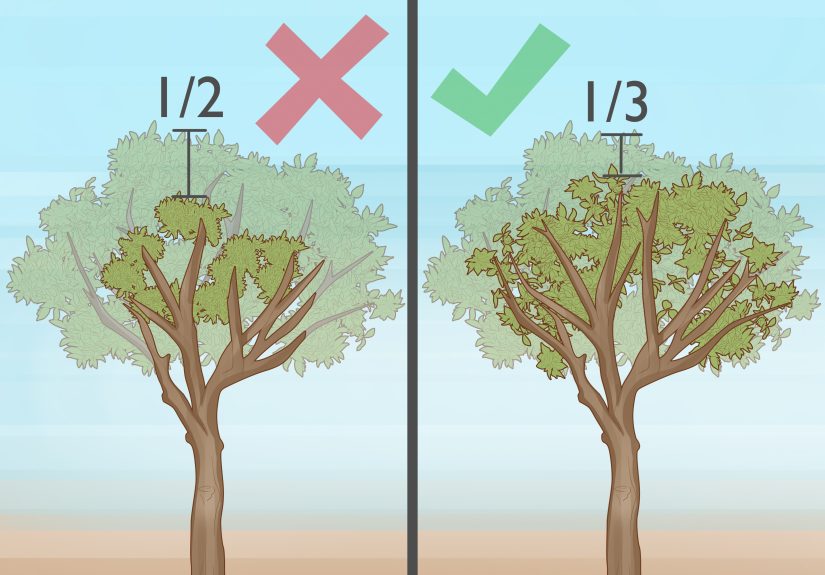
How Much Can You Prune Without Hurting Fruit?
Citrus generally rewards a light touch. Heavy pruning often reduces fruit production and encourages vigorous upright shoots
(water sprouts). A safe rule for many home situations: avoid removing more than about one-third of the canopy in a single session,
and far less if your goal is just maintenance.
Make the Right Cut (So the Tree Heals Well)
Thinning cut vs. heading cut
- Thinning cut: removes a branch back to its origin (better for opening the canopy)
- Heading cut: shortens a branch (more likely to stimulate vigorous regrowth)
For orange trees, thinning cuts are usually the MVP because they reduce crowding without triggering a bunch of shoot growth.
The three-cut method for large limbs
For bigger branches, use a three-cut method to prevent bark from tearing down the trunk:
- Undercut a short distance away from the trunk (a small cut upward from below).
- Top cut a little farther out to remove the branch’s weight.
- Final cut just outside the branch collar to remove the stub cleanly.
Protect Exposed Wood: Citrus Sunburn Is Real
Citrus bark can sunburn when suddenly exposedespecially on the south and west sides. If pruning exposes major limbs or trunk sections
that were previously shaded, protect them. A common approach is painting exposed areas with a diluted white interior latex paint mixture
(water-based, not oil-based). It looks a little odd at first, but so does a lobster, and they also got burned.
Orange Tree Pruning by Age
Young orange trees (1–3 years)
Young citrus needs very little structural pruning. Focus on:
- Removing suckers and rootstock shoots early
- Clipping broken or damaged twigs
- Correcting obvious crossing branches
- Avoiding major canopy removal (let it build leaf area and energy)
Mature orange trees
Mature trees often need only periodic maintenance:
- Remove deadwood and crossing limbs
- Thin small pockets of crowding
- Skirt if fruit touches soil
- Reduce height only when necessary for safe harvesting
Aftercare: What to Do Once You Finish Pruning
- Clean up debris: remove cut branches and dropped fruit so pests don’t throw a party.
- Sanitize tools before storing.
- Water normally: don’t drown the tree as an apology for what you just did.
- Watch for sun exposure: if you opened the canopy a lot, consider trunk/limb protection.
- Expect some regrowth: a few new shoots are normal; remove unwanted water sprouts while small.
Common Mistakes (and How to Avoid Them)
Mistake 1: Over-pruning
Taking off too much canopy at once can reduce fruit and cause a burst of upright, non-fruiting growth. If the tree looks “shocked,”
it probably is. Go lighter next time.
Mistake 2: Topping like it’s a hedge
Flat-topping creates dense regrowth at the top and shades lower fruiting wood. Prefer selective reductions to side branches.
Mistake 3: Leaving stubs
Stubs don’t heal well and can die back. Cut near (but not into) the branch collar for proper healing.
Mistake 4: Ignoring the rootstock takeover
Letting rootstock shoots grow can reduce the fruiting variety’s vigor and may lead to poor-quality fruit. Remove those shoots early.
Mistake 5: Exposing bark without protection
Sunburn on citrus can lead to bark damage. If you suddenly expose major limbs, protect them.
Quick FAQ: Orange Tree Trimming Questions
Should I prune an orange tree every year?
Not necessarily. Many orange trees do fine with light annual touch-ups (deadwood, suckers, small crossing twigs) and a more deliberate
thinning only every few years, depending on growth and your space.
Can I trim an orange tree in summer?
Light maintenance pruning can be done in summer in many warm climates, but avoid heavy pruning during extreme heat and be mindful of sunburn risk.
Will pruning increase fruit production?
Pruning doesn’t magically “add oranges,” but it can improve fruit quality and maintain a healthier canopy. Over-pruning can reduce yield,
so aim for balance.
What if my orange tree is huge and out of control?
Reduce size gradually over multiple seasons using selective cuts, and prioritize safety. If major limbs are involved or the tree is near structures,
consult a certified arboristpreferably one who respects fruit trees.
Conclusion
Trimming an orange tree is less about “shaping” and more about smart maintenance: remove suckers, clear dead or crossing wood, open the canopy for
dappled light, and keep fruit off the dirt. Do it at the right time (usually late winter to early spring), cut carefully at the collar, and don’t
turn pruning into an extreme sport. Your reward is a healthier tree, easier harvests, and fruit that tastes like sunshinewithout you getting sunburned
in the process.
Real-World Pruning Experiences: Lessons From the Orange-Tree Trenches
Every orange tree teaches the same lesson in a different way: the tree is always willing to grow, but it’s not always willing to grow how you planned.
Gardeners commonly start trimming with one simple goal“just a few branches”and end up holding a pile of thorny limbs like they wrestled a green octopus.
The best experiences are the ones that leave you with more confidence and fewer regrets, so here are some of the most useful patterns people run into.
First, the “I barely touched it!” illusion is real. Citrus canopies are dense, and small cuts add up fast. A common experience is stepping back after
20 minutes and realizing the tree suddenly looks like it’s wearing a bad haircut: thinner on one side, heavy on the other. The fix is simple:
prune in short rounds. Make a few cuts, step back, walk around the tree, and check the silhouette from multiple angles. Your eyes adjust slowly,
but your pruners are enthusiastic.
Another classic: the surprise rootstock takeover. Many gardeners don’t notice a vigorous shoot near the base until it’s already thick and thorny.
Then they wonder why the tree’s energy seems “off” and why the new growth looks different. Once you know to check below the graft union regularly,
it becomes a quick habitlike checking your phone, but healthier. Removing small suckers early is a tiny task that saves a big headache later.
Then there’s the “sunburn aftermath,” which usually shows up after someone finally opens the canopy and feels proud… until the trunk looks stressed a few
weeks later. Citrus bark isn’t thrilled about sudden exposure, especially in sunny regions. The gardeners who have the smoothest outcomes tend to do one of
two things: they prune gradually over seasons, or they protect exposed wood right away. The funny part is that the white paint solution looks weird for a bit,
but it’s the kind of weird that helps the tree recover.
Height control is where experience really pays. People often try to solve a tall-tree problem with one dramatic cut. Citrus responds by launching vertical
shoots (water sprouts) like it’s trying to rebuild a skyscraper overnight. The more successful approach feels slower but works better: reduce height using
selective cuts to outward-growing side branches, then follow up later by removing or redirecting the few vigorous uprights that appear. This “two-step” method
is less satisfying in the moment, but it leads to a calmer canopy and fewer future battles.
Finally, there’s the emotional experience: pruning anxiety. It’s normal to hesitate because you can’t un-cut a branch. A great way to build confidence is to
start every session with the safest cuts: deadwood, broken branches, obvious crossings, and suckers. Those are nearly always correct. Once the “easy wins” are
done, you can decide whether the tree truly needs thinning or height reduction. Over time, most gardeners find their orange tree gets easier each year because
small, regular maintenance prevents big, stressful pruning events. And that’s the secret: the best pruning session is the one that doesn’t feel heroic.
It feels routinelike brushing your teeth, except it smells like orange blossoms and you get snacks later.




 Close
Close