Table of Contents >> Show >> Hide
- What Are Ihada Brass Light Switches, Exactly?
- Why Designers and Detail Freaks Love Them
- What You Get for the Money
- The Functional Side: Not Just Pretty, Thankfully
- Where Ihada Brass Light Switches Look Best
- How to Style Them Without Going Full Brass Monologue
- Who Should Buy Ihada Brass Light Switches?
- Final Verdict
- Experience: Living With Ihada Brass Light Switches
There are two kinds of people in this world: people who notice light switches, and people who think they do not notice light switches until they walk into a beautifully finished room and suddenly realize something feels… expensive. That, dear reader, is where Ihada brass light switches enter the chat.
Ihada Brass Light Switches are not your average builder-grade wall accessories. They are the anti-plastic, anti-shrug, anti-“good enough” answer to a detail most homes get spectacularly wrong. In a space full of natural stone, warm wood, handmade tile, linen curtains, and lovingly chosen hardware, a standard white plastic switch plate can look like it arrived by accident. Ihada fixes that with the quiet confidence of solid brass, sculptural geometry, and a living finish that gets better instead of weirder as it ages.
If that sounds dramatic for something you flick on when entering the bathroom half asleep, welcome to the glorious world of design details. The small stuff matters. Sometimes it matters a lot.
What Are Ihada Brass Light Switches, Exactly?
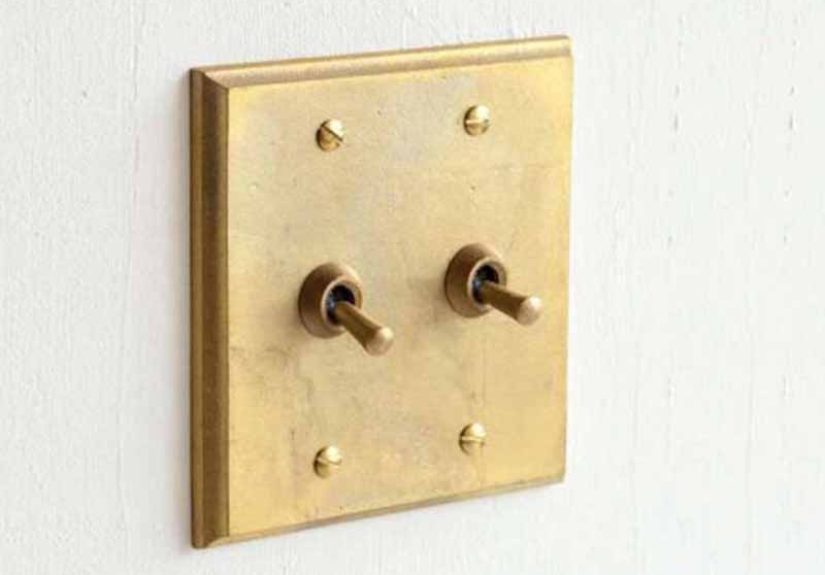
Ihada Brass Light Switches are part of the MATUREWARE line made by Futagami, a Japanese brass foundry with roots dating back to 1897. The collection was designed by Yamazaki Yoshiki and directed by Oji Masanori. The word “Ihada” refers to the signature rough, sand-cast brass texture that gives these switches their tactile, hand-finished look. In plain English, they do not look machine-smoothed, over-polished, or suspiciously eager to blend in. They look like objects with a pulse.
These switches are made from brass, and specialty retailers describe the plates and toggle components as lead-free brass. They are also sold as more than just decorative faceplates. Depending on configuration, the set can include the brass plate, brass toggle switch, toggle cover, nut cover, and brass screws. That means this is not merely a cosmetic cover-up for an ugly switch underneath. It is a full design move.
Configurations range from small one-switch versions in shapes like circle, hexagon, square, and tall rectangle to larger multi-switch layouts such as large square and wide rectangle. In other words, this line was clearly designed for people who care about proportion, not just power.
Why Designers and Detail Freaks Love Them
1. They make a wall feel finished
A beautiful room does not fail because the sofa is wrong by three inches. It usually fails because the details never got upgraded. U.S. design publications keep returning to the same idea: unlacquered or living-finish brass still feels current, warm, and timeless, especially in rooms where texture and patina are part of the story. That matters here because Ihada switches do not read as decoration slapped on top. They read as part of the architecture.
That subtle difference is huge. A standard plastic switch plate says, “The electrician was here.” An Ihada brass switch says, “Someone thought this through.”
2. The texture is the whole point
The Ihada surface is not mirror-shiny brass trying to impersonate a hotel lobby from 1997. It is sand-cast, tactile, and intentionally imperfect. That texture gives the switches a handmade, slightly industrial, slightly historical quality that works beautifully in organic modern interiors, warm minimalism, English-inspired kitchens, old-house renovations, and contemporary spaces that need less gloss and more soul.
This is also why these switches feel different from generic “gold-tone” hardware. They are not chasing sparkle. They are chasing character.
3. Brass ages with you instead of against you
One of the strongest selling points is the finish. Living brass develops patina over time from air, moisture, oils on your hands, and everyday use. For some homeowners, that is the dream. The switch slowly darkens, softens, and becomes more visually complex. It starts out golden and grows into something moodier and richer. If polished chrome is a frozen smile, unlacquered brass is a face that actually lives.
That evolving finish is especially appealing in high-touch areas like kitchens, mudrooms, hallways, and powder rooms. The very act of using the switch contributes to its beauty. There is something oddly poetic about that. Also convenient, because it means fingerprints are not the enemy. They are part of the plot.
What You Get for the Money
Let us address the brass elephant in the room: these are expensive. Specialty listings show that pricing can vary a lot by retailer and configuration. One-gang options have been listed around the mid-hundreds, while larger custom or multi-switch configurations can climb substantially higher. Some retailers list one-gang pieces starting around $175, while broader made-to-order configurations have ranged up to $600.
That is obviously not impulse-buy territory unless your impulses wear linen and subscribe to architecture magazines. But price is part of the point. Ihada Brass Light Switches are not competing with commodity switch plates from the hardware aisle. They are competing with other high-end architectural hardware, and in that category, they function more like jewelry for the wall.
You are paying for solid brass, a distinct sand-cast finish, sculptural form, made-to-order production in many cases, and a design language that looks curated rather than generic. Whether that feels worth it depends on the room, the project, and your threshold for detail-induced joy.
The Functional Side: Not Just Pretty, Thankfully
Luxury hardware that only looks good is basically a very expensive mood. Ihada Brass Light Switches do more than pose for close-ups. Retail listings note UL 1054 switch ratings, with published ratings including 15A at 125V AC and 6A at 250V AC. That matters because it confirms these are built to operate as real electrical components, not decorative props for people who enjoy pretending their pantry is a museum.
There are, however, a few practical details buyers should not gloss over. Some retailers note that the toggle switch and backplate are separate pieces that require assembly. Others specify that the embedded switch box and crimp terminal are not included. Several sellers also recommend installation by a licensed electrician. That is your clue not to approach this project with a butter knife, a YouTube video, and dangerous confidence.
Where Ihada Brass Light Switches Look Best
Kitchens
Kitchens are one of the strongest natural habitats for these switches. U.S. design outlets continue to point to unlacquered brass as a favorite in kitchens because it adds warmth, softens hard finishes, and develops character over time. If your kitchen has marble, soapstone, painted cabinets, walnut, or handmade tile, an Ihada switch can tie everything together with surprising elegance.
Powder rooms
If there is one room where a small dramatic flourish gets maximum payoff, it is the powder room. Guests are close to the wall, the lighting is usually more atmospheric, and the entire room can support a bit of extra personality. A brass switch here feels witty and intentional, like the design equivalent of good tailoring.
Entryways and hallways
These are high-touch, high-traffic zones, which makes them ideal for a living finish. Brass naturally gains depth with use, so the switch does not become more tired over time. It becomes more believable.
Bedrooms, studies, and reading nooks
In quieter spaces, the tactile quality matters even more. The act of switching on a lamp or sconce becomes a tiny ritual. It is a small thing, but good design often wins through repeated small things.
How to Style Them Without Going Full Brass Monologue
The smartest way to use Ihada Brass Light Switches is not to make every metal finish in the room match like nervous wedding guests. Mixed metals are still widely accepted in current interiors, and brass can look especially good when paired with darker finishes, brushed nickel, blackened steel, or aged bronze.
For a warmer, softer look, pair Ihada brass with oak, walnut, limestone, plaster walls, linen, and creamy paint colors. For a more graphic approach, contrast it with deep greens, charcoal, black tile, or off-white walls with visible texture. For vintage-inspired rooms, combine it with push-button dimmers, picture lights, and old-school cabinet hardware. For minimalist rooms, let the geometric plate shape do the talking.
The trick is simple: repeat the brass somewhere else in the room, but not everywhere. A sconce backplate, cabinet latch, faucet detail, shelf bracket, or mirror clip is enough to make the switch feel intentional rather than lonely.
Who Should Buy Ihada Brass Light Switches?
You should consider them if you are renovating a forever home, refining a highly designed space, or fixing that nagging feeling that your room is 95% finished and 5% mildly annoying. They are especially compelling for homeowners who value tactile materials, natural patina, and design details that improve with age.
You may want to skip them if your budget is tight, your home leans ultra-tech and glossy, or you want hardware that looks exactly the same forever. Living brass is not static. That is its beauty and its warning label.
Final Verdict
Ihada Brass Light Switches are delightfully excessive in the best possible way. They take one of the most ignored objects in a home and turn it into something tactile, durable, architectural, and quietly luxurious. They are not cheap, not casual, and not meant for people who think all switch plates deserve the same destiny.
But if you believe good design lives in the details, these switches make a compelling case for caring a little more about the wall than most people do. And honestly, once you have seen an Ihada brass switch next to a plastic one, it is hard not to become a little dramatic about it.
Experience: Living With Ihada Brass Light Switches
The experience of living with Ihada Brass Light Switches is less about a dramatic before-and-after reveal and more about a slow conversion. At first, you notice them because they are unusual. They do not disappear into the wall the way a standard plastic switch does. They sit there with a quiet confidence, like they know they belong in the room. Then, after a few days, something interesting happens: you start expecting that level of detail everywhere else.
That is the real experience. These switches recalibrate your standards.
In the morning, they feel cool to the touch. There is a little weight in the toggle, a little mechanical certainty in the click, and a little texture under your fingers that makes the action feel deliberate rather than accidental. It turns “flip the light on” into a tiny moment of interaction with a material, not just a task. That sounds very design-magazine of me, but it is true. The best objects in a home do not only serve a function. They make the function feel better.
As the days go by, the brass begins to feel even more personal. In a room that gets used constantly, you start to notice subtle changes in tone. Areas around the toggle soften. Edges pick up depth. The finish does not degrade; it develops history. That is especially satisfying if you are the kind of person who likes leather that creases, wood that darkens, linen that relaxes, and cast iron that earns its seasoning. Ihada brass belongs to that family of materials. It rewards contact.
There is also something unexpectedly emotional about seeing a humble object age gracefully. Most things in a modern home are built to resist time, disguise time, or break because of time. These switches do the opposite. They collaborate with time. They become more themselves the more they are used. That makes them feel calm, grounded, and strangely reassuring.
They also change the room in ways that are easy to underestimate. A wall with a beautiful switch plate suddenly looks more complete. Nearby finishes feel more intentional. A brass picture light, a walnut shelf, a stone backsplash, even the paint color somehow seem smarter. The switch becomes a small anchor point that makes everything around it look a little more considered. It is the home equivalent of good shoes: not always the first thing people mention, but one of the reasons the whole outfit works.
Guests may not walk in and announce, “Ah yes, exquisite sand-cast brass toggles.” People are not robots from a boutique hotel. But they do notice that the room feels elevated. They notice the warmth, the texture, the polish without shininess. And if they are at all design-minded, they will eventually wander over, tap the switch, and ask where you found it.
Perhaps the best part is that living with Ihada Brass Light Switches makes daily routines feel less generic. Entering the kitchen at dawn, turning on the hallway lamp at night, dimming the lights before dinner, clicking off the bathroom after guests leavethose tiny actions start to feel connected to the space itself. Not flashy. Not precious. Just deeply considered.
That is why these switches appeal to people who care about homes as lived environments, not just styled photos. You do not buy Ihada Brass Light Switches because you need a switch. You buy them because you want ordinary gestures to feel a little richer, a little more tactile, and a lot less forgettable.
Note: Prices, configurations, and lead times can change by retailer, and professional installation is the smartest route for most buyers.