
Table of Contents >> Show >> Hide
- Quick Navigation
- Who Geoffrey Bawa Was (and Why Designers Whisper His Name)
- Where Lunuganga Isand Why the Location Matters
- A Garden That Behaves Like Architecture
- Tropical Modernism, Explained Without a Lecture
- Why Lunuganga Is a Landmark (Even If You Never Build a House)
- How to Visit (and How Not to Trip Over the Magic)
- Build Your Own “Bawa Circuit” in Sri Lanka
- Experiences: of “What It Feels Like” at Lunuganga
Lunuganga isn’t just “a house with a garden.” It’s more like a garden that learned how to do architectureand then decided
to host you for tea. Created over decades by Sri Lankan architect Geoffrey Bawa, this country estate near Bentota has become
a global touchstone for tropical modernism: modern design that actually respects heat, rain, shadows, and the
way humans prefer to live when the weather is behaving like a moody soap opera.
If you’ve ever walked into a place and immediately felt your shoulders drop (even before you’ve had a snack), that’s the
Lunuganga effect. It’s part landscape, part laboratory, part personal diarywritten in terraces, trees, water, and perfectly
framed views that feel accidental… right up until you realize nothing here is accidental.
Who Geoffrey Bawa Was (and Why Designers Whisper His Name)
Geoffrey Bawa is often credited as a defining voicesometimes even the defining voiceof Sri Lanka’s tropical modern
architecture. But calling him “an architect” can feel slightly incomplete, the way calling a great chef “a person who cooks”
is technically true and spiritually unhelpful.
Bawa’s gift was turning climate and culture into design tools instead of design “problems.” Heat wasn’t something to conquer
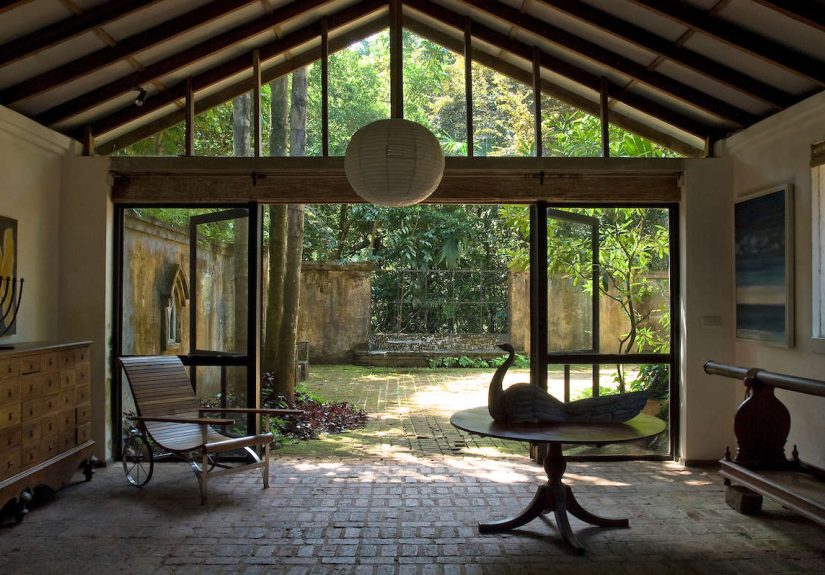
with machines; it was something to negotiate with shade, breezes, courtyards, and transitions. He blurred boundaries between
indoors and outdoors so gracefully that you stop noticing where the house ends and the garden beginsuntil you look down and
realize you’ve been standing in a doorway for five minutes like a contented ghost.
Lunuganga matters because it was personal. This wasn’t a commission with a board meeting and a PowerPoint deck. It was
Bawa’s long, patient experiment: a place to test ideas about space, view, movement, and moodover and overuntil the whole
estate became a living manifesto.
Where Lunuganga Isand Why the Location Matters
Lunuganga sits inland from Sri Lanka’s southwest coast near Bentota, in a landscape that naturally encourages the things
tropical modernism loves most: greenery that grows like it’s being paid, monsoon drama, and light that changes its mind every
fifteen minutes. You don’t visit Lunuganga in spite of the climateyou visit because the climate is part of the design.
The estate is oriented around long views (including toward water), but it doesn’t “show off” in the loud way some famous
houses do. Instead, Lunuganga is quietly theatrical. It reveals itself in sequences: a shaded path, a clearing, a water
surface that catches sky, a terrace that feels like it was placed exactly where you needed to breathe.
A quick reality check: this isn’t an elevator-friendly paradise
Lunuganga’s charm comes with steps, slopes, and uneven ground. That’s part of the terrain and part of the experienceso plan
like a smart adult: comfortable shoes, slow pace, and a willingness to pause without pretending you’re “just checking a text.”
A Garden That Behaves Like Architecture
Many gardens feel like decoration around a building. Lunuganga is the opposite: the garden is the main event, and the
buildings are supporting actors who know their lines and never upstage the star.
What makes this estate unusual is that it’s designed like a series of “rooms,” except the walls are hedges, trunks, and
shifting shadows. The ceiling is the sky (sometimes polite, sometimes extremely not), and the flooring changes under your
feet from packed earth to stone to grass. Bawa shaped the property as a sequence of experiencesspaces that unfold, overlap,
and occasionally surprise you with a view that feels like a punchline delivered at exactly the right moment.
Three design moves you’ll notice even if you’re “not into architecture”
-
Framed views: You’ll keep encountering scenes that look composedlike the landscape is posing for a
portrait. -
Compression and release: Narrow paths open into lawns; shaded corridors spill into brightness; enclosed
areas suddenly give you a horizon. -
Time-of-day staging: The estate has places that feel made for morning, noon, and late afternoon, as if the
sun is a co-designer who shows up reliably for meetings.
Think of Lunuganga as a playlist, not a single song. It’s the transitionsthe “track order”that makes the whole thing
unforgettable.
Tropical Modernism, Explained Without a Lecture
“Tropical modernism” can sound like a fancy name for “modern house with palm trees,” but it’s deeper (and more practical)
than that. It’s modern design adapted to tropical realitiesheat, humidity, sudden rain, intense sun, and a lifestyle that
benefits from airflow and shaded outdoor living.
What tropical modernism does differently
- Prioritizes ventilation and cross-breezes over sealing everything shut.
- Uses shade as a material: overhangs, verandas, screened edges, and layered thresholds.
- Blends inside and outside so living expands into gardens, courtyards, and terraces.
- Works with local texturestone, timber, plaster, tileso spaces feel grounded, not imported.
Lunuganga is a landmark of this approach because it’s not just a “style.” It’s a lived solution: a place where comfort comes
from proportions, orientation, and sequencenot from cranking the thermostat until your soul feels dehydrated.
Why Lunuganga Is a Landmark (Even If You Never Build a House)
Lunuganga is famous in design circles for the same reason great novels get assigned in English class: it teaches you how to
read. After you walk through it (or even study it closely), you start noticing space differently everywhere else.
1) It proves “luxury” can mean quiet, not just expensive
The estate’s most memorable moments aren’t shiny. They’re calm: a chair positioned for a particular view, a veranda that
catches the day’s softest light, a water surface that makes the sky feel closer. Lunuganga makes a strong argument that the
most powerful design move is often restraintthen it politely dares you to disagree.
2) It treats landscape as the true architecture
Bawa’s genius here is editorial. He didn’t try to overpower nature; he adjusted itedited itso you experience it as a
sequence of scenes. In other words, he didn’t build a monument on the land; he built a relationship with the
land.
3) It’s a masterclass in “the long game”
Lunuganga wasn’t finished in a year. It evolved for decades. That matters because the estate demonstrates how design can be
iterative and patient. Most of us don’t get 50 years to refine a garden (tragic, honestly), but we can still learn the
mindset: observe, adjust, live with it, refine again.
4) It’s a cultural artifact, not a frozen museum piece
Lunuganga is a landmark because it carries a story about Sri Lanka’s modern identity and creative networksartists, makers,
architects, and friends who shaped a post-colonial cultural language. It’s personal and historical at the same time, which is
rare. Usually history is either dusty or dramatic. Here, it’s quietly alive.
How to Visit (and How Not to Trip Over the Magic)
Lunuganga is open to visitors via guided tours, and it also operates as a place you can staymeaning you can experience the
estate at a slower pace, when the light changes and the garden feels like it’s exhaling.
Smart visitor tips
-
Go with curiosity, not a checklist. Lunuganga rewards noticing small things: a threshold, a shadow line, a
view that snaps into focus. -
Dress for heat and humidity. Lightweight clothes and shoes that forgive you for being human are your best
friends. - Respect the pace. The estate is designed to be walked, paused, and feltnot speed-run like a theme park.
-
Be mindful of steps and slopes. This is not a “smooth surfaces everywhere” destination, and that’s part of
its character. -
Photograph politely. Some places let you take pictures; some rules apply. The point is the experience, not
the algorithm.
If you’re a designer (or simply design-curious)
Bring a notebooknot to sketch every detail, but to capture the things that are hard to photograph: how a path turns before a
view opens; how a terrace feels “right-sized”; how a building edge holds shade without feeling heavy. These are the lessons
you can steal ethically.
Build Your Own “Bawa Circuit” in Sri Lanka
Part of what makes Lunuganga so compelling is how it clarifies Bawa’s broader legacy. If you’re traveling in Sri Lanka and
want to understand tropical modernism beyond a single site, you can build a small itinerary around related works and
Bawa-connected places.
A simple approach (no obsessive spreadsheets required)
- Start with Lunuganga to understand the private, experimental side of Bawa’s thinking.
-
Pair it with another Bawa site (hotel, civic building, or residence) to see how the ideas scale up for
public life. -
Notice repeated themes: breezeways, courtyards, layered thresholds, and the way water and greenery become
part of the “walls.”
Even if you only see Lunuganga, you’ll walk away with a new filter for architecture: one that asks, “Does this place help me
live well in its climate?” That single question is basically tropical modernism’s entire personality.
Experiences: of “What It Feels Like” at Lunuganga
Imagine arriving slightly overheated (because that’s how the tropics welcome you: with a warm hug that lasts too long), and
then stepping into shade that feels instantly intentional. The air changes. Not dramaticallythis isn’t a sci-fi force field.
More like your body suddenly realizes it doesn’t have to fight the weather alone.
A typical Lunuganga walk doesn’t feel like marching from attraction to attraction. It feels like reading a story told in
pauses. You move along a path that narrows just enough to make you pay attention, and then it opens into a lawn that feels
improbably calmlike someone turned down the volume on the world. Ahead, there’s often a view toward water or a distant rise,
framed so precisely that you’ll suspect you’re standing in the exact spot Bawa wanted you to stand. (You are. He was kind of
famous for that.)
The sensory experience is the point. Underfoot, the ground shifts; overhead, leaves filter light into patterns that change
every time a breeze nudges a branch. Somewhere nearby, water reflects the sky with the kind of confidence only water can
manage. You might find yourself lingering on a veranda, not because you’re tired, but because the space makes “doing nothing”
feel like a respectable activity with a long tradition.
What visitors often love most is how the estate seems to have “times of day.” Morning spots feel fresh and expectant, as if
the garden is stretching. Midday zones feel protectivedeeper shade, cooler edges, places where the design keeps you
comfortable without announcing that it’s doing so. Late afternoon areas can feel downright cinematic, with the light
flattening and warming, and views becoming more graphicdark silhouettes of trees against pale water, or a bright lawn bordered
by deep greens.
The funny thing is that, after an hour or two, you may stop thinking about architecture and start thinking about your own
home. Not in a “Should I buy a new couch?” way, but in a “Why don’t I have a single spot that’s truly meant for the end of
the day?” way. Lunuganga can make you want to design your life with more intention: one chair that faces the best view, one
small ritual at a specific time, one shady corner that invites you to breathe and put your phone down for five minutes without
feeling like you’re failing at productivity.
That’s the quiet power of Lunuganga. It doesn’t shout. It doesn’t flex. It simply demonstratesbeautifully, persistentlythat
good design isn’t about looking modern. It’s about living well, in the real world, with real weather, and real human needs.







 Close
Close