
Table of Contents >> Show >> Hide
- What Is the Marcel Breuer B5 Chair?
- Marcel Breuer and the Bauhaus Moment
- Why the B5 Chair Matters in Design History
- Materials: Chrome-Plated Tubular Steel and Eisengarn
- The Shape: Geometry Without the Yawn
- B5 Chair vs. Wassily Chair: Do Not Mix Them Up
- How the B5 Chair Reflects Bauhaus Principles
- Where the B5 Chair Appeared and Why That Matters
- Collecting the Marcel Breuer B5 Chair
- Using the B5 Chair in Modern Interiors
- Why Designers Still Care About the B5 Chair
- Experience Section: Living With the Idea of the Marcel Breuer B5 Chair
- Conclusion
The Marcel Breuer B5 Chair is the kind of furniture that walks into a room quietly and still manages to look like it invented the future. No carved flowers, no royal curves, no plush throne energyjust a sharp tubular-steel frame, taut fabric panels, and the confidence of a design that knows it does not need extra decoration to be interesting.
Designed in 1926–27, the B5 side chair belongs to Marcel Breuer’s groundbreaking experiments with tubular steel at the Bauhaus. It may not be as famous as the B3 “Wassily” chair or the later Cesca chair, but the B5 is essential for understanding why Breuer changed modern furniture. It shows a young designer taking the everyday chairone of the oldest objects in domestic lifeand reducing it to structure, tension, line, and function. In plain English: Breuer looked at a chair and asked, “What can I remove before this thing stops being a chair?” Then he removed almost everything.
The result was not cold or empty. It was clear. The Marcel Breuer B5 Chair feels like an architectural drawing you can sit on. Its rectangular frame, chrome-plated tubular steel, and durable Eisengarn fabric reflect the Bauhaus belief that design should serve real life, not perform a decorative tap dance for rich people with too many curtains.
What Is the Marcel Breuer B5 Chair?
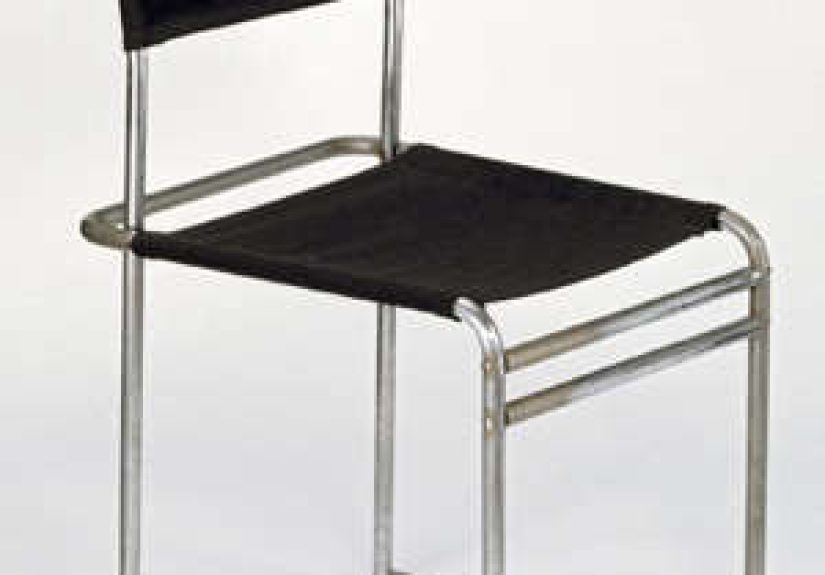
The Marcel Breuer B5 Chair is a modernist side chair made from bent tubular steel with fabric panels for the seat and back. It was created during Breuer’s intensely experimental Bauhaus period, when he was exploring how industrial materials could produce lighter, simpler, more efficient furniture.
Unlike an armchair, lounge chair, or padded dining chair, the B5 is spare and upright. It is a side chair, meaning it was meant for practical seating in interiors such as dining rooms, studios, offices, and modern living spaces. Its beauty comes from proportion and construction rather than ornament. The frame forms a clean geometric outline, while the seat and back appear suspended between metal bars. The chair looks almost like a diagram of itselfwhich, for Bauhaus design, is basically a compliment with chrome polish on top.
Marcel Breuer and the Bauhaus Moment
Marcel Breuer was born in Hungary in 1902 and became one of the most important designers associated with the Bauhaus, the German school that reshaped architecture, furniture, typography, textiles, and industrial design in the 20th century. At the Bauhaus, designers were not encouraged to create pretty objects just for display. They were pushed to solve problems, rethink materials, and connect art with modern industry.
Breuer studied at the Bauhaus and later taught there, becoming closely involved with the furniture workshop. In the mid-1920s, he began experimenting with tubular steel, a material associated more with bicycles and industry than with domestic comfort. The famous story is that Breuer was inspired by the strength, lightness, and clean curves of bicycle handlebars. Whether one treats that story as poetic design folklore or as practical inspiration, the result was real: Breuer helped move furniture away from heavy wooden frames and toward a new language of lightness.
Why the B5 Chair Matters in Design History
The B5 Chair matters because it captures a turning point. Before modernism fully entered the home, much furniture still behaved as if it had inherited a family estate: heavy legs, thick upholstery, carved details, and a strong belief that more material meant more importance. Breuer’s B5 did the opposite. It made a chair out of minimal lines and industrial materials, proving that elegance could come from engineering.
The B5 also sits at the beginning of Breuer’s larger tubular-steel furniture system. It belongs to the same design universe as the B3 chair, later known as the Wassily chair, and the cantilevered chairs that followed. The B5 was not a decorative cousin; it was part of a serious investigation into what modern seating could become. It helped establish tubular steel as a legitimate furniture material, not just something found in machines, bicycles, and places where people say “load-bearing” with great seriousness.
Materials: Chrome-Plated Tubular Steel and Eisengarn
One of the most important features of the Marcel Breuer B5 Chair is its material honesty. The frame is typically described in museum collections as chrome-plated tubular steel. The seat and back are often associated with Eisengarn, a strong treated cotton textile used in early Bauhaus tubular-steel furniture.
Eisengarn means “iron yarn,” which sounds like something a superhero grandmother would knit. In reality, it was a tough, waxed or paraffin-treated cotton material valued for strength and durability. It suited Breuer’s furniture because it could be pulled taut across the steel frame, creating a seat that was visually light but functionally supportive. The combination of shining metal and fabric tension gave the B5 its distinctive balance: industrial yet usable, strict yet surprisingly graceful.
The Shape: Geometry Without the Yawn
The B5 Chair is built around geometric clarity. It uses straight lines, right angles, and rectangular relationships. The frame does not try to imitate nature. It does not curl like a vine or puff up like a Victorian sofa. Instead, it treats the chair as a small architectural structure.
This is where the B5 becomes fascinating. Its simplicity is not laziness. A plain chair is easy to make badly. A minimal chair is hard to make well because every proportion becomes visible. If one line is awkward, the whole object looks nervous. Breuer’s B5 works because the frame, seat, back, and open spaces are carefully balanced. It looks light, but not weak. It looks strict, but not boring. It looks like it has never once apologized for being modern.
B5 Chair vs. Wassily Chair: Do Not Mix Them Up
Many people searching for the Marcel Breuer B5 Chair may accidentally wander into the world of the Wassily chair. That is understandable because both are connected to Breuer, the Bauhaus, tubular steel, and the 1920s. However, they are not the same chair.
The B3 “Wassily” Chair
The B3 chair, later nicknamed the Wassily chair, is a lounge or club chair. It has a more complex frame and uses suspended panels for the seat, back, and arms. It is dramatic, sculptural, and often treated as one of the most iconic modern chairs ever made.
The B5 Chair
The B5 is simpler and more upright. It is a side chair, not a club chair. It has no lounge-chair swagger and does not try to dominate the room. Instead, it expresses the Bauhaus idea of practical modern seating in a compact form. If the Wassily is the museum celebrity wearing sunglasses indoors, the B5 is the brilliant studio assistant who actually organized the entire exhibition.
How the B5 Chair Reflects Bauhaus Principles
The Bauhaus is often summarized with phrases like “form follows function,” though the movement was more layered than one slogan. Still, the B5 Chair clearly reflects several core Bauhaus ideas.
Function Comes First
The B5 is designed to be used. Its form comes from the need to support the body with the least amount of unnecessary material. The frame holds the sitter; the fabric panels provide surfaces; the open structure reduces visual heaviness.
Industrial Materials Belong in the Home
Breuer’s use of tubular steel was radical because it brought a machine-age material into domestic life. Instead of hiding the frame under upholstery, he made the frame the main visual feature. The metal is not disguised. It is celebrated.
Ornament Is Optional, Proportion Is Not
The B5 has almost no decoration. Its visual interest comes from proportion, rhythm, and contrast: bright metal against dark fabric, solid function against open space, rigid geometry against the soft presence of the human body.
Where the B5 Chair Appeared and Why That Matters
The B5 Chair was not merely a design-school experiment sitting in a dusty corner while everyone pretended to understand abstract painting. It was part of Breuer’s broader push to create modern furniture for modern interiors. Examples and versions of the B5 are held in major museum collections, which confirms its significance within design history.
One notable context connected with Breuer’s tubular-steel furniture is the modern avant-garde interior. The B5’s clean structure made sense in spaces where architecture, art, and furniture were being reconsidered together. Rather than acting as a decorative accessory, the chair became part of a total modern environment. It could sit beside modern tables, metal-framed pieces, abstract art, and open interiors without looking like it had arrived from a different century carrying a lace parasol.
Collecting the Marcel Breuer B5 Chair
For collectors, the Marcel Breuer B5 Chair is especially interesting because it is less commonly discussed than the Wassily or Cesca chair. That relative obscurity can make it more intriguing. A B5 is not just “a Breuer chair”; it is a piece from one of the designer’s most experimental periods.
When evaluating a B5 or a chair attributed to Breuer, collectors typically look at the frame construction, proportions, materials, age, provenance, and manufacturer history. Early examples associated with Standard-Möbel or documented museum-quality pieces are especially significant. Because tubular-steel furniture has been widely copied and reinterpreted, attribution should be handled carefully. A chair can be “in the style of Breuer” without being a genuine Breuer design or an early production example.
Condition also matters. Chrome can show pitting, wear, or restoration. Fabric panels may have been replaced. Original Eisengarn, when present and documented, can add historical value. However, collectors should balance originality with stability. A chair that is historically pure but too fragile to move without panic is less practical for everyday use, unless your hobby is whispering apologies to furniture.
Using the B5 Chair in Modern Interiors
The B5 Chair works beautifully in contemporary interiors because it does not shout. It has presence, but it leaves visual breathing room. In a minimalist apartment, it reinforces clean architecture. In a warm, layered home, it adds contrast. In a study, it brings intellectual sharpness. In a dining area, it can create a crisp modern rhythm around a simple table.
Because the chair uses open space as part of its design, it is especially useful in smaller rooms. Heavy chairs can make a compact room feel crowded. The B5’s metal frame and suspended panels let the eye move through it, making the furniture feel lighter than its function. This is one reason tubular-steel furniture has remained relevant: it gives structure without visual bulk.
Why Designers Still Care About the B5 Chair
Designers care about the Marcel Breuer B5 Chair because it teaches lessons that still matter. It shows that innovation does not always require adding technology, features, or dramatic gestures. Sometimes innovation means rethinking the ordinary object until it becomes clearer.
The B5 also reminds us that minimalism is not the same as emptiness. Good minimal design requires decisions. What material? What angle? What thickness? What tension? What relationship between body and structure? Breuer’s chair answers these questions with discipline. It is not trying to be cozy in the traditional sense. It is trying to be modern, efficient, and honest. And somehow, nearly a century later, that honesty still feels fresh.
Experience Section: Living With the Idea of the Marcel Breuer B5 Chair
Spending time with the Marcel Breuer B5 Chair, whether in a museum gallery, a design book, an auction listing, or a carefully styled interior, is different from simply looking at a “nice chair.” The B5 does not flatter the room with softness. It edits the room. It makes nearby objects reveal whether they are necessary or just hanging around for emotional support.
In a real interior, the first experience of the B5 is visual lightness. You notice the air around it almost as much as the chair itself. That is a rare quality. Many chairs occupy space like they are paying rent by the square foot. The B5 occupies space like a line drawing: enough to be understood, not enough to become heavy. Place it beside a wooden table and the contrast is immediate. The wood feels warmer, the steel feels sharper, and the whole setting becomes more intentional.
The second experience is the discipline of the seat. This is not a chair designed for sinking, slouching, or disappearing into cushions while eating crackers over your laptop. It encourages posture. It asks you to sit like a person who might have opinions about architecture. That does not mean it is unusable; it means its comfort is direct rather than indulgent. The fabric panels support the body through tension, while the steel frame defines the posture. The chair has boundaries, and honestly, some rooms need boundaries.
The third experience is historical. A B5 Chair carries the atmosphere of the Bauhaus without turning the room into a museum display. It speaks of workshops, prototypes, industrial optimism, and the belief that good design could improve daily life. That idealism may sound charmingly ambitious today, but it is also refreshing. The chair was not created to chase a seasonal trend. It was created to answer a design problem with clarity.
For homeowners and collectors, the B5 can also become a conversation piece. Not in the loud way of novelty furniture shaped like a hand or a giant shoe, but in the better way: someone notices the frame, asks about it, and suddenly the conversation moves from “Where did you buy that?” to “Why did modern furniture change so dramatically in the 1920s?” That is the secret power of design classics. They are functional objects that open doors to history.
The final experience is appreciation over time. The B5 may not deliver instant decorative warmth, but it rewards close looking. You begin to notice the rhythm of the tubes, the role of negative space, the slight tension between industrial material and human use. It is a chair that becomes more interesting the less it tries to charm you. In a world full of furniture begging for attention, the Marcel Breuer B5 Chair simply holds its lineand wins.
Conclusion
The Marcel Breuer B5 Chair is one of the clearest examples of Bauhaus furniture thinking: functional, industrial, geometric, and quietly radical. Designed in the 1920s, it helped prove that a chair could be modern without being cold, minimal without being empty, and practical without being visually dull.
Its chrome-plated tubular steel frame, Eisengarn seat and back, and disciplined side-chair form make it an important piece in Breuer’s development as a designer. While the Wassily chair may get more fame, the B5 deserves serious attention because it shows Breuer refining the basic chair into a modern structural idea. It is not just furniture. It is a compact lesson in how design changed when the machine age entered the living room, pulled up a chair, and sat down with excellent posture.







 Close
Close