
Table of Contents >> Show >> Hide
- What Was Theia?
- The Giant Impact Hypothesis Explained
- Why a Head-On Collision Became So Important
- The Oxygen Isotope Evidence
- Moon Rocks: Tiny Samples, Huge Story
- Deep Inside Earth: Possible Remains of Theia
- Computer Simulations Bring the Collision to Life
- Why Scientists Call the Evidence Strong
- What the Collision Did to Earth
- Was It Really Head-On?
- What Scientists Still Do Not Know
- Why This Discovery Matters
- Experience Section: What This Topic Teaches Us About Looking at the Moon
- Conclusion
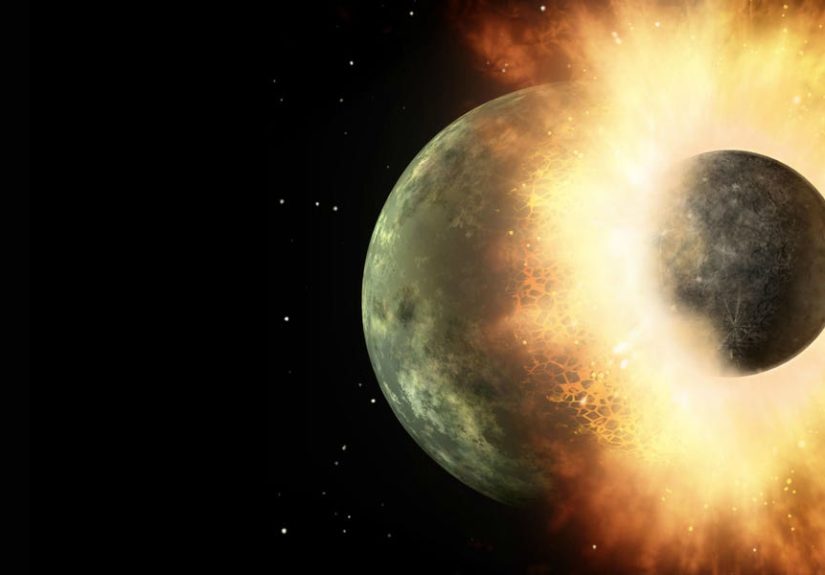
Long before oceans, dinosaurs, smartphones, or anyone complaining about airplane legroom, Earth had a very bad day. According to the leading scientific explanation for the Moon’s origin, our young planet was struck by a Mars-sized planetary body known as Theia. The collision was not a gentle cosmic bump. It was the kind of impact that melts worlds, launches rock into space, reshapes a planet’s interior, and leaves behind a glowing souvenir we now call the Moon.
For decades, scientists have supported the giant impact hypothesis, the idea that the Moon formed after a massive object slammed into proto-Earth about 4.5 billion years ago. But newer evidence has made the story more dramatic. Chemical measurements of lunar rocks, high-resolution computer simulations, and studies of strange deep-Earth structures all point toward a violent collision that may have been more direct than earlier “side-swipe” models suggested. In other words, Earth may not have been clipped by Theia. It may have been hit almost head-on.
This does not mean researchers found a giant dent with a “Theia was here” sign. Planetary science is rarely that considerate. Instead, the evidence comes from isotope fingerprints, seismic mysteries, lunar chemistry, and models that test how two young planets could smash together and still produce the Earth-Moon system we see today.
What Was Theia?
Theia is the name scientists use for the hypothetical planetary embryo that collided with early Earth. It was likely about the size of Mars, though some models allow for a somewhat larger or smaller body. Theia formed during the chaotic early Solar System, when rocky planets were still growing through repeated impacts. Imagine a cosmic construction zone, except the construction workers are molten planets and nobody is wearing a hard hat.
In this period, Earth was not yet the calm blue planet we know. It was hot, partially molten, and still collecting material. Planetary embryos were moving through overlapping orbits, and collisions were part of the normal planet-building process. Theia was probably one of these embryos. Eventually, its orbit crossed Earth’s path, and the resulting impact changed both worlds forever.
The Giant Impact Hypothesis Explained
The giant impact hypothesis proposes that Theia struck proto-Earth with enough energy to blast a huge amount of molten and vaporized material into orbit. Over time, that debris gathered together under gravity and formed the Moon. This theory explains several major features of the Earth-Moon system.
First, the Moon has a small iron core compared with Earth. If the Moon formed mainly from rocky mantle material thrown into orbit, rather than from the metal-rich core of an intact planet, its low iron content makes sense. Second, the Moon is depleted in volatile elements, substances that vaporize easily. A high-energy impact would have heated material intensely, helping explain why the Moon is relatively dry and chemically processed compared with Earth. Third, the Earth-Moon system has unusual angular momentum, which a massive collision could provide.
For years, the classic version of the theory imagined a glancing blow. Theia would have struck Earth at an angle, throwing debris into orbit while merging with our planet. That model worked well in some ways, but it created a puzzle: lunar rocks brought back by Apollo astronauts are remarkably similar to Earth rocks. If much of the Moon came from Theia, why does the Moon look chemically like Earth’s sibling rather than like a stranger?
Why a Head-On Collision Became So Important
The head-on collision idea helps solve the chemical puzzle. In a more direct impact, Earth and Theia would have mixed far more thoroughly. Instead of Theia merely donating material to a disk around Earth, both bodies could have partially blended into a shared molten mess. The Moon would then form from material that had been strongly mixed, explaining why lunar and terrestrial rocks have such similar isotope ratios.
That is the heart of the argument. A side-swipe impact may not mix enough material. A more direct collision, however, is like stirring two pots of lava with a planet-sized spoon. It is messy, extreme, and exactly the kind of event that could make Earth and Moon look chemically related.
The Oxygen Isotope Evidence
One of the strongest clues comes from oxygen isotopes. Isotopes are versions of the same element with different numbers of neutrons. Oxygen has several stable isotopes, including oxygen-16, oxygen-17, and oxygen-18. Different planets and meteorites often carry slightly different oxygen isotope signatures, almost like chemical ZIP codes from different regions of the Solar System.
When scientists compared oxygen isotopes in Earth rocks and Moon rocks, they found an extraordinary similarity. At first, this seemed to challenge the giant impact hypothesis. If Theia formed elsewhere and contributed much of the Moon’s material, lunar rocks should have carried a different isotopic fingerprint. But if the collision was energetic and direct enough to mix Earth and Theia thoroughly, the similarity becomes easier to explain.
Some studies have reported tiny differences between Earth and Moon samples, especially in materials thought to come from deeper lunar reservoirs. Other high-precision measurements find the two bodies nearly indistinguishable in oxygen isotopes. Instead of weakening the impact theory, this ongoing debate has sharpened it. The question is no longer simply, “Did an impact happen?” It is, “What kind of impact could produce this exact chemical outcome?”
Moon Rocks: Tiny Samples, Huge Story
The Apollo lunar samples remain priceless because they give scientists direct evidence from another world. These rocks are not just dusty souvenirs from astronauts with excellent job descriptions. They are time capsules from the early Solar System.
Analyses of lunar rocks have examined oxygen, titanium, chromium, tungsten, iron, and other isotopic systems. Many measurements show that Earth and Moon are extremely similar. That similarity supports models in which the Moon formed mostly from Earth’s mantle material or from a highly mixed combination of Earth and Theia. Either way, the data strongly point to a giant collision rather than older ideas that the Moon was captured by Earth’s gravity or formed separately nearby.
Some researchers have even argued that Theia may have formed in the same inner Solar System neighborhood as Earth. If Theia and Earth were made from similar materials to begin with, their chemical resemblance would be less surprising. That possibility does not cancel the collision. It simply changes Theia from an exotic outsider into a sibling planet that came over for a visit and accidentally ended a world.
Deep Inside Earth: Possible Remains of Theia
The most fascinating twist is that pieces of Theia may still exist inside Earth. Deep beneath Africa and the Pacific Ocean are two enormous structures known as large low-velocity provinces, or LLVPs. Seismic waves slow down when passing through these regions, suggesting that they are hotter, denser, or compositionally different from the surrounding mantle.
Recent research has proposed that these continent-sized blobs could be remnants of Theia’s mantle that sank into Earth after the Moon-forming impact. If true, Earth is not just a planet that survived a collision. It is a planet carrying pieces of its ancient impactor in its deep interior. That is not just science; that is cosmic leftovers on a planetary scale.
This idea remains under investigation, but it is powerful because it connects two mysteries: the origin of the Moon and the strange structure of Earth’s lower mantle. If the LLVPs are made partly of Theia material, then the Moon-forming impact did not merely launch debris into orbit. It also reorganized Earth’s interior in ways that may still influence mantle dynamics today.
Computer Simulations Bring the Collision to Life
Because nobody was standing around 4.5 billion years ago with a clipboard and safety goggles, scientists use computer simulations to reconstruct the impact. These models test different sizes, speeds, angles, temperatures, and spin rates. They ask a brutal but elegant question: what collision produces a planet like Earth and a Moon like ours?
Older simulations often favored a grazing impact. Newer high-resolution models show that a wider range of scenarios may work, including impacts that place material directly into orbit and form the Moon much faster than previously thought. Some simulations suggest the Moon could have formed in a matter of hours rather than slowly assembling over years from a debris disk.
That does not mean the case is closed. Simulations depend on assumptions about early planetary interiors, impact speed, material strength, and thermodynamics. Still, they increasingly show that a direct or highly energetic collision can explain several observations at once: lunar composition, Earth-Moon angular momentum, the Moon’s orbit, and the intense mixing implied by isotope data.
Why Scientists Call the Evidence Strong
The evidence is strong because multiple independent lines of research point in the same direction. Lunar rocks show Earth-like chemical signatures. The Moon’s small iron core fits an origin from rocky mantle debris. The Earth-Moon system has the kind of angular momentum expected from a giant collision. Simulations show that a Mars-sized impactor can produce Moon-forming material. Deep mantle structures may even preserve physical remnants of the impactor.
That is how science builds confidence. One clue is interesting. Two clues are persuasive. Five clues from chemistry, geology, physics, astronomy, and computer modeling start to look like the universe leaving a trail of breadcrumbs, except the breadcrumbs are molten and 4.5 billion years old.
What the Collision Did to Earth
The Theia impact likely transformed Earth completely. The energy released would have melted much of the planet’s outer layers, creating a global magma ocean. Theia’s metallic core probably merged with Earth’s core, while rocky material from both bodies mixed in the mantle and was thrown into orbit.
The impact may have affected Earth’s rotation, tilt, internal layering, and long-term evolution. It also gave Earth its large Moon, which helps stabilize the planet’s axial tilt over long timescales. A stable tilt contributes to relatively stable seasons, which may have helped create a more predictable environment for life to evolve. That does not mean the Moon single-handedly created life, but it may have been one of the quiet background conditions that made Earth more habitable.
In a strange way, Earth’s worst day may have helped make our best days possible. No giant impact, no Moon as we know it. No Moon, different tides, different nights, different planetary stability, and a very different sky for poets, wolves, astronomers, and people trying to take dramatic beach photos.
Was It Really Head-On?
The phrase “head-on” should be understood carefully. Scientists are not saying Theia hit Earth at a perfect 90-degree angle like a billiard ball in a textbook diagram. Planetary impacts are complex three-dimensional events involving rotation, deformation, melting, vaporization, and gravity. “Head-on” generally means a more direct, high-energy collision than the classic glancing-blow model.
The key point is mixing. A more direct impact would blend Earth and Theia more completely, making it easier to explain why Earth and Moon share such similar isotopic fingerprints. It also fits the idea that Theia did not simply skim Earth and leave a separate chemical signature behind. Instead, the two bodies may have merged so violently that their identities became almost impossible to separate.
What Scientists Still Do Not Know
Despite the strong evidence, important questions remain. Scientists still debate Theia’s exact size, composition, origin, impact angle, and speed. They also continue to investigate how quickly the Moon formed after the collision. Did it assemble from a debris disk over time, or did a Moon-like body emerge rapidly from material thrown directly into orbit?
Another question concerns Theia’s birthplace. Some chemical models suggest Theia formed close to Earth in the inner Solar System. Other evidence leaves room for a body with a somewhat different origin. Future sample-return missions, improved isotope measurements, and better simulations may help resolve this mystery.
There is also the deep-Earth question. If the LLVPs are Theia remnants, scientists need to explain how those materials survived billions of years of mantle convection. The idea is exciting, but proving it requires connecting seismic data, geochemistry, and impact modeling in a convincing way.
Why This Discovery Matters
The Theia impact is not just a story about the Moon. It is a story about how planets become planets. Earth is not a finished product that appeared neatly wrapped with oceans and continents. It is the result of collisions, melting, mixing, cooling, and chemical sorting over unimaginable time.
Studying the Theia impact helps scientists understand planet formation throughout the galaxy. If giant impacts shaped Earth, they probably shaped countless rocky exoplanets as well. Some may have gained large moons. Others may have lost atmospheres, changed rotation, or become uninhabitable. The violent early history of our planet is part of a broader cosmic pattern.
This research also reminds us that familiar objects can have wild origins. The Moon looks calm, pale, and poetic. Yet its birth story may involve two young worlds colliding with enough force to melt rock and rewrite Earth’s future. The night sky suddenly feels less like a peaceful painting and more like the quiet aftermath of a spectacular accident.
Experience Section: What This Topic Teaches Us About Looking at the Moon
Learning about the Theia impact changes the way many people experience the Moon. Before hearing the science, the Moon may seem like a simple companion: bright, dependable, and useful when the power goes out. After learning about Theia, the Moon becomes evidence. It is not just an object in the sky; it is a glowing reminder that Earth survived an ancient planetary collision.
One of the most memorable experiences related to this topic is looking at a full Moon after understanding the giant impact hypothesis. The view is familiar, but the meaning changes. That round, quiet disk may have formed from the wreckage of a Mars-sized body and early Earth. It is like discovering that the calmest person at a dinner party once wrestled a volcano and won.
This topic is also a great example of how science works in real life. Scientific understanding does not usually arrive as one dramatic announcement where everyone throws confetti and goes home. It builds slowly. Apollo samples gave researchers lunar rocks. Isotope studies revealed chemical similarities. Computer models tested possible impacts. Seismology uncovered strange structures deep inside Earth. Each piece added more context, and the story became stronger over time.
For students, science fans, and casual readers, the Theia impact offers a useful lesson: evidence can be indirect and still powerful. Nobody can replay the collision. Nobody can dig up Theia like a fossilized dinosaur bone. Yet scientists can reconstruct the event using chemistry, physics, and planetary modeling. That is detective work at the largest scale imaginable. The crime scene is Earth. The witness is the Moon. The fingerprints are isotopes.
Another experience this topic creates is humility. Humans often think of Earth as solid and permanent. We build cities, draw borders, name mountains, and argue over parking spaces as if the ground beneath us has always been calm. But Earth’s early history was violent beyond ordinary imagination. The crust we stand on is the cooled surface of a planet that endured impacts, magma oceans, and deep internal mixing. Theia reminds us that stability is something Earth achieved over time, not something it was born with.
The story also makes astronomy feel personal. The Moon affects tides, calendars, culture, mythology, and exploration. If Theia helped create the Moon, then that ancient impact indirectly shaped human history too. Lunar cycles influenced early timekeeping. Moonlight affected travel and storytelling. The Moon became a target for the space race and a symbol of human curiosity. A collision before life existed eventually helped inspire astronauts, scientists, artists, and children staring out bedroom windows.
For writers and educators, this topic is especially powerful because it combines drama with evidence. “A Mars-sized planet hit Earth head-on” sounds like science fiction, but the claim rests on real measurements and serious models. That balance makes it perfect for public science communication. It is exciting without needing exaggeration. The facts are already dramatic enough; the universe apparently hired its own special effects department.
Finally, the Theia impact gives us a new way to appreciate survival. Earth was not gently placed into the Solar System like a marble on a shelf. It was assembled through chaos. The Moon, one of the most beautiful objects in our sky, may be the result of destruction transformed into order. That is the deeper wonder of the story: from a catastrophic collision came a world with tides, seasons, eclipses, and life looking back up at the evidence.
Conclusion
Scientists have found strong evidence that Earth was struck by a Mars-sized planetary body, Theia, during the Solar System’s violent youth. The case is built from lunar rock chemistry, isotope measurements, computer simulations, the Moon’s physical properties, and possible traces of Theia deep inside Earth. While researchers still debate the exact details, a direct and highly energetic collision explains why Earth and Moon are so chemically similar and why the Moon formed the way it did.
The story is both destructive and creative. A collision that could have erased early Earth instead helped shape the planet we know. It may have formed the Moon, altered Earth’s interior, influenced planetary stability, and left behind one of the most important clues in the night sky. The next time the Moon rises, it is worth remembering: you may be looking at the beautiful aftermath of the biggest crash in Earth’s history.
Note: This article is an original, rewritten synthesis based on established planetary science research, public space science reporting, university findings, and peer-reviewed discussions of the giant impact hypothesis, Theia, lunar isotopes, Moon formation, and Earth’s deep mantle structures.







 Close
Close