
Table of Contents >> Show >> Hide
- Before You Start: Know What Kind of Twin Beds You Have
- Why Two Twin Beds Keep Separating
- Simple Ways to Keep Two Twin Beds Together: 7 Steps
- Step 1: Start With Matching Mattresses and Matching Height
- Step 2: Lock the Frames or Legs Together
- Step 3: Add Non-Slip Pads Under the Mattresses
- Step 4: Fill the Middle Gap With a Bed Bridge
- Step 5: Add a King-Size Topper for a Smoother Surface
- Step 6: Use the Right Bedding to Hold Everything in Place
- Step 7: Stabilize the Whole Setup With Rails, a Headboard, and Routine Checks
- Mistakes to Avoid
- When This Setup Makes the Most Sense
- Experience and Practical Lessons From Real-World Twin-Bed Setups
- Conclusion
If you have ever pushed two twin beds together and thought, “Perfect, now we have one giant cozy bed,” only to wake up in the middle-of-the-night Grand Canyon, welcome. You are among friends. Keeping two twin beds together sounds easy until the mattresses start drifting apart like they are in the middle of a dramatic breakup.
The good news is that this is fixable. Whether you are combining beds in a guest room, setting up a vacation rental, creating a flexible family sleeping space, or trying to make a split king feel less split and more king, a few smart adjustments can make a huge difference. The trick is not just shoving the beds together and hoping for the best. The trick is creating friction, support, alignment, and a smooth top surface so the whole setup behaves like one bed instead of two roommates who tolerate each other.
This guide walks through seven practical steps that actually help. Along the way, we will cover sizing, common mistakes, and what to do if you want a setup that is smooth, stable, and less likely to swallow your elbow at 2 a.m.
Before You Start: Know What Kind of Twin Beds You Have
This part matters more than most people expect. Two standard twin mattresses placed side by side give you roughly the width of a king, but they are shorter. In plain English, that means the bed may feel wide enough but not long enough for taller sleepers. Two twin XL mattresses, on the other hand, create the same overall footprint as a traditional king-size bed. That is why twin XL pairs are commonly used in split king setups.
If your goal is a true king-style sleeping surface, twin XL is the cleaner solution. If you already have two standard twins, do not panic. You can still keep them together and make the setup comfortable, especially in guest rooms, kids’ rooms, or spaces where flexibility matters more than perfect king dimensions.
Why Two Twin Beds Keep Separating
Most bed drift comes down to three boring but powerful villains: movement, slick surfaces, and mismatched components. When people climb in, roll over, or sit on the edge, the mattresses shift. If the foundation or floor is smooth, the frames move more easily. If one mattress is taller, softer, or lighter than the other, the seam becomes more noticeable and the beds are more likely to separate.
In other words, your bed is not haunted. It is just dealing with physics.
Simple Ways to Keep Two Twin Beds Together: 7 Steps
Step 1: Start With Matching Mattresses and Matching Height
The easiest way to create a smooth, stable sleeping surface is to begin with mattresses that are as similar as possible. Ideally, both should have the same length, height, and firmness level. When one side is taller or softer than the other, the seam in the middle becomes more obvious, and everything on top of the bed has a harder time staying in place.
If you are shopping from scratch, buy the same model in the same size. If you are working with what you already own, measure both mattresses before you do anything else. Sometimes the fix is simple: a thin topper on the lower side can help even things out. If the difference is dramatic, though, no amount of wishful thinking will make the middle feel seamless.
Think of this step as the foundation for every other fix. The closer the two mattresses match, the better your straps, bridge, topper, and sheets will perform later.
Step 2: Lock the Frames or Legs Together
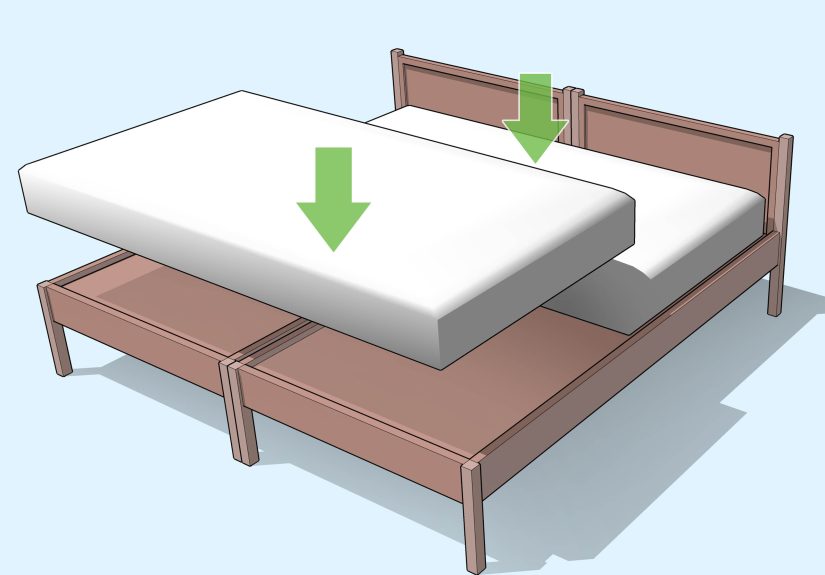
If the bed frames move, the mattresses will follow. That is why one of the smartest fixes is securing the bases before you mess with the top of the bed. If you have two separate twin frames sitting side by side, use frame connectors, brackets, or compatible hardware made for joining bed bases. For a short-term setup, some people use strong Velcro straps, bungee cords, or zip ties around the inner legs. Glamorous? No. Effective? Often, yes.
The goal is to turn two small bases into one stable platform. Once the lower structure stops wandering, the mattresses are less likely to open up a gap in the middle every time someone flops into bed like they are diving into a hotel commercial.
For adjustable bases, use the manufacturer’s recommended connectors whenever possible. They are usually better than improvised fixes and less likely to interfere with how the base moves.
Step 3: Add Non-Slip Pads Under the Mattresses
This is one of the cheapest and most effective upgrades. Put non-slip rubber pads, gripper mats, or mattress friction pads between the mattresses and the foundation. These work a lot like rug pads: they increase traction so the mattresses do not slide around as easily.
If the entire bed is drifting on hardwood, tile, or laminate, add non-slip furniture coasters under the frame legs too. That gives you grip at both levels: under the mattresses and under the frame. It is a double-defense strategy, and unlike some complicated DIY hacks, it does not require a toolbox, a YouTube degree, or a deep emotional commitment.
Just make sure the pad lies flat and does not bunch up underneath. A wrinkled gripper pad can create lumps, and nobody wants to explain to a guest why the bed suddenly feels like it is hiding a garden hose.
Step 4: Fill the Middle Gap With a Bed Bridge
If the main problem is the crack in the center, a bed bridge is your best friend. Also called a gap filler or converter kit, this is usually a foam wedge that sits in the seam between the mattresses. Its job is to smooth out the split so you do not feel like you are camping on two islands connected by optimism.
A good bed bridge works best after the mattresses are pushed tightly together and stabilized. It is not a magic fix by itself. If the beds are still sliding apart underneath, the bridge will just be a foam spectator. But when paired with secured frames and non-slip pads, it can noticeably improve comfort.
For guest rooms or occasional use, a bridge can be all you need. For nightly use, especially by couples, many people prefer combining a bridge with a topper so the surface feels even more unified.
Step 5: Add a King-Size Topper for a Smoother Surface
If you want the bed to feel more like one mattress and less like a carefully negotiated alliance, add a king-size mattress topper over both beds. A topper softens the center seam, adds a bit of weight, and helps hold the whole setup together under a fitted sheet.
This works especially well in guest rooms, rental homes, and dual-purpose rooms where two twins sometimes need to function as one larger bed. It is also a smart move when the mattresses are close in height but not perfectly identical.
There is one important catch: a full-width topper can reduce the benefit of independent movement on an adjustable split king. If one side of the bed needs to raise while the other stays flat, a large topper may fight that flexibility. So if your setup is adjustable and each sleeper wants separate control, think carefully before using a topper across both sides.
Step 6: Use the Right Bedding to Hold Everything in Place
Sheets are not just decorative. They can help anchor the setup when used correctly. For two twin beds being treated as one sleeping surface, a snug king-size fitted sheet can pull the mattresses inward and help everything stay aligned. A mattress protector or mattress pad across both beds can also add a little extra stability under the sheet.
Go for deep pockets if you are using a topper or bridge, because a sheet that barely fits will pop off faster than a dramatic soap-opera exit. Cotton or cotton-blend fitted sheets with good elastic tend to do a better job than loose, slippery bedding.
If your setup is a true split king on adjustable bases and you want each side to move separately, specialized split king sheets may be the better choice. In that case, focus more on frame connectors and friction pads, since the bedding will not be doing as much “hugging everything together” work.
Step 7: Stabilize the Whole Setup With Rails, a Headboard, and Routine Checks
Once the basics are handled, think about the bed as a system. A shared headboard can help reduce shifting and keep the setup aligned. Side rails, retainer bars, or a properly sized frame also make a big difference, especially if the mattresses tend to slide toward the edges or move when the bed is adjusted.
Then do the least glamorous but most useful thing of all: check the setup regularly. Re-tighten connectors, straighten the bridge, smooth the topper, and inspect the gripper pads every so often. Beds are like office chairs and Wi-Fi routers. They behave better when someone occasionally pays attention to them.
If something keeps slipping despite repeated fixes, step back and check the big-picture issue. The frame may be the wrong size, the mattresses may be a poor match, or the base may simply need better support hardware.
Mistakes to Avoid
Do not rely on sheets alone. They help, but they are not structural support.
Do not ignore the frame. If the frames move, the mattresses will separate again.
Do not use overly aggressive adhesives carelessly. Carpet tape and hook-and-loop products can help in some situations, but they may leave residue or pull at certain mattress fabrics.
Do not expect a bed bridge to fix everything by itself. It is a comfort tool, not a miracle worker.
Do not forget the adjustability tradeoff. A king-size topper or bridge can make a split bed feel smoother, but it may reduce independent motion.
When This Setup Makes the Most Sense
Keeping two twin beds together is especially practical in spaces that need flexibility. Guest rooms are the classic example. Two twins can serve friends, siblings, kids, or solo travelers, then convert into a larger shared bed when needed. Vacation rentals also benefit because the room can adapt to different groups without buying multiple bed types.
It can also be a smart solution for couples who want different sleep feels. In a split king arrangement, each side can have a different firmness level, and movement on one side is less likely to travel to the other. That is good news if one sleeper tosses, turns, snores, reads, scrolls, or treats bedtime like a one-person gymnastics routine.
Experience and Practical Lessons From Real-World Twin-Bed Setups
In real homes, people usually discover the need to keep two twin beds together for one of four reasons: a guest room has to multitask, a vacation rental needs more flexibility, a couple wants a split sleeping setup, or a family is trying to make a room work without buying a brand-new king mattress right away. And in almost every case, the first attempt is hilariously optimistic. Someone pushes the beds together, throws on a larger blanket, stands back proudly, and says, “There. Done.” Then the first person rolls over that night and finds the seam like it was personally offended by being ignored.
One common experience is the weekend guest-room conversion. During the week, the room functions perfectly with two separate twin beds. Then relatives visit, the beds get pushed together, and everyone realizes that the middle gap feels like a surprise obstacle course. Homeowners who solve this well usually do not rely on one fix. They use a simple combination: connectors at the frame, non-slip material under the mattresses, a bridge in the middle, and a fitted sheet that actually fits. That layered approach tends to work better than any single product trying to play superhero alone.
Another common lesson comes from adjustable bases. Couples often love the idea of separate comfort settings but hate the visible seam. The experience here is usually about tradeoffs. If both sleepers want totally independent movement, a giant topper across both sides may not be ideal. If they care more about a smooth surface than separate motion, the topper suddenly becomes the star of the show. In other words, the “best” fix depends on what matters most at bedtime: customization or togetherness.
Vacation rental hosts often learn a different lesson: durability beats cleverness. A quick DIY trick may survive one weekend, but it may not survive a steady parade of guests who drop luggage on the bed, sit heavily on the edges, or rearrange everything without mercy. For those spaces, sturdier frame connectors, reliable gripper pads, and easy-to-reset bedding usually outperform complicated fixes that only the owner understands.
Families also report that matching mattress height matters more than expected. Even when the beds stay physically together, a height mismatch can make the center feel awkward. The setup may look fine in a photo and still feel weird in practice. That is why people who get the best results often spend more time on measuring and leveling than on decorative finishing touches.
The biggest real-world takeaway is simple: success comes from treating the setup like one system, not one product. The frame, the friction, the seam, and the bedding all need to cooperate. Once they do, two twin beds can function surprisingly well together. Not “sort of okay if nobody moves,” but genuinely comfortable. And that is the dream, really. A bed that stays put, feels smooth, and does not try to separate its occupants like a cranky middle-school dance chaperone.
Conclusion
If you want to keep two twin beds together, the smartest approach is a layered one. Start with matching mattresses, secure the frames, add non-slip pads, fill the middle gap, and use bedding that supports the setup rather than fighting it. From there, a topper, headboard, or retainer system can take comfort and stability up another notch.
The best part is that you do not need a fancy renovation or a giant budget to make this work. A few practical adjustments can transform two wandering twin beds into a setup that feels stable, comfortable, and surprisingly polished. Your bed can absolutely stop drifting apart. Your sleep can absolutely stop feeling like a nightly trust exercise. And yes, your guests can absolutely stop falling into the middle and pretending they “slept great, thanks.”






 Close
Close