
Table of Contents >> Show >> Hide
- Why Tokyo Turns Everyone Into a Space-Saving Wizard
- Under the Stairs: The Most Underrated Square Footage in the Building
- Designing a Tokyo Under-Stairs Office That Feels Surprisingly Normal
- Start With a Simple Layout: Surface, Storage, Light
- Built-In vs. Modular: Tokyo Usually Rewards “Custom-ish”
- Storage That Doesn’t Bully Your Knees
- Lighting: Your Under-Stairs Office Should Not Resemble a Mystery Novel
- Power and Cable Management: Make It Boring on Purpose
- Sound and Privacy: Tiny Workspaces Need Tiny Boundaries
- Ergonomics in a Space the Size of a Suitcase
- Tokyo-Specific Small-Space Tricks You Can Steal Anywhere
- A Concrete Example: A Tokyo Maisonette Under-Stairs Office
- Common Under-Stairs Office Mistakes (And How to Avoid Them)
- Conclusion: Small Space, Big Upgrade
- Experience Add-On: Living With an Under-Stairs Office in Tokyo (The Real-World Version)
- SEO Tags
Tokyo has a special talent for making you rethink what “enough space” means. In some cities, a spare room becomes a home office. In Tokyo, a spare thought becomes a home office. And honestly? That’s kind of the charm.
This is the story (and the strategy) behind one of the smartest micro-upgrades in small-space living: creating a compact, comfortable office under the stairs.
It’s equal parts design puzzle, ergonomics experiment, and “I refuse to work from my bed ever again” manifesto.
Why Tokyo Turns Everyone Into a Space-Saving Wizard
Tokyo’s housing reality encourages creative living. Data frequently cited in reporting and surveys puts the average home size in Tokyo around the mid-60-square-meter range, with substantially less “dwelling space” once you remove hallways, bathrooms, and other non-living areas.[1]
And on the extreme end, “micro-apartments” can be small enough to be described in tatami matssometimes just three mats (around nine square meters).[2]
In that context, “wasted” space becomes emotionally offensive. The awkward triangle under a staircase? That’s not dead space. That’s rent you’re paying for… to store a vacuum cleaner you resent. Tokyo teaches a simple lesson: if a space exists, it should earn its keep.
Under the Stairs: The Most Underrated Square Footage in the Building
Under-stairs zones are famously tricky: low head clearance, odd angles, shadows, and usually a collection of “I’ll deal with this later” items.
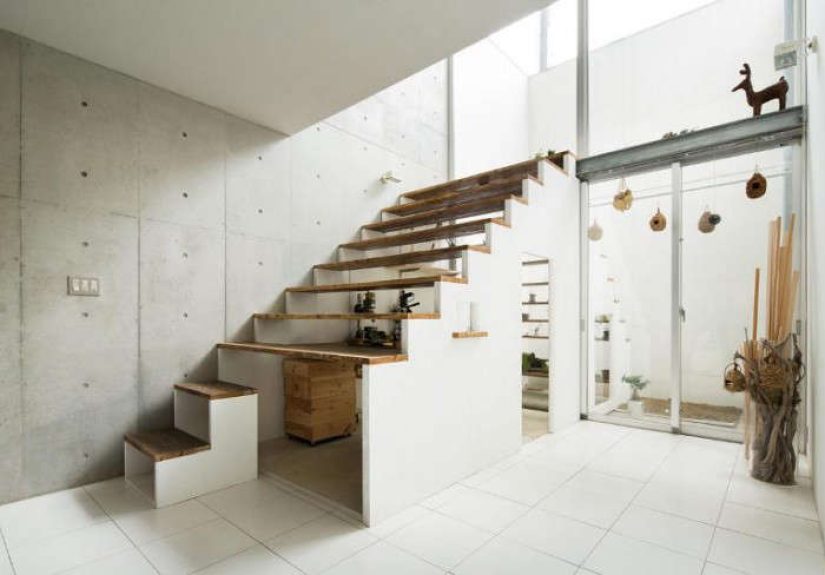
But design and DIY communities have shown again and again that stair voids can be transformed into functional nooksstorage, reading alcoves, pet zones, mini mudrooms, even compact workstations.[3]
In many Tokyo homes and maisonette-style apartments, stairs are one of the few architectural features that naturally create a semi-enclosed pocket. That little pocket is exactly what a focused work area needs:
separation, boundaries, and a psychological “I’m at work” switchwithout requiring a whole room.
The “Kaidan-shita” Mindset (A Fancy Way to Say “Use the Weird Corner”)
You don’t need a grand remodel to make an under-stairs office work. You need three things:
(1) a usable surface, (2) adequate light, and (3) a setup that doesn’t punish your neck and wrists by lunchtime.
Measure Twice, Buy Once (Especially When the Ceiling Slopes)
The number-one under-stairs mistake is buying furniture first and measuring later. Under a staircase, a “standard desk” is rarely standard-friendly.
Measure:
- Width at the back wall (often the widest point)
- Depth where your knees and chair will actually go
- Seated head clearance (you don’t need to stand there, but you do need to sit without hunching)
- Outlet locations and how cables can route cleanly
- Ventilation path (small spaces trap heat fast)
Designing a Tokyo Under-Stairs Office That Feels Surprisingly Normal
The goal isn’t to cram a corporate cubicle into a triangle. It’s to build a “micro-zone” that supports real work:
laptop, monitor, calls, deep focus, and the occasional moment of staring into the distance like you’re about to pivot careers into artisanal soba-making.
Start With a Simple Layout: Surface, Storage, Light
Think in three layers:
- Surface: a desk or counter-depth worktop that fits the angle and lets your forearms rest comfortably
- Storage: vertical shelving, shallow cabinets, or drawers that keep clutter out of sight
- Light: task lighting plus ambient fill so it doesn’t feel like you’re working in a stylish cave
Built-In vs. Modular: Tokyo Usually Rewards “Custom-ish”
Custom built-ins are the dream because they follow the slope perfectly and can integrate drawers, shelves, and cable channels.
But you can get 80% of the benefit with a “custom-ish” approach:
a cut-to-size countertop, wall-mounted brackets, and modular storage that fits the available height.
Small-space guides frequently emphasize using vertical surfaces and multifunctional elements to avoid visual clutter and reclaim floor area.[4]
A particularly effective tiny-home trick is a fold-down or wall-mounted work surfaceideal when the under-stairs area doubles as a passageway or storage zone.
Designers have used fold-down desks to blur the line between furniture and architecture in compact homes, including projects in Tokyo-focused small-space coverage.[5]
Storage That Doesn’t Bully Your Knees
Under-stairs storage is great… until it steals legroom. Favor storage that goes up and back, not forward.
Good options:
- Floating shelves above monitor height for books and décor
- Shallow cabinets (10–12 inches deep) for stationery and tech
- Drawer units tucked to one side where the slope is lowest
- Pegboard or rail systems for headphones, scissors, chargers
- A single “drop zone” tray for keys and walletbecause Tokyo life is fast and pockets are fictional
Lighting: Your Under-Stairs Office Should Not Resemble a Mystery Novel
Small nooks tend to be darker than you expect. Layer your lighting:
- Task light: a focused lamp aimed at the work surface
- Ambient fill: an LED strip under a shelf or along the underside of the stairs
- Glare control: angle the monitor to reduce reflections, and avoid placing the screen directly under a harsh light source
Ergonomics and safety guidance commonly recommends adjusting lighting to reduce glare and eyestrain, especially in computer-heavy setups.[6]
Power and Cable Management: Make It Boring on Purpose
The more compact the workspace, the more cable chaos expands like a gas. Keep it simple:
- Mount a power strip under the desk
- Use adhesive cable clips to route cords along edges
- Label chargers (future-you will feel personally thanked)
- If you rent, use removable solutionsTokyo landlords are not always sentimental about your “improvements”
Sound and Privacy: Tiny Workspaces Need Tiny Boundaries
If your under-stairs office sits near a hallway or living area, you’ll want some “soft separation.”
Consider:
- A curtain on a tension rod (cheap, renter-friendly)
- A slim sliding panel or screen
- Acoustic felt tiles on the wall behind the monitor
- A small rug to reduce echo and add comfort
Ergonomics in a Space the Size of a Suitcase
The biggest risk of a tiny office is “micro-discomfort”: small misalignments that feel fine for 20 minutes and terrible by day three.
The fix is not expensive gearit’s smart positioning.
Monitor and Laptop Setup: Save Your Neck First
Many ergonomics resources converge on the same principle: the top of your screen should be at or slightly below eye level, with the center of the screen positioned below horizontal eye leveloften described as roughly 15–20 degrees downward.[7]
In plain English: you should look slightly down at your screen, not crane up or bend down.
If you work on a laptop, consider a laptop stand plus an external keyboard and mouse so the screen can rise without forcing your hands into a weird angle.
Home-office ergonomics guidance frequently highlights this exact pairing as a practical fix.[8]
Chair, Feet, and the “Why Do My Legs Feel Weird?” Problem
If your feet can’t rest comfortably on the floor, use a footrest (or a sturdy boxno judgment).
Ergonomics checklists often call out feet support and chair adjustments as the foundation of comfort in computer work.[9]
In a tiny under-stairs nook, a footrest can also help you sit slightly back, creating more knee clearance under the sloped ceiling.
Micro-Breaks: The Smallest Habit With the Biggest Payoff
Compact offices can encourage “frozen posture” because moving around feels like a hassle. Don’t fall into that trap.
Many ergonomics and therapy resources recommend regular breaksstanding, stretching, shifting focusto reduce strain and eye fatigue.[10]
Set a timer if you must. The timer doesn’t judge you. The timer loves you.
A Quick Ergonomic Checklist for Under-Stairs Offices
- Screen at or slightly below eye level; positioned directly in front of you[7]
- Keyboard and mouse at elbow level; wrists neutral[6]
- Chair supports your lower back; shoulders relaxed[8]
- Feet supported (floor or footrest); knees comfortably bent[9]
- Lighting reduces glare; add task light if the nook is dim[6]
- Stand and reset regularly; change position every 30–60 minutes[10]
Tokyo-Specific Small-Space Tricks You Can Steal Anywhere
1) Make Furniture Do Two Jobs
Small-space design advice often returns to the same theme: multifunction beats “perfect” single-purpose pieces.
Think wall-mounted desks, storage benches, shelving that doubles as display, and cabinetry that hides the mess so the room feels calmer.[4]
Under the stairs, this might look like a worktop that also functions as a charging station and filing surfacethen disappears behind a curtain after hours.
2) Go Vertical Like It’s a Lifestyle Choice
If your floor footprint is tiny, your walls become prime real estate. Add shelves, rails, hooks, and slim cabinets.
Under-stairs idea collections consistently emphasize using every inchespecially with custom drawers, cabinets, and built-ins that follow the slope.[3]
3) Reduce Visual Noise
In small Tokyo spaces, clutter doesn’t just look messyit feels like the room is shrinking in real time.
A single closed cabinet, a neutral storage box, or a drawer system can make a workspace feel “designed” instead of “temporary.”
Storage-focused guides from major shelter publications repeatedly recommend concealed storage as a way to make compact rooms feel calmer and larger.[11]
A Concrete Example: A Tokyo Maisonette Under-Stairs Office
Let’s imagine a common scenario: a compact two-level rental with a staircase near the entry or living space.
The under-stairs void measures about 47 inches wide at the back wall, with usable depth of 20–24 inches where your chair can slide in comfortably.
The lowest section is too short for your headperfect for drawers and storage.
The Setup
- Work surface: a 24-inch-deep countertop cut to width, mounted on brackets
- Chair: a compact adjustable task chair (or a slimmer chair plus lumbar cushion)
- Screen: external monitor on a riser, or laptop on a stand + external keyboard
- Storage: one narrow drawer unit to the side; shelves above the monitor
- Lighting: LED strip under the stair stringer + a small task lamp
- Boundary: curtain on a tension rod to “close” the office after work
Why This Works
You get a dedicated work zone without giving up the main living area. You keep cables controlled. You avoid the posture penalties of bed-working.
And you can “shut down” the office visuallyan underrated mental health feature when your home is also your workspace.
Small-space home office planning resources often stress zoning and intentional layout as the difference between “cozy” and “chaotic.”[12]
Common Under-Stairs Office Mistakes (And How to Avoid Them)
- Too little light: Add layered lighting; don’t rely on one overhead bulb.
- Heat buildup: Choose cooler-running lights, keep airflow paths open, and avoid sealing the nook completely.
- Head bumps: Mark the danger zone with a soft edge trim or padding (your forehead will learn fast, but you don’t need it to).
- Monitor too low: Raise ityour neck is not a sacrificial offering to productivity.[7]
- Storage that steals legroom: Move storage up and to the sides; keep the knee zone clear.
Conclusion: Small Space, Big Upgrade
An office under the stairs isn’t just a clever trickit’s a practical response to real urban constraints.
Tokyo small-space living pushes you toward intentional design: making zones, using vertical space, keeping clutter contained, and protecting your body with better ergonomics.
The best part? Once you build a workspace that fits you, the nook stops feeling tiny. It starts feeling efficient.
And in a city where every inch counts, efficiency is basically a love language.
Experience Add-On: Living With an Under-Stairs Office in Tokyo (The Real-World Version)
The first morning I tried working from an under-stairs nook in Tokyo, I had the same skeptical energy people bring to “healthy” desserts.
Like, sure, it’s technically a brownie, but are we all pretending together? The space looked goodneat desk, shelves, soft lamp, a tiny plant trying its bestbut I kept wondering if I’d feel cramped after an hour.
What surprised me most wasn’t the size. It was the focus. The under-stairs pocket created a natural boundary: when I sat down, my view was basically “screen, notebook, and a small strip of wall.”
No laundry pile staring me down. No couch whispering sweet nothings about naps. The space didn’t let my brain sprawl, so my attention didn’t either.
In a normal room, distraction has room to stretch out. Under the stairs, distraction hits the angled ceiling and gives up.
The second surprise was how quickly comfort becomes non-negotiable in small spaces. If the monitor was an inch too low, my neck noticed immediately.
If the chair didn’t support my back, there was nowhere else for my posture to “hide.”
That’s when the ergonomics advice stopped being theoretical and started being survival.
I raised the screen, added an external keyboard, and put a firm box under my feet. Instantly better.
It wasn’t glamorousbut it was the difference between “cute nook” and “place where I can actually work.”
The third surprise was temperature. Small enclosed pockets warm up fast, especially with a laptop running video calls.
I learned to keep the nook “open” during the day: curtain pulled back, airflow clear, and lights that didn’t turn the space into a toaster.
In summer, a small fan aimed past the desk (not directly at my face) helped a lotenough to make the area feel livable without sounding like a helicopter on calls.
Then there’s the Tokyo soundtrack: neighbors moving around, a delivery bike outside, someone’s footsteps on the stairs.
The under-stairs office muffled some noise, but it also amplified the “nearby” feeling of everything.
A small rug softened the echo, and a pair of noise-reducing headphones made deep work possible.
Oddly, the space felt more private than a desk in the open living roomeven though it was only a few feet awaybecause it had its own little envelope.
My favorite ritual became the end-of-day shutdown. I’d tuck the keyboard away, slide papers into a drawer, turn off the lamp, and pull the curtain closed.
That tiny act made the apartment feel like a home again, not a workplace with a bed in it.
In small-space living, emotional boundaries matter as much as physical ones.
An under-stairs office works when it’s not just functionalbut when it can also disappear.
After a week, the nook stopped feeling like a compromise and started feeling like a hackone of those “why doesn’t everyone do this?” ideas.
Because in Tokyo, the definition of luxury isn’t size. It’s a space that’s designed on purpose.
And an office under the stairs, done right, is surprisingly luxurious: focused, tidy, ergonomic, and just hidden enough to make work feel contained.






 Close
Close