Table of Contents >> Show >> Hide
- Why Titan Is Not Just Another Frozen Moon
- The Icy Crust: A Frozen Lid With a Complicated Personality
- What May Be Hiding Beneath Titan’s Surface
- Titan’s Atmosphere: A Chemical Factory in Orange Haze
- The Methane Mystery
- What Titan Can Teach Us About Earth
- NASA’s Dragonfly Mission: A Flying Laboratory for an Alien World
- Could There Be Life on Titan?
- Experiences and Reflections: Why Titan Captures the Imagination
- Conclusion
Saturn’s moon Titan is the kind of place that sounds like science fiction until you remember that nature has been writing better scripts than Hollywood for 4.5 billion years. It has rivers, lakes, seas, clouds, rain, dunes, weather, seasons, and an atmosphere thick enough to make it feel almost planet-like. The catch? Its rivers are not filled with water. Its rain is mostly methane. Its surface is colder than your freezer’s freezer. And beneath its icy crust, scientists suspect there may be a hidden world where water, organic chemistry, and planetary heat have been quietly negotiating the rules of habitability.
That is why Titan has become one of the most fascinating targets in the search for life beyond Earth. It is not “Earth 2.0,” and it is certainly not a cozy backup apartment for humanity. But it may preserve clues about how chemistry becomes biology, how planets evolve, and how our own world may have looked before life learned to complicate everything.
Why Titan Is Not Just Another Frozen Moon
Titan is Saturn’s largest moon and the second-largest moon in the solar system. It is bigger than Earth’s Moon and even larger than the planet Mercury, although it is far less massive. What makes Titan truly stand out is its thick, nitrogen-rich atmosphere. Among moons, that is extremely rare. In fact, Titan is the only moon in our solar system known to have a substantial atmosphere.
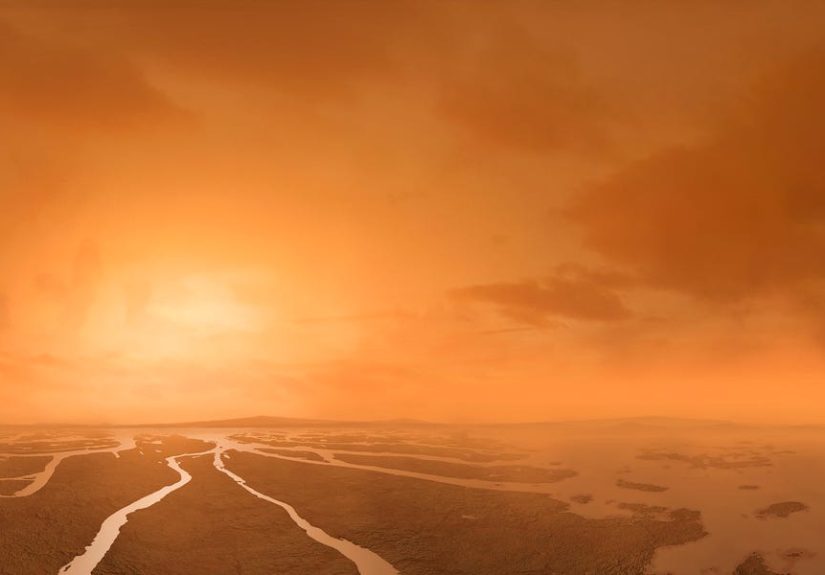
Even more surprising, Titan is the only world besides Earth known to have stable liquid on its surface. But instead of oceans of water, Titan has lakes and seas of methane and ethane, hydrocarbons that behave as gases on Earth but remain liquid in Titan’s deep cold. Imagine a world where natural gas falls from the sky, flows through river channels, fills lakes, evaporates, forms clouds, and rains again. Titan basically looked at Earth’s water cycle and said, “Cute. I’ll do mine with methane.”
This methane-based cycle gives Titan an eerily familiar landscape. Cassini-Huygens data revealed dunes, channels, coastlines, deltas, lakes, and seas. The surface looks geologically active, shaped by wind and liquid, even though the chemistry is alien. That combinationfamiliar landforms made from unfamiliar materialsis why Titan is often described as one of the most Earth-like worlds in the solar system, even though standing there without protection would be a very bad, very brief vacation.
The Icy Crust: A Frozen Lid With a Complicated Personality
Titan’s outer shell is made largely of water ice. At Titan’s surface temperature, around minus 290 degrees Fahrenheit, water ice behaves less like the ice cube in your drink and more like rock. It can form mountains, crust, plains, and cratered terrain. But scientists now think the upper crust may be even stranger than simple frozen water.
Recent research suggests that methane may be trapped within Titan’s icy crust as methane clathrate, a crystalline structure in which methane molecules are locked inside cages of water ice. This methane-rich layer could be several miles thick. That matters because clathrate ice can act as insulation, changing how heat moves through Titan’s crust and affecting how the surface responds to impacts.
One clue comes from Titan’s impact craters. Compared with other icy moons, Titan has surprisingly few visible craters, and many of the known craters appear shallower than expected. A methane clathrate crust could help explain this mystery. If the crust is warmer and more flexible beneath the surface, crater topography may relax over time, gradually softening and flattening like a dent slowly rising out of warm wax. Titan, in other words, may be quietly erasing its scars.
Why Shallow Craters Matter
Crater shapes are more than cosmic potholes. They are records of a world’s interior. A deep, sharp crater suggests a stiff crust that preserves impact features. A shallow, softened crater suggests heat, movement, or material properties that allow the ground to deform. On Titan, the shallow craters may hint that the icy crust is not a dead shell but an active layer connected to deeper processes.
That is important for astrobiology because life, as we understand it, needs more than interesting molecules. It needs environments where chemistry can keep moving, mixing, and changing. A rigid crust might lock Titan’s surface organics away from deeper liquid water. A more dynamic crust could create pathwaysthrough impacts, fractures, melt pockets, or slow convective movementthat help surface chemistry interact with the subsurface.
What May Be Hiding Beneath Titan’s Surface
Scientists have long suspected that Titan contains a subsurface ocean of liquid water, possibly mixed with salts and ammonia. Cassini gravity measurements and data from the Huygens probe helped build the case for a hidden ocean beneath the icy ground. Some models place liquid water tens of miles below the surface, sealed away under the crust like a secret basement in the solar system’s strangest house.
That ocean, if present and long-lived, could be one of Titan’s most important habitats. Water is essential for life as we know it, and Titan has an extraordinary supply of organic molecules. The big question is whether those organics can reach the water in useful amounts. A pantry full of ingredients does not make dinner unless somebody opens the door, turns on the stove, and stops the cat from walking across the counter.
On Titan, impact cratering may be one possible delivery system. When a large object strikes the surface, it can generate heat, melt ice, and create temporary pockets of liquid water. These melt zones might mix with organic material from Titan’s surface and atmosphere. Some of that mixture could sink or move downward through the ice, potentially carrying carbon-rich chemistry toward the ocean.
However, recent studies also suggest caution. Titan may be rich in organics, but that does not automatically mean it can support a large biosphere. The amount of biologically useful material reaching the ocean may be limited. This makes Titan scientifically exciting rather than scientifically settled. It is not a place where we can say, “Life is definitely there.” It is a place where we can ask better questions than before.
Titan’s Atmosphere: A Chemical Factory in Orange Haze
Titan’s atmosphere is mostly nitrogen, with methane and smaller amounts of other carbon-rich compounds. Sunlight and energetic particles break apart methane and nitrogen molecules high in the atmosphere. Those fragments then recombine into more complex organic molecules, forming Titan’s famous orange haze.
This haze is not just atmospheric decoration. It is chemistry in motion. Over time, organic particles drift downward and coat the surface, feeding dunes and plains with carbon-rich material. Some of these molecules are related to prebiotic chemistrythe kind of chemistry that may have mattered on early Earth before living cells existed.
That is one reason scientists care so much about Titan. It may act as a natural laboratory for studying the steps between simple molecules and more complex chemistry. Earth’s early atmosphere and surface have been transformed by plate tectonics, oceans, weather, oxygen, and life itself. Titan, by contrast, may preserve chemical processes in a colder, slower, more visible form.
The Methane Mystery
There is another puzzle: methane should not last forever in Titan’s atmosphere. Solar radiation breaks it down over time. If nothing replenished it, Titan’s methane would eventually disappear. Yet methane is clearly present, driving clouds, rain, lakes, and atmospheric chemistry.
So where does Titan’s methane come from? Possible answers include reservoirs inside the crust, methane clathrates, cryovolcanic activity, underground hydrocarbon aquifers, or episodic release from the interior. The methane-rich crust hypothesis is especially intriguing because it could connect several Titan mysteries at once: the methane atmosphere, the shallow craters, and the thermal behavior of the ice shell.
In good science, the best clues often multitask. A theory becomes more attractive when it explains not one oddity, but several. Titan’s methane clathrate crust may be one of those cluesan icy key that could unlock the story of Titan’s surface, atmosphere, and hidden ocean.
What Titan Can Teach Us About Earth
At first glance, Titan and Earth seem wildly different. Earth is warm, oxygen-rich, and covered with liquid water. Titan is freezing, methane-rich, and wrapped in orange smog. But the comparison becomes more interesting when we look at processes instead of appearances.
Both worlds have atmospheres dominated by nitrogen. Both have weather cycles. Both have liquids carving channels into the surface. Both have organic chemistry. Both show how climate, geology, and chemistry can interact across an entire world.
Titan may help scientists understand how planetary environments organize complex chemistry before biology enters the stage. On Earth, the origin of life happened so long ago that many clues have been erased. Titan offers a different laboratory, one where organic molecules form naturally in the atmosphere and collect on the surface. Studying Titan may help researchers test which chemical pathways are common in the universe and which ones require very specific conditions.
That does not mean Titan is a frozen copy of early Earth. It is not. But it may preserve pieces of the same larger puzzle: how simple chemistry becomes complex, how environments concentrate useful molecules, and how liquid solventswater on Earth, methane and ethane on Titanshape planetary surfaces.
NASA’s Dragonfly Mission: A Flying Laboratory for an Alien World
The next major step in Titan exploration is NASA’s Dragonfly mission, a rotorcraft lander designed to fly across Titan’s surface. Dragonfly is expected to launch no earlier than July 2028 and arrive at Titan in late 2034. Once there, it will use Titan’s dense atmosphere and low gravity to hop from site to site, studying dunes, impact-related materials, and areas that may preserve evidence of past interactions between liquid water and organic compounds.
Dragonfly is not being sent to scoop up an alien microbe and wave it at the camera. Its main goal is to study habitability and prebiotic chemistry. It will investigate how far chemistry has progressed in an environment rich in organic molecules. It may also help scientists understand whether Titan’s surface materials have ever mixed with liquid water, especially around impact sites such as Selk Crater.
This mission is exciting because mobility changes everything. A stationary lander sees one neighborhood. A flying laboratory can compare multiple locations, like a planetary field geologist with rotors. On Titan, that is a huge advantage. The moon’s surface is diverse, and the most important clues may not be politely sitting in one convenient landing spot.
Could There Be Life on Titan?
The honest answer is: maybe, but we do not know. There is no evidence of life on Titan. What Titan offers is not proof, but possibility. Its subsurface water ocean could potentially provide a habitat for life as we know it. Its surface lakes and seas raise the more exotic possibility of chemistry unlike life on Earth, perhaps based on liquid hydrocarbons instead of water. That idea is fascinating, but highly speculative.
The stronger case for Titan’s astrobiological importance is its chemistry. Titan is a world where organic molecules are produced naturally and widely. It is a place where the raw ingredients associated with life’s chemistry exist in abundance, even if the conditions are difficult. The question is whether those ingredients ever enter environments where they can react in life-friendly ways.
That brings us back to the icy crust. If Titan’s crust is simply a thick, locked barrier, the surface and ocean may remain mostly separate. If the crust is more dynamicinsulated by methane clathrate, softened by internal heat, disturbed by impacts, or fractured over timethen Titan becomes more interesting. The crust may not just hide secrets. It may decide whether those secrets can meet each other.
Experiences and Reflections: Why Titan Captures the Imagination
Thinking about Titan is a little like standing at the edge of a dark lake at night. You cannot see what is underneath, but the surface tells you something is there. On Earth, lakes reflect trees, clouds, and city lights. On Titan, lakes reflect Saturn’s distant sunlight through a thick orange haze, while the liquid itself is made of methane and ethane. The image is strange, but the feeling is familiar: a shoreline always invites questions.
For anyone who has watched rain run down a window, Titan offers a cosmic echo. Rainfall is one of the most ordinary experiences on Earth. It cancels picnics, feeds forests, floods streets, and makes people suddenly remember where they left their umbrella. On Titan, rain also fallsbut as methane, in a cold so extreme that water is stone-hard ice. That contrast makes Titan powerful. It shows that nature can repeat patterns using completely different ingredients.
The experience of learning about Titan also changes how we see Earth. Our planet can feel normal because we live here. Oceans, weather, coastlines, rivers, and clouds seem expected. Titan reminds us that these systems are not guaranteed. They are planetary achievements. A world needs the right temperature, pressure, chemistry, gravity, and history to keep liquids moving across its surface. Earth does it with water. Titan does it with methane. Both are remarkable.
There is also a humbling experience in studying a place so far away. Cassini traveled across the solar system, orbited Saturn for years, repeatedly flew past Titan, and sent back data that scientists are still analyzing. Huygens descended through Titan’s atmosphere and landed on the surface in 2005, giving humanity its first direct look from the ground of a moon in the outer solar system. That is not just engineering; it is patience with antennas.
Titan teaches a valuable lesson about discovery: the most important answers often arrive slowly. A radar reflection becomes a lake. A crater depth becomes a clue about crust thickness. A haze particle becomes a clue about prebiotic chemistry. A strange moon becomes a mirror, not because it looks exactly like Earth, but because it helps us ask what made Earth special.
For readers, Titan’s story is a reminder that science is not only about finding life. It is also about learning what life requires, what chemistry can do, and how many kinds of worlds may exist between “dead rock” and “living planet.” Titan sits in that mysterious middle ground. It is cold, distant, and difficult, yet it is also active, chemical, layered, and full of possibility.
That is why Titan feels less like a frozen object and more like a question with a landscape. Its icy crust may hide an ocean. Its atmosphere may preserve chemistry related to life’s beginnings. Its methane seas may reveal how liquids shape worlds. And its future exploration may help us understand not only whether life exists elsewhere, but why life emerged here at all.
Conclusion
The icy crust of Saturn’s moon Titan is more than a frozen shell. It may be an archive, an insulator, a chemical gatekeeper, and a planetary storyteller. Beneath its orange haze and methane weather, Titan holds clues about organic chemistry, hidden oceans, surface-atmosphere cycles, and the conditions that may lead toward habitability.
We should be careful not to turn every exciting moon into an alien-life headline machine. Titan has not given us evidence of life. What it has given us is something scientifically richer: a world where the ingredients, environments, and mysteries of life’s origin can be studied in a completely different setting. That is why Titan matters. It helps us look outward toward life beyond Earth while also looking backward toward the deep chemical history of our own world.
Note: This body-only HTML article is written for web publication and synthesizes current public science from NASA, JPL, NASA Astrobiology, Johns Hopkins APL Dragonfly materials, University of Hawaiʻi research, Cornell reporting, Nature Communications findings, and peer-reviewed astrobiology literature. No source links are embedded in the article body by request.