Table of Contents >> Show >> Hide
- The Sinkhole That Changed a Neighborhood Overnight
- Why South Dakota Was Vulnerable to a Sinkhole Like This
- Who Explored the Sinkhole and What They Found
- Why the Discovery Was Bigger Than One Hole
- Why the Story Captured So Much Attention
- The Human Cost Behind the Curiosity
- The Real Takeaway From This South Dakota Sinkhole Story
- Extra: What Experiences Around a Story Like This Really Feel Like
Some stories sound made up until the details show up wearing steel-toe boots. A giant sinkhole opening in South Dakota already sounds dramatic. Add a hidden mine underneath a neighborhood, a team of trained cavers descending into the darkness, and the discovery of old tracks, mining equipment, and a vintage car, and suddenly the whole thing sounds like the opening scene of a very specific disaster movie. The difference is that this one was real, and for the people living nearby, it was a lot less “wow, neat” and a lot more “should I be sleeping here tonight?”
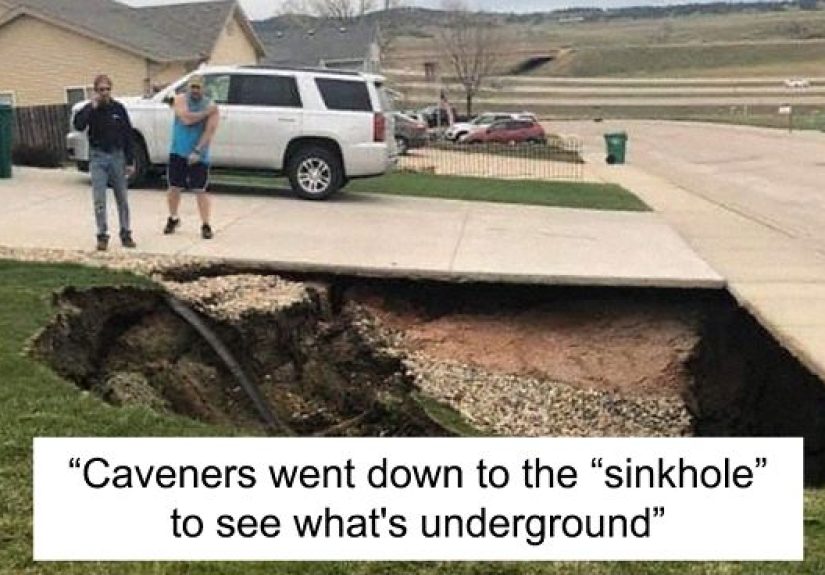
The real story behind the headline “There’s A Huge Sinkhole In South Dakota And People Explore It” centers on Black Hawk, a community near Rapid City. In 2020, the ground gave way in the Hideaway Hills subdivision and exposed what turned out to be an abandoned gypsum mine beneath the neighborhood. That single collapse quickly became a geology lesson, an engineering problem, a human-interest story, and a legal battle all rolled into one. It also became one of those rare moments when the hidden world under a suburban street suddenly became impossible to ignore.
If you are searching for the truth behind this South Dakota sinkhole story, here it is: yes, people explored it, but not in a casual “grab a flashlight and go” way. The people who went down were experienced cavers and mappers. What they found was fascinating. What it meant for residents was frightening. And what it revealed about old mining, land development, and sinkhole risk is worth a much closer look.
The Sinkhole That Changed a Neighborhood Overnight
The most gripping part of this story is how ordinary the setting was before everything changed. This was not a remote canyon, a forgotten desert site, or some spooky patch of wilderness with a warning sign no one read. It was a residential neighborhood. People were mowing lawns, using their sinks, walking sidewalks, and going about their routines. Then the ground opened up.
When the sinkhole appeared, it did not just create a dramatic hole in the earth. It also broke water and sewer lines, destabilized the area around nearby homes, and forced evacuations. That alone would have made the event major local news. But what really pushed the story into national attention was the discovery beneath the surface: the sinkhole had opened into an old underground gypsum mine that many residents had no idea existed.
This is where the story stops being merely strange and starts becoming revealing. A sinkhole can feel like a random act of chaos, but in this case the collapse exposed a long-buried history of mining and land use. In other words, the hole was not random at all. It was the visible symptom of an underground problem that had been waiting, quietly and inconveniently, for its moment.
Why South Dakota Was Vulnerable to a Sinkhole Like This
Gypsum: useful mineral, terrible surprise under your subdivision
Gypsum is an important mineral used in products like plaster and drywall, so it has plenty of industrial value. It is also water-soluble, which is a less charming trait when it sits underground beneath homes, streets, and buried utility lines. In regions where gypsum and similar evaporite rocks are present, water can slowly dissolve the material, enlarge voids, weaken support, and set the stage for collapse.
That matters in western South Dakota. The broader Black Hills region has a known history of gypsum-related collapse features and karst hazards. In plain English, the geology there is capable of producing sinkholes. Add historic mining to the mix, and the risk becomes even more complicated. Mines leave voids. Old workings may flood, collapse, or partially fill. Roofs can weaken. Surface development can add weight. Water can move where no one expected it to move. Eventually, the earth votes no.
That is one reason the Black Hawk sinkhole drew so much interest from geologists and engineers. It was not just a hole. It was a case study in what can happen when soluble rock, abandoned mine workings, groundwater, and modern construction all end up in the same neighborhood.
Not all sinkholes are the same
People often picture sinkholes as sudden, dramatic craters, and sometimes they are. But many begin with gradual subsidence, cracking, settling, or small depressions that do not look cinematic at first. That is part of what makes them dangerous. The landscape may be signaling trouble long before it stages the headline-making collapse.
In the Black Hawk case, later reporting and court materials suggested that some homeowners had seen cracking and settlement issues years before the 2020 collapse turned the danger into something nobody could shrug off. The big sinkhole made the story impossible to miss, but the instability itself appears to have been part of a larger pattern.
Who Explored the Sinkhole and What They Found
Trained cavers went down, not random thrill-seekers
The phrase “people explore it” can sound a little reckless, like tourists lining up for a peek into the abyss with selfies in mind and judgment in short supply. That was not the situation here. The people who descended into the opening were members of Paha Sapa Grotto, an experienced caving group affiliated with the National Speleological Society. Their goal was not to collect bragging rights. It was to map the underground void and help officials understand what had been exposed.
That distinction matters. Abandoned mines are dangerous. They can contain unstable ceilings, flooded passages, hidden drop-offs, bad air, weak floors, and debris that looks solid until it very much is not. The cavers approached the site like investigators, not adventurers on a weekend content mission.
And what they found was remarkable. Instead of a small cavity, they encountered a sizable underground mine with room-and-pillar style workings. Depending on the measurement cited, the accessible portion stretched roughly 500 to 650 feet in length and as much as 150 to 160 feet across in places. Some ceilings reached up to around 15 feet high. That is not a crack in the ground. That is an underground landscape.
The underground details were equal parts fascinating and eerie
The cavers reported old mining equipment, ore car tracks, pools of water, flooded passages, and an old car inside the mine. One local report described a 1951 Ford found underground, which is the kind of detail that makes readers pause and say, “I’m sorry, what?” There were also animal bones identified by personnel from the Mammoth Site as belonging to an infant cow, which is a lot less sensational than “mystery skeleton” and a lot more useful if you enjoy accuracy.
Some parts of the mine were dry. Other parts were flooded and impassable. Some ends terminated in collapse. In several places, the space between the mine ceiling and the ground surface was reportedly alarmingly thin. That helped explain why the site was treated as an active hazard rather than a weird local attraction.
So yes, people explored the South Dakota sinkhole. But the truly important part is what that exploration proved: the collapse had opened a direct window into a forgotten man-made underground structure beneath homes.
Why the Discovery Was Bigger Than One Hole
Once the mine was discovered, the obvious next question was brutal in its simplicity: how far does this thing go? That is the kind of question nobody wants to ask when the answer might include “under more houses” or “possibly toward the interstate.”
That uncertainty led to geophysical studies designed to map the underground workings more carefully. Engineers and researchers used methods such as electrical resistivity tomography, self-potential analysis, and electromagnetic techniques to identify tunnel-shaped anomalies, flooded zones, dry zones, and areas with elevated hazard potential. In other words, they turned to science because nobody was eager to learn the mine’s boundaries the old-fashioned way by waiting for more ground to disappear.
These studies reinforced the idea that shallow mine tunnels were a major factor in the collapse. They also suggested that the abandoned mine could extend farther than the initial accessible mapping showed, with some concern that the workings might reach toward Interstate 90. Hazard maps later categorized parts of the neighborhood by geotechnical risk, which is official language for “some parts of this place are much more troubling than others.”
That broader context is what makes this story more than a viral curiosity. A big sinkhole is dramatic. A big sinkhole that reveals a larger underground hazard zone is something else entirely. It shifts the conversation from spectacle to long-term risk, property loss, public safety, and land-use accountability.
Why the Story Captured So Much Attention
There are a few obvious reasons this story spread so widely. First, it had strong visual appeal. A huge sinkhole is instantly compelling. Second, it had a discovery element. People love a hidden-world story, especially one involving a place beneath familiar ground. Third, it combined danger and mystery in a way that felt both cinematic and real.
But the story also resonated because it played on a very specific modern fear: what if the problem under your home is literally under your home? Not metaphorically. Not financially. Geologically. That fear is oddly universal. You do not need to live in South Dakota to understand the horror of finding out your neighborhood sits above a forgotten underground void.
At the same time, the story had a strange pull. The mine was unsettling, but it was also historically revealing. It was a hidden remnant of South Dakota’s industrial past. The collapse exposed not just a cavity but a timeline: mining, abandonment, development, settlement, cracking, collapse, investigation, and litigation. That makes for gripping reading because it turns geology into narrative.
The Human Cost Behind the Curiosity
It is easy to get carried away with the underground-map part of the story and forget that families had to leave homes, worry about safety, and watch property values evaporate faster than enthusiasm at a mandatory HOA meeting. For residents, this was not an adventure. It was disruption, fear, and uncertainty.
Initial evacuations affected at least a dozen homes, and later reporting described much broader instability concerns across the subdivision. Lawsuits followed. Residents argued that development had occurred despite knowledge of mining history or unstable subsurface conditions. The legal fight continued for years, and by late 2025 the matter had reached the South Dakota Supreme Court.
That extended timeline says a lot. Sinkholes do not just swallow dirt. They swallow confidence. They raise questions about who knew what, when they knew it, how land was reclaimed, whether the risks were disclosed, and who should bear the costs when the ground fails. Once a neighborhood is associated with collapse risk, the damage is not only physical. It becomes financial, emotional, and deeply personal.
The Real Takeaway From This South Dakota Sinkhole Story
The phrase “There’s a huge sinkhole in South Dakota and people explore it” sounds like internet bait, and to be fair, it has excellent headline energy. But the real story is richer and more important than the click-worthy version. This was a revealing collision of geology, mining history, skilled underground mapping, and suburban vulnerability.
It also offers a useful reminder: curiosity is natural, but sinkholes are not roadside attractions. The Black Hawk case became famous because trained people explored the exposed void and because scientists and engineers worked to understand what it meant. The site was compelling precisely because it was dangerous.
In the end, the South Dakota sinkhole stands out for two reasons. It was visually dramatic, yes. But more importantly, it exposed something larger than a hole: a hidden infrastructure of risk beneath a community that thought it was standing on ordinary ground. That is what makes the story memorable. Not just the size of the sinkhole, but the truth it uncovered.
Extra: What Experiences Around a Story Like This Really Feel Like
To understand why this story stuck with people, it helps to think about the experience from three different angles: the resident, the explorer, and the outsider reading about it from the safety of an intact floor.
For residents, the experience was likely a surreal collision between the familiar and the impossible. One day your biggest neighborhood concern might be a loud truck, patchy grass, or whether somebody’s dog has once again mistaken your yard for public property. Then suddenly the earth drops away. Water lines break. Officials put up barriers. Your house is no longer just your house; it is part of a hazard zone. Even walking outside would feel different. Every crack in the sidewalk becomes suspicious. Every rainstorm becomes a little more personal. Every ordinary vibration starts to feel like a possible warning.
For the cavers, the experience seems to have been a combination of professional focus and genuine disbelief. They went underground expecting uncertainty and found a forgotten mine hidden beneath a neighborhood. Imagine descending through a fresh collapse and realizing you are standing in a large man-made void with tracks, equipment, pools of water, and relics from a much older chapter of local history. That would be fascinating, but not in a carefree way. In a place like that, fascination walks beside caution. Every step has to be considered. Every ceiling crack matters. Every dark passage asks whether it ends in open space, collapse, or water.
And for the general public, the story hits a nerve because it scrambles categories. It is part natural hazard story, part buried-history story, part engineering mystery, and part legal drama. It triggers the imagination. People picture a neat little suburban map and then mentally peel the surface away to reveal voids, pillars, rails, and flooded tunnels. That mental contrast is powerful. It reminds us how thin the boundary can be between the built world and the ground that allows it to exist in the first place.
There is also a distinctly American quality to the story. Old industry, newer development, complicated land history, conflicting claims, and then a sudden physical event that forces everybody to stop arguing in the abstract and face what is literally opening underfoot. It feels local and national at the same time. South Dakota is the setting, but the deeper themes travel well.
That is why the experience of this sinkhole story lingers. It is not just about a big hole. It is about what happens when a landscape keeps receipts. Years of mining, years of building, years of warning signs, and then one collapse turns the underground record into a public fact. The result is part cautionary tale, part geological thriller, and part reminder that the ground beneath us is not always as solid, simple, or forgetful as we would like it to be.