
Table of Contents >> Show >> Hide
- What You’ll Get From This Guide
- Before You Go: Hours, Access, and the “Don’t Forget This” Details
- What the Test Garden Is (and Why It’s Not Just “A Nice Garden”)
- What You’ll See: A Stroll Through “Multiple Backyards” in One City Block
- 1) The Courtyard: Where everyone slows down
- 2) Perennial borders: The masterclass in timing
- 3) The Shade Garden: Proof that “shade” isn’t a punishment
- 4) Rose Garden: The “no drama” approach
- 5) Vegetable and Herb Garden: Raised beds, raised standards
- 6) Water features and calm corners: The “stay a minute” zones
- 7) Specialty pockets: Conifers, rock gardens, meadows, and “garden rooms”
- How to Visit Smart When You’ve Only Got Two Hours
- How to “Steal” Ideas (Legally) From a Test Garden
- Make It a Day: Nearby Des Moines Stops That Pair Perfectly
- Quick FAQ: The Questions Everyone Asks (and You Should Too)
- Extra: What the Experience Feels Like ( of “You Are Here” Energy)
- Conclusion: A Small Garden With Big Takeaways
If you’ve ever looked at a Better Homes & Gardens spread and thought, “Sure, but does that plant actually behave in real life?”
congratulationsyou are spiritually ready for the Better Homes & Gardens Test Garden®.
Tucked into downtown Des Moines, Iowa, this isn’t a “museum garden” where nothing ever dares to wilt. It’s a working space: part display garden, part
plant-testing lab, part outdoor photo studio, and part “how is this in the middle of a city?” oasis. In other words, it’s the kind of place that
makes gardeners whisper the same sacred phrase: I need to take notes.
Before You Go: Hours, Access, and the “Don’t Forget This” Details
The first thing to understand is that the Better Homes & Gardens Test Garden® is a working garden in the middle of a business district.
That’s why public visiting hours are famously limited (and why your inner planner gets to feel superior for once).
Visiting hours (plan like it mattersbecause it does)
Public access is typically offered for self-guided tours on Fridays from noon to 2 p.m. during the growing season
(often May through September). Some dates may be excluded for holidays or operational needs, so treat your visit like a concert ticket:
check details close to your travel date.
Location and how to arrive without doing an accidental scavenger hunt
The garden sits in downtown Des Moines, near the offices connected to the Better Homes & Gardens brand.
You’ll be in a walkable area with landmarks nearbyso yes, you can absolutely pair it with other downtown stops.
Accessibility notes (the kind you actually want before you go)
- Wheelchairs and strollers: The main loop path is accessible, but there may be stairs at one entrance. Use the gate that provides the smoothest access.
- Bathrooms: The garden itself isn’t designed as a full-service attraction with facilities, so plan a restroom stop before (or immediately after) your visit.
- Food and drink: It’s not a café settingthink “bring your own water” and “snack like an adult who knows better.”
What to bring
- A small notebook (or a phone notes app you’ll actually use)
- Water (because admiration is not hydration)
- Comfortable shoes (the garden is compact, but you’ll wander slowly)
- Sun protection (hat, sunscreenyour future self says thanks)
- A tote bag for… nothing from the garden (it’s not a shop), but great for your own stuff
Pro tip: If you’re the kind of person who takes “just one photo” and then wakes up with 147 pictures of ornamental grasses,
set your phone to a lower burst rate. Your storage will appreciate it.
What the Test Garden Is (and Why It’s Not Just “A Nice Garden”)
Plenty of gardens inspire you. This one also informs youbecause it’s built around the idea that advice should be earned, not guessed.
The guiding principle is basically: grow it to know it.
A living lab for real-world performance
Think of it as the outdoor sibling of a test kitchen. New plants, new varieties, and new ideas are tried in conditions that are,
frankly, not always polite. The Midwest has a way of offering four seasonsand at least seven moodsso plants that shine here tend to
earn the right to brag.
Some of the material tested can include varieties supplied by breeders and growers before they’re widely available. That means you might spot
a plant that’s not yet common at your local garden centerlike getting a sneak peek at next season’s best-dressed perennials.
Why it matters to regular home gardeners
A trial garden doesn’t just answer “Is this pretty?” It asks:
- Does it stay healthy with minimal fuss?
- Is it resilient through heat, humidity, rain, and the occasional dramatic temperature swing?
- Does it bloom or produce as promisedor does it ghost you by July?
- Does it look good in a mixed planting (the way most real gardens work)?
Those questions are exactly what you care about at homeexcept you don’t want to spend three years and $180 learning the answer.
This garden helps shorten the “trial and error” era of your gardening life.
What You’ll See: A Stroll Through “Multiple Backyards” in One City Block
The Better Homes & Gardens Test Garden® is designed to feel like a sequence of different outdoor spacesalmost like walking through
multiple backyards, each with its own vibe. In a relatively compact footprint, it’s divided into distinct garden areas that showcase
different light conditions, styles, and plant personalities.
1) The Courtyard: Where everyone slows down
Many visitors naturally drift toward the central gathering space first. Courtyards work because they do two things at once:
they make you feel “held” by the garden, and they give your eyes a place to rest. Look for:
- A focal point (often a fountain or sculptural element)
- Seating that’s placed for both sun and shade
- Planting that reads well from a distance and up close
If you’ve ever wondered why your patio feels “fine” but not “inviting,” this is where you’ll get answers without anyone saying a word.
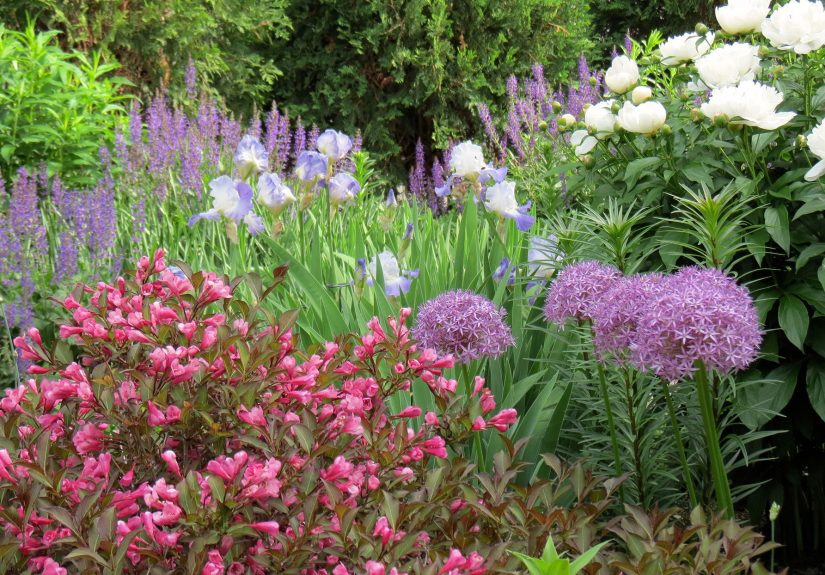
2) Perennial borders: The masterclass in timing
Borders here are all about sequence: early bulbs, mid-season bloomers, late-season standouts, and ornamental grasses that step in
when flowers decide to take a nap. Watch for the garden’s strategy:
- Staggered bloom times so something always carries the scene
- Repeated colors to guide your eye along the path
- Texture changes (fine, medium, bold) to keep it interesting without chaos
3) The Shade Garden: Proof that “shade” isn’t a punishment
Shade gardens are where people either become poets or quit gardening. Here, shade is treated like a design opportunity.
Look for layered plantinggroundcovers, foliage plants, and seasonal bloomersand notice how the palette stays cohesive even when flowers aren’t the star.
If you have shade at home, pay special attention to foliage combinations. Flowers are a moment; foliage is a lifestyle.
4) Rose Garden: The “no drama” approach
Roses can be high-maintenance divas… or they can be chosen for resilience and repeat bloom.
In a test setting, the point is to highlight varieties that perform without constant intervention.
Use this area as a prompt to ask: “What if my garden worked with me instead of against me?”
5) Vegetable and Herb Garden: Raised beds, raised standards
In the sunniest corner, you’ll usually find vegetables and herbs planted in raised beds. This setup is practical for trialing:
it improves soil control, can extend the season, and keeps plantings tidy and accessible.
As you walk, notice spacing and support systems (trellises, cages, stakes). It’s like watching a well-run kitchen line: everything has a place,
and the place is chosen for a reason.
6) Water features and calm corners: The “stay a minute” zones
Many visitors gravitate to the pond/cascade or water-feature areas because water changes everything:
it adds movement, light reflection, and ambient sound that makes the city fade a little.
If you don’t have room for a pond at home, don’t panic. You can borrow the principle without borrowing the plumbing:
a small recirculating fountain, a birdbath placed thoughtfully, or a container water garden can create the same “pause here” effect.
7) Specialty pockets: Conifers, rock gardens, meadows, and “garden rooms”
These smaller areas are where you’ll see the garden’s rangestructural evergreens, drought-tolerant plantings, cutting-friendly beds, and spaces that feel
like outdoor rooms. The takeaway isn’t “copy this exactly.” It’s:
- Pick one “anchor” element (evergreen, shrub mass, or hardscape feature)
- Add seasonal layers (bulbs, annuals, perennials)
- Repeat a few plants to create rhythm instead of randomness
How to Visit Smart When You’ve Only Got Two Hours
The limited visiting window is not a problemit’s a feature. It forces you to experience the garden like a designer:
intentionally, with your eyes open, and without a five-hour meander that ends in “Wait, did I even look at the shrubs?”
A simple 2-hour game plan
- First 15 minutes: Do one full loop without stopping too long. Get the big picture.
- Next 45 minutes: Revisit your top three areas (shade, borders, edible bedswhatever matches your yard).
- Next 30 minutes: Photograph combinations you want to replicate: color pairings, container groupings, edging ideas.
- Final 30 minutes: Look for the “boring” winsmulch depth, pathway width, plant spacing, and how transitions are handled.
What to pay attention to (the details that change your garden at home)
- Plant labels and grouping: Notice which plants are repeated and which are accents.
- Edges: Crisp borders are the secret sauce of “magazine-ready.”
- Height transitions: Tall-to-medium-to-low is your friendno abrupt cliff drops.
- Maintenance signals: Healthier leaves, fewer pest issues, less floppingthese are clues to strong plant choices.
Bonus move: Choose one idea you can actually implement next weekend. Not “rebuild my entire landscape.”
More like “swap in two better-performing perennials and redo my bed edge.” Small wins compound fast in gardening.
How to “Steal” Ideas (Legally) From a Test Garden
The best visitors don’t just take pictures of flowers. They take pictures of systems.
Here’s how to extract practical value from your visitwithout needing a landscape architecture degree or a second mortgage.
Borrow the trial mindset at home
Trial gardens exist for a reason: results beat assumptions. You can apply the same logic in your yard on a smaller scale:
- Pick two or three varieties of a plant you want (say, basil, zinnias, or tomatoes).
- Grow them under the same conditions (same sun, soil, watering pattern).
- Track what matters: disease resistance, bloom length, flavor, sturdiness, and how much babysitting they demand.
That’s not just “gardening.” That’s gardening with receipts.
Use the “backyard zones” idea in any size space
The garden’s greatest trick is making a compact area feel like multiple experiences. You can do that in a small yard by defining zones:
- Welcome zone: One strong container or planting bed that frames your entry.
- Hangout zone: Seating + shade + a focal point (even a small fountain).
- Productive zone: A raised bed or two with herbs and easy vegetables.
- Calm zone: Texture-heavy foliage plants and a simple path for a slow stroll.
Learn the “photo studio” secret
Because the garden is used for photography and content creation, it’s designed to read beautifully on camera. You can mimic that effect at home with:
- Clean sightlines: Keep one viewpoint uncluttered so the eye has a place to land.
- High contrast moments: Dark foliage behind light blooms, or spiky texture beside rounded leaves.
- One statement feature: A trellis, arbor, sculptural pot, or benchsomething that “anchors” a scene.
Make It a Day: Nearby Des Moines Stops That Pair Perfectly
The Test Garden’s visiting hours are short, so it’s smart to build a half-day (or full-day) downtown Des Moines plan around it.
You’ll feel less rushed, and you’ll get more “I’m on a delightful little trip” energy.
Across-the-street art: Pappajohn Sculpture Park
If you like your outdoor experiences with a side of “giant art you can walk around,” this is the obvious companion stop.
It’s a downtown sculpture park with major works on a wide-open lawngreat for a post-garden stroll.
Lunch strategy
Since the garden itself isn’t a full-service venue, treat lunch like part of the plan:
eat before you go, bring something simple, or head to a nearby café afterward. The point is to avoid spending half your garden time
thinking about sandwiches.
If you want more plants after plants (no judgment)
Des Moines has other green spaces and seasonal garden attractions. If you’re the “one more garden!” type, consider adding another horticultural stop
later in the dayespecially if you’re visiting in peak growing season.
Quick FAQ: The Questions Everyone Asks (and You Should Too)
Can I take photos?
Yespersonal photos are typically welcome. But because it’s used for professional shoots and work, commercial photography is generally restricted.
Translation: your “look at these hostas!” photos are fine; your “full wedding party in the rose garden” plan is not.
Can I bring my pet?
Usually only service animals are permitted. If your dog is an emotional support chihuahua with big opinions about perennials,
you’ll need a backup plan.
Are there restrooms?
Plan for nearby public facilities rather than expecting restrooms inside the garden. This is one of those “small detail, huge impact” items.
Is it worth visiting if I’m not a hardcore gardener?
Absolutely. If you’ve ever wanted your outdoor space to feel more welcoming, more colorful, or just more “put together,” you’ll get ideas.
You don’t need to know Latin plant names. You just need eyes, curiosity, and a willingness to say, “Okay, that looks better than what I’m doing.”
Extra: What the Experience Feels Like ( of “You Are Here” Energy)
You step through the gate andalmost immediatelythe city changes volume. Traffic is still out there doing traffic things, but inside the garden,
it becomes background noise, like a TV playing in another room. The air feels a touch cooler in the shade pockets, and warmer in the sunny corners,
and you can tell which direction the day is leaning just by how people gravitate: sun-lovers drifting toward blooms, shade-seekers collecting themselves
under foliage like it’s a personal spa appointment.
The first sensation isn’t “flowers.” It’s order. Paths guide you without bossing you around. Planting beds have that confident, composed look
the kind that makes you suspect someone somewhere has a spreadsheet. (And they probably do, because this is a test garden. Beauty is not an accident here.)
In the courtyard, you’ll notice how the space invites lingering. Benches aren’t shoved to the side like an afterthought; they’re placed like punctuation.
A fountain or central feature gives your eyes a place to return to, which is surprisingly calming when your attention keeps being stolen by a perfect
plant combo. You’ll watch people do the universal gardener move: lean in, squint, and silently mouth, “What is that?” at a plant label.
Then you drift into the borders, and you start to understand the garden’s real superpower: timing. There’s always something carrying the scene.
Early-season color gives way to summer’s louder blooms, and then texturegrasses, seed heads, sturdy foliagesteps in like a reliable friend who shows up
exactly when the party needs snacks. Even if you don’t recognize the plants, you recognize the effect: it’s balanced, layered, and pleasing in a way that
feels effortless (even though you know it’s not).
The shade garden hits differently. It’s quieternot just in sound, but in mood. The light is filtered, softer, and the plants respond with a different kind
of beauty: leaves with sheen, leaves with color, leaves with shapes that make you realize flowers aren’t the only stars. If you’ve ever struggled with shade
at home, this area feels like proof that your yard isn’t “difficult.” It’s just waiting for the right cast of characters.
When you reach the raised beds in the vegetable and herb area, you’ll notice how practical beauty looks. It’s neat without being sterile. Herbs offer that
immediate, sensory rewardbrushing past basil and suddenly remembering what “fresh” actually means. And because trials are part of the garden’s mission, you
get a hint of what’s next: varieties chosen not only for taste or color, but for how they behave when real weather shows up uninvited.
By the time you loop back around, you’ll have two kinds of photos: pretty ones and useful ones. The pretty ones make you happy. The useful ones make you
dangerousin the best waybecause now you can go home and say, “I know what I’m changing in my yard,” with the calm confidence of someone who has
seen the receipts.
And that’s the magic of visiting the Better Homes & Gardens Test Garden®: you leave inspired, yesbut also equipped. It’s not just a lovely stroll.
It’s a shortcut to better decisions, better plant choices, and better outdoor spaces. Plus, you’ll be weirdly proud that you planned your Friday around
a two-hour garden window. Honestly? Iconic behavior.






 Close
Close