
Table of Contents >> Show >> Hide
- What Is Voyager 2?
- The Grand Tour That Almost Sounded Too Good to Be True
- Voyager 2 Mission Timeline
- Jupiter: The First Giant Stop
- Saturn: Rings, Moons, and a Big Decision
- Uranus: The Sideways World
- Neptune: The Spectacular Finale
- Voyager 2 in Interstellar Space
- How NASA Still Talks to Voyager 2
- Powering a Spacecraft for Decades
- The Golden Record: A Message in a Cosmic Bottle
- Why Voyager 2 Still Matters
- Experiences Related to Voyager 2: What This Mission Feels Like From Earth
- Conclusion
Voyager 2 is one of those rare machines that makes the word “historic” feel too small. Launched by NASA on August 20, 1977, this hardy space probe was built for a planetary road trip and somehow turned into a cosmic long-distance champion. It visited Jupiter, Saturn, Uranus, and Neptune, then kept going. Today, it travels through interstellar space, far beyond the protective bubble created by the Sun, still sending scientific data back to Earth like the most dedicated employee in the solar system.
What makes Voyager 2 so fascinating is not only its age, although a spacecraft from the 1970s still working in the 2020s deserves a standing ovation and maybe a tiny gold watch. Its real magic is the way it changed humanity’s view of the outer solar system. Before Voyager 2, Uranus and Neptune were distant blue-green dots in textbooks. After Voyager 2, they became worlds with rings, moons, storms, strange magnetic fields, and personalities of their own.
This article explores the Voyager 2 mission, its discoveries, how it communicates with Earth, why it still matters, and what its journey can teach us about patience, curiosity, and the power of aiming far beyond the obvious.
What Is Voyager 2?
Voyager 2 is an uncrewed NASA spacecraft designed and managed by NASA’s Jet Propulsion Laboratory. It was launched from Cape Canaveral, Florida, aboard a Titan IIIE-Centaur rocket. Although it launched before Voyager 1, its flight path was slower and more flexible, allowing it to continue past Jupiter and Saturn toward Uranus and Neptune.
The probe weighed about 1,592 pounds at launch and carried a suite of scientific instruments for imaging, magnetic field measurements, charged particle detection, plasma studies, radio science, infrared observation, ultraviolet observation, and more. In simple terms, Voyager 2 was not just a camera with ambition. It was a flying laboratory built to inspect worlds that no spacecraft had ever visited up close.
Its original mission was expected to last only a few years. Instead, Voyager 2 has continued operating for decades. That alone is remarkable. Many modern gadgets beg for a software update after two weeks. Voyager 2, meanwhile, has been surviving radiation, extreme cold, aging hardware, and a communication delay measured in hours.
The Grand Tour That Almost Sounded Too Good to Be True
The Voyager mission was made possible by a rare alignment of the outer planets. In the late 1970s, Jupiter, Saturn, Uranus, and Neptune were positioned in a way that allowed a spacecraft to use gravity assists to move from one planet to the next. This alignment occurs only about every 176 years, so NASA had a narrow cosmic opportunity.
How Gravity Assist Worked
A gravity assist is often described as a slingshot maneuver, but no actual giant rubber band was involved, which is probably for the best. As Voyager 2 approached a planet, the planet’s gravity changed the spacecraft’s speed and direction. Mission planners used this technique to send the probe onward without requiring enormous amounts of fuel.
This was the genius of the mission. Voyager 2 did not simply fly past planets by luck. It followed a carefully calculated path, using each encounter to set up the next one. Jupiter helped send it to Saturn. Saturn helped set up the possibility of Uranus. Uranus helped direct it toward Neptune. Each success made the next success possible.
Voyager 2 Mission Timeline
| Year | Event | Why It Mattered |
|---|---|---|
| 1977 | Voyager 2 launched | NASA began one of the most successful deep-space missions in history. |
| 1979 | Jupiter flyby | The probe studied Jupiter, its rings, and its complex system of moons. |
| 1981 | Saturn flyby | Voyager 2 observed Saturn’s atmosphere, rings, and moons in extraordinary detail. |
| 1986 | Uranus flyby | It became the first spacecraft to visit Uranus and remains the only one to do so. |
| 1989 | Neptune flyby | It became the first and only spacecraft to visit Neptune up close. |
| 2018 | Entered interstellar space | Voyager 2 crossed beyond the heliopause, the edge of the Sun’s protective bubble. |
Jupiter: The First Giant Stop
Voyager 2 reached Jupiter in July 1979. Jupiter was already known as the largest planet in the solar system, but Voyager 2 helped reveal it as a dynamic system rather than a simple gas giant. The spacecraft studied Jupiter’s atmosphere, rings, and moons, returning thousands of images and measurements.
One of the mission’s important contributions was expanding knowledge of Jupiter’s moon system. Voyager 2 discovered a 14th moon at Jupiter and helped scientists better understand the dramatic activity around the Jovian system. The Voyager missions also showed that Jupiter’s moon Io was volcanically active, turning what had once seemed like a frozen moon into one of the most geologically exciting places in the solar system.
Jupiter also gave Voyager 2 the gravitational boost it needed to continue toward Saturn. In storytelling terms, Jupiter was the mission’s first major chapter. In engineering terms, it was a crucial launchpad hidden inside a flyby.
Saturn: Rings, Moons, and a Big Decision
Voyager 2 reached Saturn in August 1981. The ringed planet was already famous for its beauty, but Voyager 2 showed that Saturn’s rings were not smooth, simple bands. They were complex structures shaped by gravity, motion, and small moons. The spacecraft captured images of ring features and observed shepherd moons such as Prometheus and Pandora, which help shape Saturn’s F ring.
Saturn was also a turning point for the mission. After the flyby, mission planners chose a path that would send Voyager 2 onward to Uranus and eventually Neptune. That decision gave up the possibility of certain closer studies of Saturn’s moon Titan, but it preserved the chance to complete the full Grand Tour of the four giant planets.
It was a bold choice, and it paid off beautifully. Without that decision, humanity might still be waiting for its first close look at Uranus and Neptune.
Uranus: The Sideways World
Voyager 2 flew past Uranus on January 24, 1986. This was the first close encounter with the ice giant, and no spacecraft has returned since. Uranus is famous for rotating almost on its side, but Voyager 2 revealed that the planet was even stranger than expected.
At Uranus, Voyager 2 discovered 10 new moons and two new rings. It also measured an unusual magnetic field that appeared tilted and offset from the planet’s center. For decades, Uranus was treated as one of the solar system’s great oddballs, a planet whose magnetosphere seemed to behave in ways that puzzled scientists.
Recent analysis of Voyager 2 data has added a fascinating twist. Researchers found that the spacecraft may have observed Uranus during an unusual solar wind event that compressed the planet’s magnetosphere. That means Voyager 2’s single flyby may have captured Uranus in a rare state, not its everyday behavior. In other words, the spacecraft may have visited Uranus on a very weird day. Space science: occasionally like meeting someone for the first time when they have just spilled coffee on themselves.
Neptune: The Spectacular Finale
Voyager 2 reached Neptune on August 25, 1989. This encounter marked the end of the planetary Grand Tour and remains the only close spacecraft visit to Neptune. The flyby transformed Neptune from a distant blue point into a real world with storms, rings, moons, and atmospheric drama.
The spacecraft discovered the Great Dark Spot, a massive storm system in Neptune’s atmosphere. It also found new moons and confirmed rings around the planet. Neptune’s moon Triton was especially intriguing. Voyager 2 observed signs of active geyser-like eruptions, making Triton one of the most interesting icy bodies in the outer solar system.
After Neptune, Voyager 2 had no more planets to visit. But the mission did not end. It entered a new phase: the Voyager Interstellar Mission.
Voyager 2 in Interstellar Space
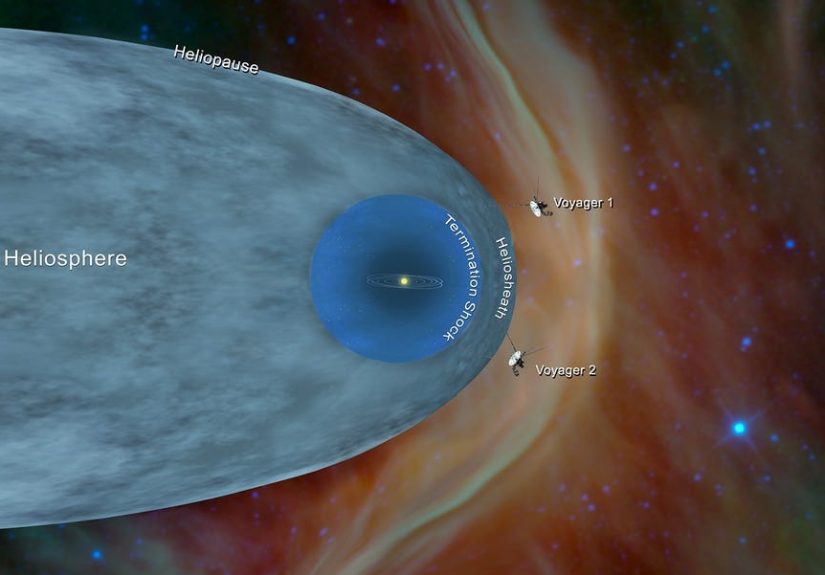
In 2018, NASA announced that Voyager 2 had crossed the heliopause, the boundary where the solar wind gives way to the interstellar medium. This made Voyager 2 the second human-made object to enter interstellar space, after Voyager 1.
It is important to be precise here. Voyager 2 has left the heliosphere, but it has not truly left the solar system if the solar system is defined by the Sun’s gravitational reach. The distant Oort Cloud, a vast region of icy objects, lies far beyond the planets and remains under the Sun’s influence. Voyager 2 will not pass through that region for a very long time.
Still, crossing the heliopause is a major scientific milestone. Voyager 2 is now sampling particles, magnetic fields, and plasma waves in a region no spacecraft mission was originally designed to explore for this long. Its data helps scientists understand how the Sun interacts with the space between stars.
How NASA Still Talks to Voyager 2
Communicating with Voyager 2 is one of the most impressive parts of the mission. NASA uses the Deep Space Network, a global system of giant radio antennas located in California, Spain, and Australia. Because Earth rotates, the network’s locations allow distant spacecraft to stay in contact with at least one station as the planet turns.
The signal from Voyager 2 is incredibly faint by the time it reaches Earth. Commands sent from Earth also take many hours to arrive. In 2023, after an accidental command briefly tilted Voyager 2’s antenna away from Earth, NASA restored communication by sending a powerful command from the Canberra Deep Space Network facility. At that time, the one-way light time was about 18.5 hours, meaning the team had to wait roughly 37 hours to know whether the command worked.
That story captures the patience required for deep-space exploration. There is no “refresh page” button for a spacecraft billions of miles away. You send a command, wait, drink coffee, try not to stare at the clock, and hope a 1970s robot is still listening.
Powering a Spacecraft for Decades
Voyager 2 is powered by radioisotope thermoelectric generators, often called RTGs. These devices convert heat from the decay of plutonium-238 into electricity. RTGs are useful in deep space because sunlight becomes too weak for solar panels to provide enough power at such enormous distances from the Sun.
However, the available power slowly decreases over time. To keep the spacecraft alive, engineers have gradually turned off instruments and heaters. As of NASA’s April 2026 status update, Voyager 2 still had several science instruments operating, including the cosmic ray subsystem, magnetometer, and plasma wave subsystem. Other instruments, including cameras and some particle or plasma instruments, have been shut down to save power.
This makes every remaining measurement precious. Voyager 2 is no longer a young explorer racing from planet to planet. It is more like an elderly scientist in a very cold library, still taking notes because the universe is not finished being interesting.
The Golden Record: A Message in a Cosmic Bottle
Both Voyager spacecraft carry a Golden Record, a gold-plated phonograph record created as a message from Earth. The record includes images, natural sounds, music from different cultures, spoken greetings in 55 languages, and messages from leaders of the time.
The Golden Record was not designed as a serious attempt at quick alien communication. Space is too vast, and the chance of discovery is extremely small. But symbolically, it is one of the most poetic objects humanity has ever made. It says: Here we are. We make music. We hear thunder. We greet strangers. We wonder who else is out there.
In that sense, Voyager 2 is not only a scientific mission. It is a cultural artifact. It carries instruments for measuring cosmic rays and magnetic fields, but it also carries evidence that humans care about beauty, memory, and connection.
Why Voyager 2 Still Matters
Voyager 2 matters because it remains the only spacecraft to visit Uranus and Neptune. Everything it saw at those planets still shapes modern planetary science. When scientists discuss future missions to the ice giants, Voyager 2’s data is the foundation they keep returning to.
It also matters because it proves the value of durable engineering. The spacecraft was built with technology that looks ancient by modern standards, yet it has outlived generations of computers, phones, cars, and operating systems. Its success came from careful design, redundancy, smart mission planning, and the ability of engineers to solve problems creatively across impossible distances.
Finally, Voyager 2 matters because it gives humanity direct information from beyond the heliosphere. We cannot send astronauts there. We cannot place a laboratory on the edge of interstellar space. But Voyager 2 is there, quietly measuring conditions in a region where the Sun’s influence fades and the galaxy begins to feel closer.
Experiences Related to Voyager 2: What This Mission Feels Like From Earth
Following Voyager 2 is a different kind of space experience. It is not like watching a rocket launch, where everything happens in fire, smoke, countdowns, and cheering crowds. Voyager 2 asks for a slower kind of attention. Its story unfolds over decades, not minutes. To appreciate it, you have to become comfortable with patience, distance, and delayed wonder.
One meaningful experience connected to Voyager 2 is looking at the night sky and realizing that the spacecraft is out there in a direction you cannot easily point to, traveling through darkness with no dramatic engine burn and no bright trail. It is not visible through a backyard telescope. It does not put on a show. Yet the knowledge that it exists changes the feeling of the sky. The stars become less like decoration and more like geography.
Another experience is reading about the Neptune flyby and remembering that humanity has still visited Neptune only once. That fact can feel surprising in an age of Mars rovers, space telescopes, reusable rockets, and high-resolution images of distant galaxies. Voyager 2’s Neptune encounter reminds us that exploration is not evenly distributed. Some places get repeated attention; others receive one unforgettable visit and then decades of silence. It makes those 1989 images feel almost sacred, like postcards from a place we barely know.
Voyager 2 also creates an emotional experience around engineering. Most people do not get sentimental about antennas, gyroscopes, or power budgets. But with Voyager 2, those details become strangely moving. A tiny adjustment, a faint carrier signal, or a command traveling for more than 18 hours can decide whether the mission continues. The spacecraft turns technical maintenance into a story of care. Engineers are not just operating hardware; they are nursing a historic explorer across interstellar space.
For students, writers, scientists, and curious readers, Voyager 2 offers a useful personal lesson: big achievements often come from extending the mission after the original goal is complete. Voyager 2 could have been remembered as a successful Jupiter and Saturn probe. Instead, because planners preserved options and kept solving problems, it became the only spacecraft to visit Uranus and Neptune, then an interstellar messenger. That is a powerful model for creative work, education, business, and life. Finish the assignment, yes, but stay alert for the larger journey hiding behind it.
There is also a humbling experience in comparing Voyager 2’s age with human lives. People who watched its launch as children are now grandparents. Scientists who began their careers with Voyager data have trained new generations of researchers. The spacecraft has become a bridge across time. It connects 1977 optimism, 1980s planetary discovery, 21st-century interstellar science, and future centuries when it will continue drifting silently through the galaxy.
In a noisy world, Voyager 2 teaches a quiet kind of ambition. It does not trend, shout, or hurry. It simply keeps going.
Conclusion
Voyager 2 is one of humanity’s greatest exploration stories. It began as a mission to study the outer planets and became a symbol of scientific endurance. It gave us close-up views of Jupiter, Saturn, Uranus, and Neptune; revealed moons, rings, storms, and magnetic mysteries; crossed into interstellar space; and continues to send data across billions of miles.
The spacecraft is aging, and its remaining power is limited. Eventually, Voyager 2 will fall silent. But silence will not erase what it achieved. Long after its final signal, it will keep traveling, carrying the Golden Record and the memory of a species that dared to send a small machine into the dark just to learn what was there.







 Close
Close