Table of Contents >> Show >> Hide
- Why Yoga Works So Well for Legs (It’s Not Magic, It’s Mechanics)
- Before You Start: 60 Seconds of Setup That Saves Your Knees
- The 7 Best Yoga Poses for Stronger, More Flexible Legs
- 1) Chair Pose (Utkatasana) Quad & Glute Toning
- 2) Warrior II (Virabhadrasana II) Endurance + Hip Stability
- 3) Crescent Lunge / High Lunge Hip Flexors, Quads, and “Leg Day” Energy
- 4) Extended Triangle (Utthita Trikonasana) Hamstrings + Inner Thigh Strength
- 5) Half Moon (Ardha Chandrasana) Outer Hip Strength + Balance
- 6) Low Lunge (Anjaneyasana) Hip Flexor Release + Front-Leg Strength
- 7) Bridge Pose (Setu Bandha Sarvangasana) Glutes, Hamstrings, and Stronger Hips
- A Simple 10-Minute “Yoga for Legs” Flow (No Guessing)
- How to Know It’s Working (Beyond “My Legs Are Shaking”)
- Conclusion: Strong Legs, Flexible Hips, Happier Movement
- Real-World Experiences: What Practicing Yoga for Legs Often Feels Like (500+ Words)
If you want legs that feel strong on stairs, steady on trails, and less cranky after sitting all day, yoga is a sneaky-good solution. It’s not “just stretching.” Done with intention, yoga trains your legs to produce force (strength), control force (stability), and absorb force (mobility and resilience). And yes: your thighs may file a formal complaint the first time you hold Chair Pose.
Below are seven classic poses that target the big leg playersquads, hamstrings, glutes, calves, and hip stabilizersplus the often-forgotten MVPs: ankles and inner thighs. You’ll get clear cues, common mistakes to avoid, and options for beginners and “I lift but my hips are tight” folks alike.
Quick note: This article is for general education, not medical advice. If you have pain, recent surgery, or a condition like uncontrolled blood pressure, talk with a qualified clinician before pushing your range.
Why Yoga Works So Well for Legs (It’s Not Magic, It’s Mechanics)
Most “leg workouts” live in two extremes: heavy strength training (great, but not everyone has the setup) or endless cardio (also great, but doesn’t fix stiffness). Yoga sits in the middle. It uses isometric strength (holding shapes), eccentric control (slow lowering and stabilizing), and active flexibility (lengthening muscles while they’re engaged). That combo is what helps your legs feel toned and capable, not just tired.
You’ll also practice alignmentlike stacking the knee over the ankle in lunges and Warriorswhich teaches your body to distribute load through the whole leg instead of dumping it into one angry knee or a grumpy lower back.
Before You Start: 60 Seconds of Setup That Saves Your Knees
- Warm up first: 3–5 slow rounds of easy Sun Salutation movements or a brisk walk around your home. Cold stretching is overrated.
- Knee rule of thumb: In standing poses, aim to keep the front knee aligned over the ankle and tracking toward the middle toes (not collapsing inward).
- Use props like a pro: Blocks, a chair, or a wall aren’t “cheating.” They’re training wheels that still get you strong.
- Breathing test: If you can’t breathe smoothly through your nose, back off the depth. Your legs learn better when you’re not panicking.
The 7 Best Yoga Poses for Stronger, More Flexible Legs
1) Chair Pose (Utkatasana) Quad & Glute Toning
Chair Pose is basically a squat that went to finishing school. It builds heat in your quads and glutes while training ankle and knee stability. If you want “toned legs,” this is one of yoga’s most direct answersbecause your thighs are working the entire time.
How to do it:
- Stand tall with feet hip-width apart. Reach your arms overhead.
- Bend your knees and sit your hips back as if lowering into an invisible chair.
- Keep your chest long (not collapsing) and your weight grounded through the whole foot.
- Hold 5–8 breaths. Work up to 30–60 seconds.
Make it friendlier: Put your back against a wall and slide down slightly. Or hold a block between your thighs to help inner-thigh engagement.
Common mistake: Knees collapsing inward. Think “knees track toward the pinky-toe side” without rolling onto the outer feet.
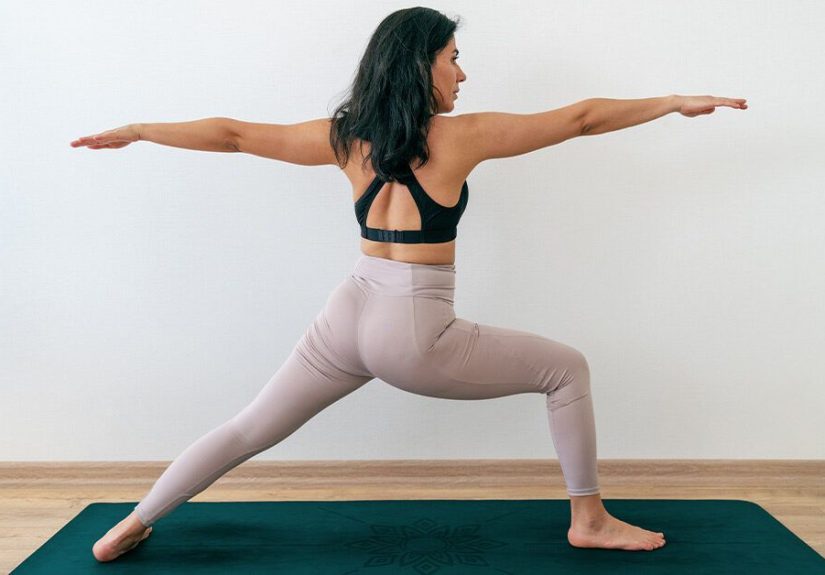
2) Warrior II (Virabhadrasana II) Endurance + Hip Stability
Warrior II builds stamina in the bent front leg (quads, glutes, inner thigh) while stretching the back leg’s calf and hamstrings. It also teaches you to stabilize the pelvis and resist the knee collapsing inwardan underrated skill for running, hiking, and everyday walking.
How to do it:
- Step into a wide stance. Turn your front foot out; angle the back foot slightly in.
- Bend the front knee and stack it over the ankle (don’t force a perfect 90-degree angle).
- Stretch arms long, gaze over the front hand, and press into the outer edge of the back foot.
- Hold 5–10 breaths each side.
Make it friendlier: Shorten the stance or reduce the knee bend. You’ll still get strongjust with fewer dramatic sound effects from your thighs.
Common mistake: Front knee drifting inward. Gently guide it to track in line with your toes.
3) Crescent Lunge / High Lunge Hip Flexors, Quads, and “Leg Day” Energy
High Lunge is where yoga quietly turns into leg training. Your front leg works like a lunge, your back leg fires up to stabilize, and your hip flexors get a real stretchespecially if you spend a lot of time sitting.
How to do it:
- From standing, step one foot back and come onto the ball of the back foot (heel lifted).
- Bend the front knee so it stacks over the ankle, and square your hips forward.
- Lift your chest; reach arms overhead or keep hands on hips for balance.
- Hold 5–8 breaths each side.
Make it friendlier: Keep hands on hips, widen your stance a bit, or bend the back knee slightly.
Make it spicier: Sink a little deeper (without letting the front knee shoot forward) or add a slow pulse for 3–5 breaths.
Common mistake: Overarching the lower back. Think “tailbone heavy, ribs knit in” so the stretch hits the hip flexors, not your spine.
4) Extended Triangle (Utthita Trikonasana) Hamstrings + Inner Thigh Strength
Triangle looks calm, but it’s a full leg lesson: the front leg’s hamstrings and calves lengthen while the quads engage, and the back leg works to stabilize. It also improves balance and body awareness, which matters more than you think once you hit an uneven sidewalk.
How to do it:
- From a wide stance, turn the front foot out and the back foot slightly in.
- Reach forward over the front leg, then tip at the hip and bring your hand to your shin or a block.
- Rotate the chest open; extend the top arm upward.
- Hold 5–8 breaths each side.
Make it friendlier: Use a block, or place your hand on a chair seat for more space and control.
Common mistake: Rounding the spine to “touch the floor.” Touching the floor is not a personality trait. Prioritize length and alignment.
5) Half Moon (Ardha Chandrasana) Outer Hip Strength + Balance
Half Moon is a leg toner disguised as a balance pose. Your standing leg’s outer hip (glute med) and ankle stabilizers work overtime, which is exactly what helps your knees and hips feel more supported in real life.
How to do it:
- Start from Triangle with your front foot forward.
- Bend the front knee slightly and shift weight forward.
- Place the bottom hand on the floor or a block under the shoulder; lift the back leg to hip height.
- Open the chest; reach the top arm up. Keep a micro-bend in the standing knee.
- Hold 3–6 breaths each side (quality over chaos).
Make it friendlier: Use a block on its highest setting, or do it with your hand/forearm supported on a chair seat.
Common mistake: Locking the standing knee. A soft knee helps your muscles stabilize instead of jamming the joint.
6) Low Lunge (Anjaneyasana) Hip Flexor Release + Front-Leg Strength
Low Lunge is your “I sit too much” antidote. It stretches the front of the back hip and thigh while training control and stability in the front leg. It’s also a great place to practice knee alignment without the balance demands of High Lunge.
How to do it:
- Step the right foot forward and lower the left knee down (pad it with a blanket if needed).
- Align the front knee over the heel, then slide the back knee slightly until you feel a comfortable front-hip stretch.
- Lift the torso; reach arms overhead or keep hands on the front thigh for support.
- Hold 5–8 breaths each side.
Make it friendlier: Keep hands on blocks, or reduce the back-knee slide so the stretch stays mild.
Common mistake: Letting the front knee drift way past the ankle. Adjust your stance so the shin stays more vertical.
7) Bridge Pose (Setu Bandha Sarvangasana) Glutes, Hamstrings, and Stronger Hips
Bridge Pose strengthens the posterior chainglutes and hamstringswhile opening the front of the hips. If your legs feel “strong but tight,” Bridge helps you build strength where many people are underpowered: the back of the body.
How to do it:
- Lie on your back, bend knees, and place feet hip-width apart.
- Press into your feet evenly and lift the hips up. Think of rolling up one vertebra at a time.
- Keep knees tracking forward (not splaying out) and breathe.
- Hold 5–10 breaths, then lower slowly.
Make it friendlier: Place a block under the sacrum for a supported version (restorative). Or lift less high.
Make it stronger: Hold 30–45 seconds, or try marching the feet one at a time (only if your pelvis stays level).
Common mistake: Over-compressing the lower back by lifting too high. Aim for length through the front body, not maximum height.
A Simple 10-Minute “Yoga for Legs” Flow (No Guessing)
Do this sequence 2–4 times per week. Rest 1–2 breaths between shapes if needed.
- Chair Pose 30–45 seconds
- Warrior II 6–8 breaths each side
- High Lunge 6 breaths each side
- Triangle 6 breaths each side
- Half Moon 3–5 breaths each side (use a block)
- Low Lunge 6–8 breaths each side
- Bridge Pose 2 rounds of 5–10 breaths
- Downward-Facing Dog 6–10 breaths to finish (optional, but lovely)
Want to progress without overthinking it? Add one breath to each hold every week. Tiny changes stack up fastkind of like laundry and emails, but in a good way.
How to Know It’s Working (Beyond “My Legs Are Shaking”)
- Strength: You can hold Warrior II and Chair without your chest collapsing or your knee wobbling inward.
- Flexibility: Hamstrings feel less “guitar-string tight,” especially in Triangle and Down Dog.
- Stability: Half Moon becomes less of a circus act and more of a controlled balancing challenge.
- Daily-life wins: Stairs feel easier, your stride feels smoother, and standing for long periods feels less tiring.
Conclusion: Strong Legs, Flexible Hips, Happier Movement
Yoga for legs isn’t about chasing a burn for bragging rightsthough you will absolutely feel it. It’s about building legs that are strong and stable, while giving your joints the mobility they need to move well for years. If you practice these seven poses consistently, you’ll train your lower body in a way that supports real life: walking, running, lifting, playing, and getting up off the floor without negotiating with your hamstrings.
Start where you are, use props like a strategist, and keep your breath smooth. Your legs will get strongerand you’ll stay flexible enough to tie your shoes without turning it into a full event.
Real-World Experiences: What Practicing Yoga for Legs Often Feels Like (500+ Words)
The first thing many people notice when they start doing “legs-focused yoga” is how different it feels from traditional gym leg day. There’s less external load (no barbells), but way more time under tension. That means your legs can get tired in a sneaky, slow-cooking way. The classic example: Chair Pose looks harmless for about three breathsthen your quads suddenly remember every time you’ve ever taken an elevator.
In week one, the most common experience is shaking. Not the “I’m weak” kindmore the “my stabilizer muscles are clocking in” kind. In Warrior II and High Lunge, that shake often shows up around the front knee and ankle as your body learns how to stack joints and distribute force. In Half Moon, the wobble is practically a rite of passage. Many beginners assume balance is a talent you either have or don’t have. In reality, balance is a skill that improves when your feet, ankles, and outer hips get strongerand when your brain stops trying to multitask mid-pose.
Somewhere around weeks two to four, people often report a shift from “surviving poses” to “feeling muscles work on purpose.” Chair Pose starts to feel like glutes and thighs are cooperating instead of arguing. High Lunge stops being a frantic attempt not to topple, and becomes a clear sensation of strength in the front leg with a stretch across the back hip flexor. This is also when many people notice their walking stride feels smoother, because the hips are moving with more freedom and the ankles are stabilizing better on uneven ground.
Flexibility changes can be surprisingly specific. Hamstrings may still feel tight in Down Dog, but instead of a sharp tug, it becomes a manageable stretch. Triangle often becomes the “aha” pose: when you stop rounding your back to reach the floor and start using a block, the hamstring stretch deepens while your spine stays long. Many people are shocked by thisusing a block can actually make you feel more stretch, not less, because you’re no longer cheating the pose by collapsing into it.
Another common experience: hip flexors talking back. If you sit a lot, Low Lunge and High Lunge can feel intense in the front of the back hip. The best real-world strategy is consistency plus honesty. “A little stretch, no pain” beats forcing depth once a week. People who practice lunges gently but regularly often notice they can stand taller and extend the back leg more comfortably when walking fast, climbing stairs, or running.
By weeks four to eight, the biggest payoff tends to be stability. Not glamorous, but powerful. One-leg balance improves, knees track more cleanly in lunges, and hips feel more supportedespecially in daily movements like stepping off a curb or turning quickly. That’s when yoga becomes more than “exercise” and starts to feel like movement insurance. Your legs are still working hard, but the work feels organized: muscles engage, joints feel steadier, and recovery is faster.
If there’s one universal lesson people learn, it’s this: progress rarely looks like doing deeper poses. It looks like doing the same pose with a calmer breath, steadier alignment, and less drama in the joints. And honestly? That’s a glow-up your legs can use everywhere, not just on a yoga mat.