
Table of Contents >> Show >> Hide
- Why Yoga Can Help IBS (Even If Your Gut Is Stubborn)
- IBS-Friendly Yoga Safety Rules (So You Don’t Regret This)
- The Best Yoga Poses for IBS
- 1) Child’s Pose (Balasana)
- 2) Cat–Cow (Marjaryasana–Bitilasana)
- 3) Sphinx Pose (Salamba Bhujangasana)
- 4) Knees-to-Chest (Apanasana)
- 5) Supine Twist (Supta Matsyendrasana)
- 6) Reclining Bound Angle (Supta Baddha Konasana)
- 7) Legs Up the Wall (Viparita Karani)
- 8) Supported Bridge (Setu Bandha Sarvangasana, restorative version)
- 9) Seated Forward Fold (Paschimottanasana, gentle)
- 10) Happy Baby (Ananda Balasana)
- 11) Wind-Relieving Pose (Pavanamuktasana, one leg at a time)
- 12) Supported Squat (Malasana, optional and modified)
- Simple IBS Yoga Sequences (Pick the One That Matches Your Day)
- Breathing for IBS: The Secret Sauce Most People Skip
- When Yoga Isn’t Enough (And That’s Not Your Fault)
- Real-Life IBS + Yoga Experiences (Common Patterns People Notice)
- Wrap-Up: The Best Yoga for IBS Is Gentle, Consistent, and Yours
If you have IBS, you already know your gut can be a tiny drama club: it reacts to stress, reacts to food, reacts to
weather, reacts to that one email you opened at 10:59 p.m. While yoga won’t “cure” IBS, a smart, gentle practice can
be a surprisingly helpful sidekickespecially when symptoms are tied to tension, shallow breathing, and a nervous
system stuck in high-alert mode.
This guide breaks down the best yoga poses for IBS, why they may help, and how to practice safely whether you’re
dealing with IBS-C (constipation), IBS-D (diarrhea), IBS-M (mixed), or just “IBS-why-is-my-stomach-like-this.”
Expect practical cues, modifications, and simple sequences you can repeat on your best days and your “cancel all plans”
days.
Why Yoga Can Help IBS (Even If Your Gut Is Stubborn)
IBS is considered a disorder of gut-brain interaction. Translation: your digestive system and nervous system talk
constantly, and sometimes they text in all caps. Stress and anxiety can increase gut sensitivity, change motility
(how fast things move), and make bloating and cramping feel more intense. Yoga targets this connection in a few
down-to-earth ways:
- Breath shifts your nervous system: Slow, diaphragmatic breathing nudges the body toward a calmer “rest-and-digest” state.
- Gentle movement supports motility: Easy spinal flexion/extension and mild twists can encourage comfortable movement in the abdomenwithout jarring impact.
- Muscle relaxation reduces guarding: Many people with IBS unconsciously brace the belly. Softening helps reduce that clenched “protective” posture.
- Mindfulness lowers symptom amplification: Paying attention without panic can reduce the stress spiral that makes sensations louder.
Important note: yoga should be supportive, not another thing your body has to “power through.” If a pose increases
pain, pressure, reflux, nausea, or urgencyskip it. The best pose for IBS is the one that doesn’t pick a fight with
your digestive system.
IBS-Friendly Yoga Safety Rules (So You Don’t Regret This)
- Practice gently, especially during flares. Think “restore and soothe,” not “new personal record.”
- Avoid deep twists after meals. Give yourself 1–2 hours after eating (longer if you’re sensitive).
- Keep the belly soft. If you’re clenching, you’re not helping digestionyou’re auditioning for a statue.
- Support is smart. Blocks, bolsters, pillows, and folded blankets are not “cheating.” They’re IBS-proofing.
- Skip strong core work in a flare. Aggressive boat pose is not the hero your gut needs today.
- Talk to your clinician first if you’re pregnant, have recent abdominal surgery, hernias, severe reflux, inflammatory bowel disease, or unexplained weight loss, bleeding, or fever.
The Best Yoga Poses for IBS
These poses focus on gentle compression/relaxation, spinal mobility, and nervous-system settling. Do them in a calm
space, breathe slowly, and use props generously.
1) Child’s Pose (Balasana)
Why it helps: A classic “exhale and unclench” posture. It relaxes the abdominal wall and encourages
slower breathinghelpful for stress-triggered cramping and bloating.
How to do it: Kneel, big toes touch, knees apart (wider can feel better for the belly). Fold forward,
forehead on mat or pillow, arms forward or by your sides. Breathe slowly for 1–3 minutes.
IBS tip: If pressure feels uncomfortable, place a bolster/pillow under your chest so your belly isn’t
compressed.
2) Cat–Cow (Marjaryasana–Bitilasana)
Why it helps: Gentle spinal movement can ease tension around the rib cage and abdomen. It’s also a
friendly way to coordinate breath with motioncalming and regulating.
How to do it: On hands and knees, inhale as you arch (cow), exhale as you round (cat). Move slowly for
8–12 rounds.
IBS tip: Keep the movement small. Think “massage,” not “gymnastics.”
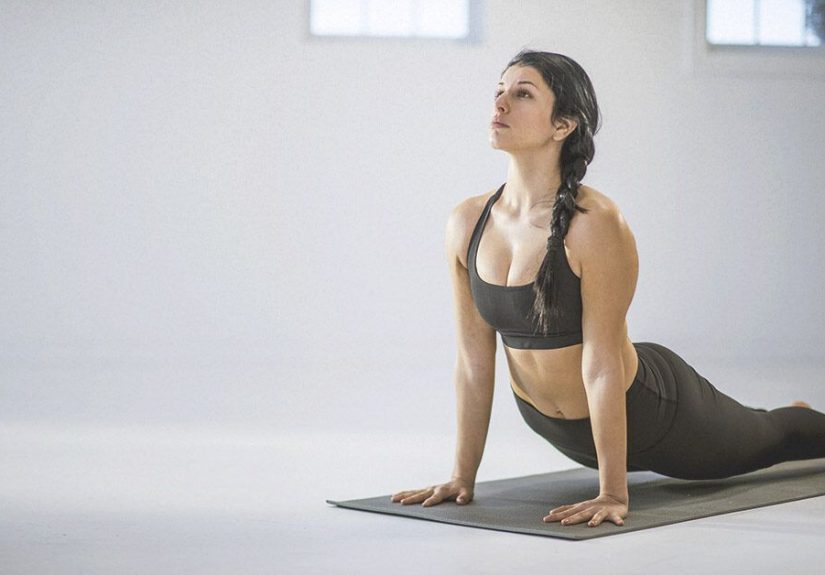
3) Sphinx Pose (Salamba Bhujangasana)
Why it helps: A mild backbend can open the front body and support easier breathing. Some people with
IBS-C find gentle backbends help them feel less “stuck.”
How to do it: Lie on your belly, elbows under shoulders, forearms down. Lift your chest slightly and
relax your glutes. Breathe for 30–60 seconds.
IBS tip: If reflux is an issue, keep this very mildor skip it on reflux-heavy days.
4) Knees-to-Chest (Apanasana)
Why it helps: Often called a “wind-relieving” shape for a reason. Gentle compression may help gas move
along more comfortably.
How to do it: Lie on your back, hug knees in. Rock side to side or stay still for 30–90 seconds.
IBS tip: If cramping is intense, hold behind the thighs instead of pulling the knees tightly.
5) Supine Twist (Supta Matsyendrasana)
Why it helps: A gentle twist can reduce low-back tension and encourage a feeling of abdominal release.
It’s also deeply calming when done slowly.
How to do it: Lying on your back, bring knees toward chest, then let them drop to one side. Extend arms
like a “T,” turn your head gently the opposite way if comfortable. Hold 30–60 seconds each side.
IBS tip: Keep knees supported on a pillow/blanket to avoid a deep twist. Less twist, more chill.
6) Reclining Bound Angle (Supta Baddha Konasana)
Why it helps: This is a “permission to relax” pose. It opens the hips and encourages diaphragmatic
breathinguseful when stress tightens your midsection.
How to do it: Lie back, soles of feet together, knees fall open. Support knees with pillows. Stay 2–5 minutes.
IBS tip: Place one hand on chest and one on belly. Let the belly rise on inhale and soften on exhale.
7) Legs Up the Wall (Viparita Karani)
Why it helps: A restorative inversion that can lower stress and help with fatigue. Many people find it
soothing when their gut feels overreactive.
How to do it: Sit beside a wall, swing legs up, lie back. Scoot hips a few inches away from the wall if
hamstrings are tight. Stay 3–10 minutes.
IBS tip: If you feel pressure or reflux, keep your head and chest slightly elevated with a folded blanket.
8) Supported Bridge (Setu Bandha Sarvangasana, restorative version)
Why it helps: A gentle backbend that opens the front body without strain. The supported version is
calm, stable, and breath-friendly.
How to do it: Lie on your back, knees bent, feet hip-width. Lift hips and place a block or firm pillow
under the sacrum (not the low back). Rest 1–3 minutes.
IBS tip: If you feel abdominal pulling, lower the height or skip. Comfort first.
9) Seated Forward Fold (Paschimottanasana, gentle)
Why it helps: A slow forward fold can soothe the nervous system and stretch the back body. It’s more
about quieting the mind than touching your toes.
How to do it: Sit with legs extended (or knees bent). Hinge forward slightly with a long spine.
Support your torso on a pillow stacked on your thighs. Breathe 1–2 minutes.
IBS tip: During bloating, keep this mild and supported to avoid uncomfortable compression.
10) Happy Baby (Ananda Balasana)
Why it helps: Opens hips and gently lengthens the low back. Some people find it helps release tension
that contributes to pelvic floor tightness (which can matter for constipation patterns).
How to do it: On your back, grab feet or shins, knees toward armpits. Keep the tailbone heavy.
Hold 30–60 seconds.
IBS tip: If gripping feet feels too intense, hold behind thighs and keep the pose smaller.
11) Wind-Relieving Pose (Pavanamuktasana, one leg at a time)
Why it helps: One-leg-at-a-time compression can be gentler than hugging both knees, especially if you’re crampy.
How to do it: Hug right knee in while left leg extends on the floor. Breathe 5–8 slow breaths. Switch sides.
IBS tip: Exhale longer than you inhale. That longer exhale is like telling your nervous system, “We’re safe.”
12) Supported Squat (Malasana, optional and modified)
Why it helps: A supported squat can relax the pelvic floor and may feel helpful for some people with IBS-C.
For others (especially with urgency), it’s a “no thanks.” Your call.
How to do it: Stand with feet a bit wider than hips, turn toes out slightly, lower into a squat and sit on a
block/stacked books (support is key). Keep chest lifted. Stay 20–40 seconds.
IBS tip: If you feel urgency, pressure, or discomfort, skip it and choose a restorative pose instead.
Simple IBS Yoga Sequences (Pick the One That Matches Your Day)
10-Minute “Bloating & Gas Reset”
- Child’s Pose – 1 minute (supported if needed)
- Cat–Cow – 10 slow rounds
- Knees-to-Chest – 1 minute
- Supine Twist – 45 seconds each side (supported)
- Legs Up the Wall – 3–5 minutes
12-Minute “IBS-C Gentle Motility Flow”
- Cat–Cow – 12 rounds
- Sphinx – 45 seconds
- Supported Bridge – 2 minutes
- Happy Baby – 45 seconds
- Wind-Relieving (one leg at a time) – 5 breaths each side, repeat once
- Legs Up the Wall – 3 minutes
8-Minute “IBS-D Calm-Down Practice”
- Reclining Bound Angle (supported) – 3 minutes
- Supine Twist (very gentle) – 45 seconds each side
- Child’s Pose (supported) – 2 minutes
- Easy breathing lying down – 1 minute (slow exhale)
Breathing for IBS: The Secret Sauce Most People Skip
Poses are helpful, but breathing is often the main event for IBSbecause it directly influences stress physiology.
Try this simple approach in any comfortable position:
- Inhale through the nose for 4 seconds (let your belly expand gently).
- Exhale through the nose for 6 seconds (let the belly soften; don’t force it in).
- Repeat for 2–5 minutes.
If you’re new to yoga, starting with breathing and one restorative pose can be more effective than a longer session
that accidentally turns into a stressor. With IBS, the goal is consistency and calmnot intensity.
When Yoga Isn’t Enough (And That’s Not Your Fault)
IBS management often works best as a toolbox: nutrition strategies (like identifying trigger foods), medical guidance,
sleep support, movement, and mind-body techniques. Yoga fits beautifully into that “mind-body + gentle movement” lane,
but it isn’t a substitute for evaluation or treatment.
Check in with a healthcare professional if you have severe or worsening symptoms, blood in stool, fever, unexplained
weight loss, persistent nighttime symptoms, or a big change from your usual pattern. It’s always better to rule out
other conditions and build a plan that’s truly tailored to you.
Real-Life IBS + Yoga Experiences (Common Patterns People Notice)
People often imagine yoga helping IBS in a dramatic, movie-montage way: one class, one perfect twist, and suddenly the
digestive system becomes a calm, well-behaved houseplant. In real life, the “wins” tend to be smallerand honestly,
that’s still a big deal when your gut is unpredictable.
A common experience is realizing that the best yoga for IBS doesn’t always look like yoga on social media. On flare
days, many people prefer “floor yoga,” meaning you stay low, supported, and quiet: Child’s Pose with a pillow,
Reclining Bound Angle with knees propped up, and Legs Up the Wall while you breathe like you’re trying to convince your
nervous system to stop sending emergency alerts. It can feel almost too gentle at firstuntil you notice your belly
softening, your jaw unclenching, and your breath slowing down. Those are meaningful signals that your body is shifting
from “fight-or-flight” toward “rest-and-digest.”
Another pattern: timing matters more than effort. Many people report that practicing right after a big meal makes them
feel worse (pressure, reflux, or cramping), but practicing earlier in the day or a couple hours after eating feels
supportive. Some find a short morning routine helps set the tonelike Cat–Cow, Wind-Relieving, and a gentle twistwhile
others prefer an evening routine to reduce stress so sleep (and digestion) improve together.
For IBS-C, people commonly describe the sweet spot as “movement without intensity.” A few slow rounds of Cat–Cow,
a mild Sphinx, and Supported Bridge can feel like they’re waking up the torso in a friendly way. But if the practice
turns into strainingdeep core work, long holds that make you brace, or any pose that makes you hold your breaththe
body can respond with more tension, not less. If constipation is your main issue, some people also notice that poses
that relax the hips and pelvic floor (like Happy Baby or a supported squat) feel helpfulagain, only if they’re
comfortable and not triggering urgency or pressure.
For IBS-D, the experience often flips: less “mobility” and more “soothing.” People report that long, supported holds
and slower breathing feel better than anything that ramps up heart rate. A gentle twist with knee support can feel
calming, while deep twists or strong abdominal compression can feel like poking an already irritated system. On urgent
days, many prefer to skip anything that increases intra-abdominal pressure and instead focus on nervous-system downshift:
longer exhales, soft belly breathing, and resting poses.
One of the most helpful real-world habits is tracking patterns without obsessing. People often find it useful to note
what they practiced and how they felt afterward: “Twists felt good today,” “Forward fold was too compressive,” “Legs up
the wall helped me relax,” “Sphinx triggered reflux.” Over time, you build a personal IBS yoga menu. And that’s the goal:
a practice that adapts to you, not a rigid routine that makes you feel like you’re failing on days your gut is loud.
Finally, many people describe an unexpected benefit: yoga becomes a way to feel in control without controlling
everything. IBS can make you feel like your body is unpredictable. A short, repeatable yoga routineespecially one you
can do on the floor with propscan be a reliable anchor. Not because it guarantees symptom-free living, but because it
gives you a practical way to respond: “I can help my nervous system settle,” “I can breathe,” “I can soften,” “I can
choose what feels supportive right now.” For a lot of IBS folks, that’s not small. That’s powerful.
Wrap-Up: The Best Yoga for IBS Is Gentle, Consistent, and Yours
The best yoga poses for IBS focus on calming the nervous system, easing tension around the belly, and supporting
comfortable movementwithout forcing anything. Start with restorative classics (Child’s Pose, Reclining Bound Angle,
Legs Up the Wall), add gentle mobility (Cat–Cow, mild twists), and adjust based on whether constipation, diarrhea, or
bloating is the main issue that day. Pair your poses with slow breathing, and you’ll give your gut the one thing it
begs for in the middle of a flare: less stress input.




 Close
Close