Table of Contents >> Show >> Hide
- First Priority: Survive the Moment
- What to Do in the First Few Seconds
- What Not to Do at Gunpoint
- If Other People Are With You
- When Escape Is Possible
- After the Immediate Danger Passes
- Take Care of Your Body, Your Accounts, and Your Mind
- Expert Mindset: Your Goal Is Survival, Not Control
- Experiences Survivors Commonly Describe After Being Held at Gunpoint
- Conclusion
Being held at gunpoint is one of those moments where your brain may try to sprint, hide, and write a dramatic movie script all at once. Real life, unfortunately, is not a movie. The goal is not to win, impress, or outsmart anyone. The goal is to survive the moment, get to safety, and give law enforcement useful information afterward.
If someone points a gun at you, the smartest response is usually the simplest one: stay as calm as you can, avoid sudden movements, and do what improves your odds of staying alive. That may sound almost too basic, but in a crisis, basic is beautiful. Fancy plans tend to fall apart when adrenaline kicks the door off its hinges.
This guide breaks down what to do, what not to do, and what many people forget to handle after the danger passes. It focuses on practical, realistic safety steps you can remember under pressure.
First Priority: Survive the Moment
When a gun is involved, your first job is survival. Property can be replaced. Pride can recover. A phone, a wallet, a watch, or a bag is not worth gambling your life over. If the person appears to want money or belongings, compliance is often the safest path.
Stay as calm as possible
You do not need to feel calm. You just need to act calm enough to avoid escalating the situation. Take one slow breath if you can. Keep your voice steady. Speak briefly. Panic can make your movements jerky and your decisions sloppy, and this is not the time for freestyle chaos.
Try simple, direct phrases such as:
- “Okay.”
- “I understand.”
- “I’m going to reach slowly.”
- “My wallet is in my back pocket.”
Short sentences help because they reduce confusion and signal that you are cooperating rather than resisting.
Keep your hands visible
Hidden hands make armed people nervous. Nervous armed people are not a group you want to energize. Keep your hands where they can be seen. Do not shove them into pockets, behind your back, or under a seat unless you are specifically told to do so.
If you need to move, narrate the movement before you make it. For example: “I’m taking out my phone slowly,” or “I’m setting my bag down.” Slow, predictable motion is your friend here.
Do not challenge, argue, or insult
This is not the moment to debate their life choices, call their bluff, or perform a speech about consequences. Even if the person seems clumsy, intoxicated, young, or uncertain, treat the threat as real. Arguing can raise tension fast. So can sarcasm, eye-rolling, sudden defiance, or “You don’t have the guts.” Please leave the action-movie dialogue in the action movies.
What to Do in the First Few Seconds
Follow instructions carefully
If you are told to hand over property, do it. If you are told to step back, sit down, or look away, comply unless doing so would immediately put you in greater danger. The general rule is to avoid surprising the armed person.
If you need to reach for something they want, explain your movement first. Move slowly and deliberately. Fast motion can be misunderstood, and misunderstandings around firearms are not known for their happy endings.
Avoid sudden movements
Do not lunge, swat, grab, or turn quickly. Do not bolt unless there is an obvious, immediate chance to get away safely. A surprise move may be read as resistance. In many gunpoint encounters, the safest choice is controlled compliance until the threat eases or the person leaves.
Keep your attention soft, not confrontational
It helps to notice details, but avoid hard staring. A direct, prolonged stare can feel threatening. Instead, use quick glances. Notice broad features: height, build, clothing color, tattoos, scars, hairstyle, voice, accent, direction of travel, vehicle type, and anything unusual about the weapon.
Think like a camera, not a challenger. Observe quietly. Store details for later.
What Not to Do at Gunpoint
Do not reach for your phone unless it is necessary
Pulling out a phone can look like pulling out something else. Unless the person orders you to hand it over, leave it alone until it is safe. Calling 911 is important, but “safe” is the keyword doing all the heavy lifting there.
Do not make heroic grabs for the weapon
People often imagine they will suddenly discover ninja reflexes under pressure. Real life tends to be much less cinematic. Disarming an armed person is extremely dangerous, and most civilians are not trained to do it under stress. The safer mindset is de-escalation, compliance, and escape when a clear opening appears.
Do not chase afterward
If the person runs off, let them go. Do not follow them, do not hop in your car, and do not turn yourself into a one-person detective agency. Once they leave, focus on getting to safety, calling 911, and remembering details. Your role is witness and survivor, not stunt double.
If Other People Are With You
Keep children close and your voice simple
If children are nearby, use calm, plain instructions. “Come here.” “Stand behind me.” “Be still.” This is not the time for long explanations. Children tend to read adult emotion fast, so even a shaky version of calm can help more than visible panic.
Avoid group confusion
In a store, parking lot, or public place, one person’s sudden move can start a chain reaction. If you can safely do so, use brief, low-key language to reduce panic: “Stay still.” “Do what they say.” “Wait.” The goal is to keep everyone from creating extra motion and noise that could escalate the encounter.
When Escape Is Possible
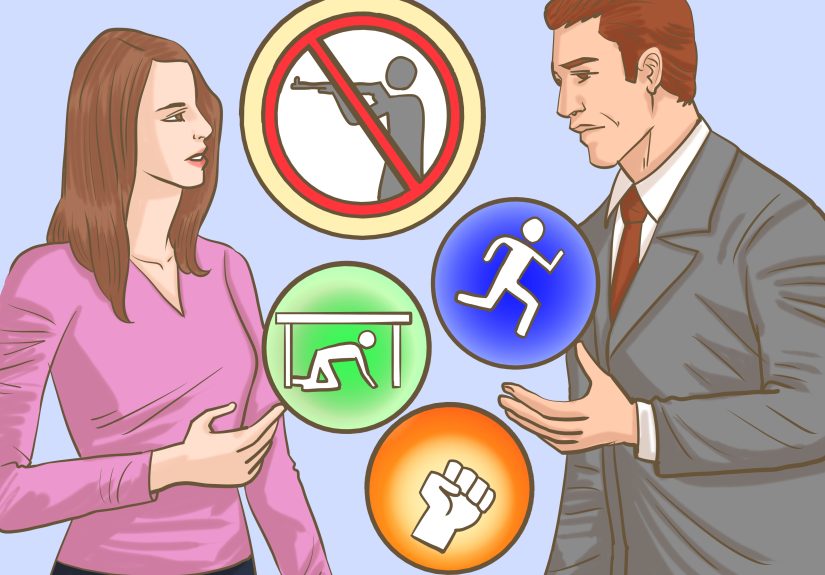
Most gunpoint robberies are over quickly. If the armed person wants property and leaves once they get it, let the encounter end. If, however, the situation shifts into a broader public attack and there is a clear, immediate route to safety, official emergency guidance generally favors escape first, then hiding if escape is not possible, and physical resistance only as a last resort when your life is in immediate danger.
That said, when a gun is directly trained on you at close range, a sudden dash is often more dangerous than controlled compliance. The key is judgment: do not force an escape that is not there. A safe opening is obvious. A bad opening usually starts with, “Well, maybe if I spin, leap, and hope for the best…”
After the Immediate Danger Passes
Get to a safe place first
As soon as the person is gone and it is safe to move, go somewhere secure. That may be inside a locked building, back into a store, inside a nearby office, or toward other people. If you are driving, go to a public, well-lit place and call for help there.
Call 911 as soon as you safely can
Report:
- Your location
- What happened
- Whether anyone is injured
- Description of the person
- Direction they went
- Vehicle details, if any
- Whether a gun was shown or implied
Speak clearly. If you feel scattered, start with the basics: “I was robbed at gunpoint. I’m safe now. I’m at [location].” The dispatcher can guide the rest.
Do not touch possible evidence
If the incident happened in a business, vehicle, or room, try not to touch surfaces the person may have handled. Leave notes, dropped items, or other objects where they are if possible. If there are witnesses, ask them to stay, or at least get names and contact information for police.
Be ready when law enforcement arrives
Keep your hands visible and empty. Follow instructions right away. Officers responding to an armed incident are focused on safety first, and they may move quickly. Do not run toward them or reach into pockets while they are sorting out who is who.
Take Care of Your Body, Your Accounts, and Your Mind
Get medical attention if needed
Even if you think you are “fine,” stress can mask injuries. If you were shoved, fell, hit your head, have chest pain, trouble breathing, dizziness, or anything that feels off, get checked out. Bodies sometimes send the full memo after the adrenaline meeting ends.
Protect your financial accounts
If your wallet, cards, or phone were stolen, contact your bank or card issuer as soon as possible. Freeze or lock cards, monitor accounts for unauthorized charges, and change passwords connected to payment apps or email. A stolen phone can become a stolen digital life surprisingly fast.
Use victim support resources
Many people focus on the police report and forget the emotional side. That is a mistake. Being threatened with a weapon can leave you jumpy, angry, ashamed, exhausted, or weirdly numb. None of that means you are weak. It means your nervous system just had a terrible day.
Victim support services, counseling, and compensation programs may help with medical bills, counseling costs, lost wages, and guidance after a violent crime. Reaching out is a smart recovery step, not a dramatic one.
Expert Mindset: Your Goal Is Survival, Not Control
The biggest mental shift is this: stop asking, “How do I take control?” and start asking, “What keeps me alive and gets me safe?” In many gunpoint situations, survival comes from reducing unpredictability. Calm body language, visible hands, slow movement, brief speech, and compliance with demands for property are not signs of surrendering your dignity. They are signs of making a hard, intelligent choice under extreme pressure.
People often judge themselves harshly afterward. They say things like, “I should have done more,” or “I froze,” or “I handed over everything.” But surviving is doing something. In fact, it is the most important thing. There is no trophy for being stubborn with a handgun pointed at your chest. There is only getting home.
Experiences Survivors Commonly Describe After Being Held at Gunpoint
Many survivors say the strangest part is not always the moment itself. It is the aftermath. The body may leave the scene, but the nervous system sometimes lingers like an alarm that forgot how to turn off. People often describe time distortion during the incident. A few seconds can feel endless. Small details may become weirdly vivid, like the color of a sleeve, the sound of shoes on pavement, or the way a voice cracked. At the same time, larger details may feel blurry. That does not mean someone is lying or unreliable. It means trauma is messy.
Another common experience is replaying the event again and again. Survivors may think, “Why did I say that?” “Why didn’t I notice the car sooner?” “Why did I freeze?” This kind of mental replay is common after a frightening event. The brain keeps reviewing the danger, almost like it is trying to edit the scene after the fact. Unfortunately, the brain is a terrible film editor. It adds guilt where there may be none and acts as though perfect decisions were possible in an imperfect, terrifying moment.
Sleep can also get weird. Some people feel exhausted but cannot rest. Others wake up suddenly at small noises, check locks repeatedly, or avoid the place where the incident happened. Crowds, parking lots, gas stations, or strangers approaching too quickly may suddenly feel different. A once-boring trip to the convenience store can start to feel like a mission set to hard mode.
Emotional reactions vary. Some survivors feel afraid. Others feel angry. Some cry immediately, while others stay flat and emotionless for hours or days. There are people who crack jokes the same night because humor is how they keep from falling apart. There are people who feel embarrassed that they handed over property quickly, even though that was probably the safest thing to do. There are also people who seem fine at first and struggle later. None of these reactions are unusual.
Support matters here. Talking to a trusted friend, family member, advocate, or counselor can help you organize what happened and reduce the feeling of carrying it alone. Practical support matters too: replacing documents, handling insurance claims, reviewing account security, getting rides if you do not feel comfortable going out alone, and arranging time off if needed. Recovery is not just emotional. It is logistical.
What helps most is giving yourself permission to recover like a human being instead of grading yourself like a machine. You were threatened. Your body responded. That response may include fear, jumpiness, anger, avoidance, or exhaustion. If those symptoms become intense, last for weeks, or interfere with daily life, professional help is worth seeking. Getting support after trauma is not overreacting. It is maintenance after a major internal collision.
Conclusion
If you are ever held at gunpoint, remember the core rule: your life matters more than your stuff. Stay as calm as you can, keep your hands visible, move slowly, comply when property is the goal, and look for safety once the immediate threat passes. Then call 911, protect evidence, take care of your health, and get support if the experience keeps echoing afterward.
You do not need to be fearless. You do not need to be clever. You do not need to become an action hero in under ten seconds. You need to survive, get safe, and let trained professionals handle the rest. In this situation, boring decisions are often the best decisions. And getting home alive is the only ending that counts.