Table of Contents >> Show >> Hide
- What Is AC in D&D 5E?
- The Basic AC Formula
- How Armor Changes AC
- How Shields Affect AC
- Armor Proficiency Matters
- AC from Class Features
- AC from Spells
- Natural Armor and Racial Traits
- Cover and Temporary AC Bonuses
- Magic Items and AC
- Step-by-Step: How to Calculate AC in D&D 5E
- Common AC Calculation Examples
- Common AC Mistakes to Avoid
- What Is a Good AC in D&D 5E?
- Player and DM Experience: Practical Lessons from the Table
- Conclusion
Note: This guide focuses on the classic Dungeons & Dragons 5E rules used at many tables, with practical advice for players and Dungeon Masters who want fast, accurate Armor Class calculations without turning character creation into tax season.
What Is AC in D&D 5E?
Armor Class, usually shortened to AC, is one of the most important defensive numbers on a Dungeons & Dragons 5E character sheet. It represents how hard you are to hit in combat. A nimble rogue dodging between barrels, a fighter hiding behind a steel shield, and a wizard protected by a magical force all use AC to answer the same question: “Does the attack hit me, or did I just look cool for free?”
The basic idea is simple. When a creature makes an attack roll against you, it rolls a d20 and adds its attack bonus. If the total equals or beats your Armor Class, the attack hits. If the total is lower than your AC, the attack misses. That means higher AC generally makes you safer from weapon attacks, claw attacks, bite attacks, and many spell attacks.
However, calculating AC in D&D 5E can feel confusing because there are several possible formulas. Your AC might come from armor, your Dexterity modifier, a shield, a spell, a class feature, natural armor, cover, or magic items. The trick is knowing which formula sets your base AC and which bonuses are added afterward.
The Basic AC Formula
If your character is not wearing armor and has no special class feature or spell changing the calculation, your Armor Class is:
AC = 10 + Dexterity modifier
Your Dexterity modifier comes from your Dexterity score. A Dexterity score of 10 or 11 gives a +0 modifier. A score of 12 or 13 gives +1. A score of 14 or 15 gives +2. A score of 16 or 17 gives +3, and so on. If your Dexterity is low, the modifier can be negative, which means your AC can be lower than 10. Yes, the goblin noticed.
Example: Unarmored Character
A sorcerer with Dexterity 14 has a +2 Dexterity modifier. If they are wearing no armor and have no active defensive spell, their AC is:
10 + 2 = 12 AC
That is playable, but not sturdy. This character should probably avoid standing in the front line unless their life goal is to become a cautionary tale.
How Armor Changes AC
Armor changes your AC by giving you a different base calculation. In D&D 5E, armor is divided into three categories: light armor, medium armor, and heavy armor. Each category handles Dexterity differently.
Light Armor
Light armor is best for characters with good Dexterity, such as rogues, rangers, bards, and some warlocks. Light armor lets you add your full Dexterity modifier to the armor’s base AC.
| Light Armor | AC Formula |
|---|---|
| Padded | 11 + Dexterity modifier |
| Leather | 11 + Dexterity modifier |
| Studded Leather | 12 + Dexterity modifier |
For example, a rogue with Dexterity 16 has a +3 modifier. If that rogue wears studded leather armor, their AC is:
12 + 3 = 15 AC
That is a solid early-game AC for a character who also relies on positioning, Stealth, and the ancient defensive art of “not being where the ogre is swinging.”
Medium Armor
Medium armor is useful for characters with decent Dexterity but not necessarily a sky-high Dexterity score. Medium armor lets you add your Dexterity modifier, but only up to a maximum of +2. This means Dexterity 14 is usually enough to get the best AC benefit from most medium armor.
| Medium Armor | AC Formula |
|---|---|
| Hide | 12 + Dexterity modifier, max +2 |
| Chain Shirt | 13 + Dexterity modifier, max +2 |
| Scale Mail | 14 + Dexterity modifier, max +2 |
| Breastplate | 14 + Dexterity modifier, max +2 |
| Half Plate | 15 + Dexterity modifier, max +2 |
Example: a cleric with Dexterity 16 has a +3 modifier, but they are wearing scale mail. Because medium armor caps the Dexterity bonus at +2, their AC is:
14 + 2 = 16 AC
The extra Dexterity is still useful for initiative, Dexterity saving throws, and certain skills, but it does not push this armor calculation beyond the medium armor limit.
Heavy Armor
Heavy armor ignores your Dexterity modifier completely. It does not add positive Dexterity, and it does not punish negative Dexterity. That is wonderful news for the noble paladin with the reflexes of a sleepy refrigerator.
| Heavy Armor | AC |
|---|---|
| Ring Mail | 14 |
| Chain Mail | 16 |
| Splint | 17 |
| Plate | 18 |
Example: a fighter with Dexterity 8 has a -1 Dexterity modifier. If they wear chain mail, their AC is still:
16 AC
Heavy armor is one reason Strength-based fighters, paladins, and clerics can survive in the front line without investing heavily in Dexterity. Some heavy armor has Strength requirements, and wearing armor without meeting those requirements can reduce speed, so check the armor table before declaring yourself an unstoppable tin can.
How Shields Affect AC
A shield usually adds +2 to AC while you are wielding it. This bonus is added after your base AC is calculated. A shield can be excellent for fighters, clerics, paladins, druids, and any character with shield proficiency.
Example: Chain Mail and Shield
A paladin wearing chain mail has 16 AC. If the paladin also uses a shield, the calculation becomes:
16 + 2 = 18 AC
This is why shield users can feel surprisingly durable at low levels. A character with 18 AC at level 1 can make goblins deeply reconsider their career choices.
However, shields occupy one hand. If you use a shield, you may not be able to use a two-handed weapon, and spellcasters may need to consider spell components. AC is powerful, but it always comes with trade-offs.
Armor Proficiency Matters
Technically, almost anyone can put on armor. That does not mean they should. If your character wears armor or uses a shield without proficiency, they suffer serious penalties, including disadvantage on many Strength- and Dexterity-based rolls and the inability to cast spells. For most characters, wearing armor without proficiency is less “clever optimization” and more “fashion-related disaster.”
Always check your class proficiencies. Fighters and paladins commonly start with broad armor options. Rogues usually rely on light armor. Wizards and sorcerers typically do not begin with armor proficiency, which is why they often use spells, positioning, or the brave barbarian standing between them and the monster.
AC from Class Features
Some classes have special features that provide an alternative AC formula. These are not usually stacked together as multiple base AC formulas. Instead, you choose the calculation that applies and gives the legal result for your character.
Barbarian Unarmored Defense
A barbarian’s Unarmored Defense lets the character calculate AC as:
10 + Dexterity modifier + Constitution modifier
The barbarian can still use a shield and keep this benefit. For example, a barbarian with Dexterity 14 (+2) and Constitution 16 (+3) has:
10 + 2 + 3 = 15 AC
If that barbarian uses a shield, the AC becomes:
15 + 2 = 17 AC
Monk Unarmored Defense
A monk’s Unarmored Defense uses Wisdom instead of Constitution:
10 + Dexterity modifier + Wisdom modifier
A monk with Dexterity 16 (+3) and Wisdom 16 (+3) has:
10 + 3 + 3 = 16 AC
Monks usually cannot use shields with this feature, so their defense depends heavily on ability scores, movement, tactical positioning, and class abilities.
AC from Spells
Spells can either set a new AC calculation or add a temporary bonus. This distinction is important. Some spells replace your base AC formula, while others stack as bonuses.
Mage Armor
Mage Armor changes the target’s base AC to:
13 + Dexterity modifier
This is excellent for wizards, sorcerers, and other lightly protected characters who are not wearing armor. A wizard with Dexterity 16 (+3) under Mage Armor has:
13 + 3 = 16 AC
That is a huge improvement over 13 or lower, especially at early levels. It will not turn the wizard into a front-line knight, but it may stop a random skeleton from ruining their entire personality.
Shield Spell
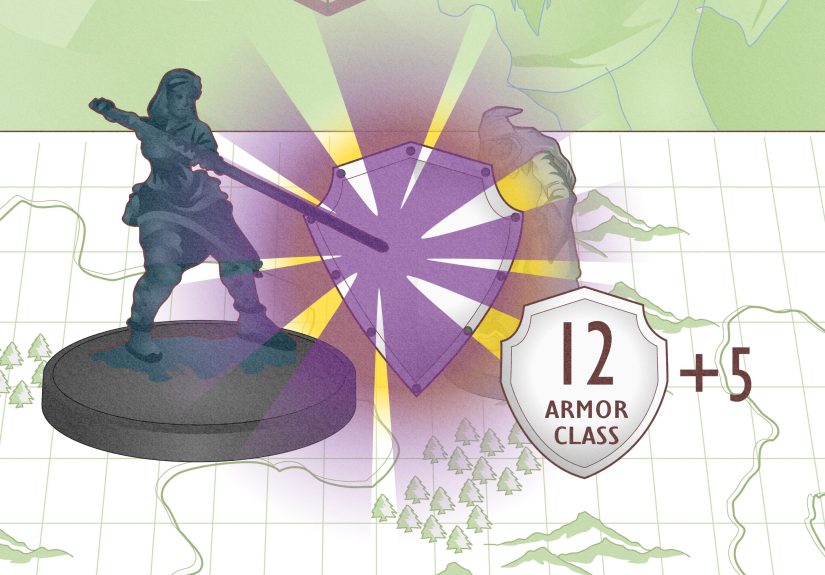
The Shield spell gives a temporary +5 bonus to AC, including against the triggering attack, until the start of your next turn. This is one of the strongest defensive reactions in the game because it can turn a hit into a miss.
Example: a wizard with Mage Armor and Dexterity 16 has 16 AC. If an enemy rolls a 19 to hit, the wizard can cast Shield and temporarily raise AC to:
16 + 5 = 21 AC
The attack now misses unless it has some special rule that changes the situation. The wizard survives, the enemy looks confused, and the table learns why spell slots are precious.
Shield of Faith
Shield of Faith adds +2 AC to the target for the duration of the spell, as long as concentration is maintained. A cleric wearing chain mail and a shield normally has 18 AC. With Shield of Faith, that becomes:
18 + 2 = 20 AC
That is strong, but remember that concentration can be broken by damage, failed saving throws, or choosing to concentrate on another spell.
Natural Armor and Racial Traits
Some creatures and playable species may have natural armor or special defensive traits. Natural armor usually gives another AC formula, such as a fixed number plus Dexterity modifier. As with other formulas, the key question is whether the feature sets your base AC or adds a bonus.
If two different features give you two different ways to calculate base AC, you normally choose one. You do not combine every formula into a glorious mathematical lasagna. For example, if a character has natural armor and also gains Mage Armor, those are both base AC options. Pick the one that results in the better legal AC.
Cover and Temporary AC Bonuses
Cover is one of the most overlooked ways to improve survivability in D&D 5E. It does not change your character sheet AC forever, but it can affect whether an attack hits in the moment.
| Cover Type | Benefit |
|---|---|
| Half Cover | +2 bonus to AC and Dexterity saving throws |
| Three-Quarters Cover | +5 bonus to AC and Dexterity saving throws |
| Total Cover | Usually cannot be targeted directly |
A ranger with 16 AC standing behind a low stone wall might have half cover, raising the effective AC against certain attacks to 18. If the ranger is mostly behind an arrow slit or thick tree, three-quarters cover might raise the effective AC to 21. This is why smart players love terrain. The battlefield is not just decoration; it is free real estate for survival.
Magic Items and AC
Magic items can also improve AC. Common examples include magic armor, magic shields, rings or cloaks of protection, and bracers designed for unarmored characters. These items vary by campaign and require the Dungeon Master’s approval.
When using magic items, read the item carefully. Some give a flat bonus. Some require attunement. Some only work if you are not wearing armor or not using a shield. A +1 shield is simple: it generally improves the normal shield bonus. Bracers of defense, on the other hand, are usually designed for characters who are not wearing armor and not using shields.
Step-by-Step: How to Calculate AC in D&D 5E
Use this simple process whenever you calculate AC:
- Start with your base AC formula. This might be 10 + Dexterity modifier, an armor value, Mage Armor, Unarmored Defense, or natural armor.
- Apply Dexterity correctly. Add full Dexterity for no armor or light armor, cap it at +2 for medium armor, and ignore it for heavy armor.
- Add shield bonus if allowed. A shield usually adds +2 AC while wielded.
- Add active spell bonuses. Include spells like Shield of Faith or the temporary Shield spell when they apply.
- Add magic item bonuses. Include legal bonuses from magic armor, shields, rings, cloaks, or other items.
- Consider cover. Add cover bonuses only when the battlefield situation grants them.
- Check restrictions. Make sure armor proficiency, shield use, concentration, attunement, and class feature requirements are all valid.
Common AC Calculation Examples
Example 1: Rogue in Studded Leather
A rogue has Dexterity 18, which gives a +4 modifier. They wear studded leather armor.
12 + 4 = 16 AC
This is a strong AC for a mobile character, especially when combined with Cunning Action and good positioning.
Example 2: Cleric in Scale Mail with Shield
A cleric has Dexterity 14 (+2), wears scale mail, and carries a shield.
14 + 2 + 2 = 18 AC
This is excellent for a low-level support character who expects to stand near danger while healing, blessing, or bonking enemies with sacred enthusiasm.
Example 3: Fighter in Plate with Shield
A fighter wears plate armor and uses a shield.
18 + 2 = 20 AC
No Dexterity is added because plate is heavy armor. This is one of the classic high-AC martial setups.
Example 4: Wizard with Mage Armor and Shield Spell
A wizard has Dexterity 14 (+2) and Mage Armor active.
13 + 2 = 15 AC
If the wizard casts Shield as a reaction, the temporary AC becomes:
15 + 5 = 20 AC
That does not last all day, but in the right moment it can save the wizard from becoming floor decoration.
Common AC Mistakes to Avoid
Adding Dexterity to Heavy Armor
Heavy armor does not add your Dexterity modifier. A fighter in chain mail has 16 AC whether their Dexterity is 8, 10, or 16. Dexterity still helps with initiative and saving throws, but it does not improve heavy armor AC.
Ignoring the Medium Armor Dexterity Cap
Medium armor only allows up to +2 from Dexterity unless a special feature says otherwise. A ranger with Dexterity 18 wearing half plate does not get 19 AC from armor alone. The calculation is 15 + 2, for 17 AC.
Stacking Multiple Base AC Formulas
If you have Mage Armor, natural armor, and Unarmored Defense, you do not add all of them together. Choose the valid formula that gives the best AC. Bonuses can stack when they say they add to AC, but base formulas usually do not merge.
Forgetting Shield Proficiency
Using a shield without proficiency can create major problems, especially for spellcasters. Do not assume every character can grab a shield and become untouchable. The rules are not that generous, and neither is your DM after the third rules debate of the evening.
What Is a Good AC in D&D 5E?
A “good” AC depends on level, class, campaign style, and role in the party. At low levels, 12 or 13 AC is fragile, 14 or 15 is workable, 16 or 17 is solid, and 18 or higher feels very sturdy. Front-line characters often aim for 18 or more when possible. Back-line casters can survive with lower AC if they stay mobile, use cover, and avoid attracting every angry monster on the map.
At higher levels, monsters often have stronger attack bonuses, so AC alone will not solve every problem. Saving throws, hit points, resistances, mobility, healing, battlefield control, and smart tactics all matter. A character with 22 AC can still have a terrible afternoon if they fail a Wisdom save against a charm effect or stand in the center of a dragon’s breath weapon.
Player and DM Experience: Practical Lessons from the Table
After you have played a few sessions of D&D 5E, you start to realize that AC is not just a number. It changes how people behave at the table. A player with high AC often becomes more confident, sometimes heroically so, and sometimes in the “I open the suspicious door with my face” style of confidence. A player with low AC learns very quickly that walls, allies, and distance are not optional accessories.
One of the biggest lessons is that AC works best when it matches your character’s role. A paladin with 20 AC is doing exactly what the party expects: standing in front, blocking enemies, and forcing monsters to waste attacks against a heavily armored problem. A rogue with 16 AC is not supposed to stand still and trade hits with an ogre. That rogue survives by hiding, disengaging, attacking from advantage, and making the enemy chase shadows. A wizard with 15 AC from Mage Armor should feel safer, but not immortal. The wizard’s real defense is usually a mix of positioning, control spells, reactions, and letting the barbarian be the party’s loudest distraction.
Dungeon Masters also learn that high AC is not something to punish automatically. If a player invested in heavy armor, a shield, defensive spells, or class features, let that choice matter. Let goblins miss. Let the fighter feel like a fortress. Let the cleric grin when three skeletons bounce off their shield. That said, encounters become more interesting when they include more than basic attack rolls. Use grapples, saving throws, difficult terrain, hazards, objectives, social pressure, and enemies with different tactics. The goal is not to “beat” high AC; the goal is to create scenes where every defense matters differently.
Another practical experience is that cover makes combat more fun. Many groups forget cover because everyone is focused on character sheet numbers. But once players start diving behind wagons, ducking around pillars, or using doorways intelligently, battles feel more cinematic. A character with average AC can become much harder to hit with half cover, and ranged characters suddenly care about where they stand. This also gives DMs a simple way to make battle maps more tactical without adding complicated house rules.
For new players, the best advice is to write your AC calculation in the notes section of your character sheet. Do not just write “AC 17.” Write “scale mail 14 + Dex 2 + shield 2 = 18” or “Mage Armor 13 + Dex 3 = 16.” This makes level-ups, equipment changes, and spell effects much easier to manage. It also prevents the classic mid-combat mystery where nobody remembers why the bard has 19 AC and the answer turns out to be “because we added the shield bonus twice three sessions ago.”
In real play, AC is a balance between math and story. It tells you whether the arrow hits, but it also describes the moment: a shield raised at the last second, a blade sliding off plate armor, a monk twisting away from a spear, or a wizard panicking so hard that magic briefly becomes personal space. Calculate it correctly, use it creatively, and your combats will feel cleaner, faster, and much more satisfying.
Conclusion
Learning how to calculate AC in D&D 5E is one of the fastest ways to understand combat. Start with the correct base AC formula, apply Dexterity properly, add shields and bonuses only when they legally apply, and remember that cover can change the result in the moment. Once you understand the difference between a base AC calculation and an AC bonus, most confusion disappears.
Armor Class is not just about becoming impossible to hit. It is about making smart character choices. A heavily armored fighter, a graceful monk, a shield-bearing cleric, and a magically protected wizard can all have strong defenses in different ways. Know your formula, check your restrictions, and do not be afraid to use the terrain. The best AC calculation is the one that keeps your character alive long enough to make the next terrible decision.