Table of Contents >> Show >> Hide
- What Is an Oxidation Number?
- Quick Rule Cheat Sheet (Save Your Sanity)
- How to Find Oxidation Numbers: 12 Steps
- Step 1: Write the formula clearly (and include the charge if it’s an ion)
- Step 2: Check for any element in its free (uncombined) form
- Step 3: If it’s a monatomic ion, you’re basically done
- Step 4: Assign “usual suspects” first (Group 1 and Group 2 metals)
- Step 5: Lock in fluorine (because it refuses to compromise)
- Step 6: Assign oxygen… then immediately remember oxygen has a dramatic personality
- Step 7: Assign hydrogen (usually +1… unless it’s hanging out with metals)
- Step 8: Use common oxidation numbers for “frequent flyers” (when appropriate)
- Step 9: Treat familiar polyatomic ions like building blocks (optional but powerful)
- Step 10: Write the sum equation (this is the “always works” part)
- Step 11: Solve for the unknown (and sanity-check it)
- Step 12: Use oxidation numbers to spot oxidation/reduction (the reason you’re doing this)
- Worked Examples (With the “Tricky Parts” Explained)
- Common Mistakes (So You Don’t Fall Into the Same Trap as Everyone Else)
- Practice Mini-Set (Try Before You Peek)
- Why This Skill Actually Matters (Beyond “Because the Test Says So”)
- Conclusion
Oxidation numbers (also called oxidation states) are chemistry’s way of playing detective: you assign “pretend charges”
to atoms so you can track electrons, spot redox reactions, and generally feel like you have superpowers in lab.
They’re not always the atom’s real chargethink of them as a useful accounting system that works remarkably well for
most general chemistry problems.
This guide walks you through a clean, repeatable method to find oxidation numbers in elements, ions, and compoundswithout
staring at a formula like it just insulted your intelligence. We’ll use the standard rule set, show the exceptions that love
showing up on exams, and work through specific examples (including the “why is oxygen suddenly weird?” moments).
What Is an Oxidation Number?
An oxidation number is the hypothetical charge an atom would have if all bonds were treated as fully ionic (electrons assigned to
the more electronegative atom). The point isn’t to perfectly model realityit’s to consistently track electron ownership so you can
identify oxidation (increase in oxidation number) and reduction (decrease in oxidation number).
Quick Rule Cheat Sheet (Save Your Sanity)
- Free elements (Na, O2, Cl2, S8, etc.): oxidation number 0.
- Monatomic ions: oxidation number equals the ion charge (Fe3+ is +3, S2− is −2).
- Group 1 metals: +1 (Li, Na, K, etc.).
- Group 2 metals: +2 (Mg, Ca, etc.).
- Fluorine: −1 in compounds (it’s aggressively electronegative).
- Oxygen: usually −2 (exceptions: peroxides −1; superoxides −1/2; with fluorine, oxygen becomes positive).
- Hydrogen: usually +1 (exception: metal hydrides where H is −1).
- Sum rule: add oxidation numbers for all atoms = overall charge of the molecule/ion.
How to Find Oxidation Numbers: 12 Steps
-
Step 1: Write the formula clearly (and include the charge if it’s an ion)
Before you assign anything, make sure you know what you’re dealing with: a neutral compound (total charge 0) or a polyatomic
ion (total charge shown). “SO4” and “SO42−” are not the same situationone of them comes with a
built-in math problem. -
Step 2: Check for any element in its free (uncombined) form
If an atom is present as a pure element, its oxidation number is 0. Examples:
- O2: O = 0
- Cl2: Cl = 0
- Fe(s): Fe = 0
This is often the easiest “free points” you’ll ever get in chemistry, so take them.
-
Step 3: If it’s a monatomic ion, you’re basically done
Monatomic ions have oxidation numbers equal to their charge:
- Al3+ = +3
- Br− = −1
- Zn2+ = +2
If the species is polyatomic, keep goingthose are where the fun (and mild frustration) happens.
-
Step 4: Assign “usual suspects” first (Group 1 and Group 2 metals)
Group 1 metals are almost always +1; Group 2 metals are almost always +2 in compounds. So:
- NaCl: Na = +1
- MgO: Mg = +2
- Ca(NO3)2: Ca = +2
These assignments help you solve everything else by using the sum rule later.
-
Step 5: Lock in fluorine (because it refuses to compromise)
Fluorine is −1 in its compounds. Period. This matters most when oxygen is bonded to fluorine (because oxygen loses its usual −2
privilege).Example: OF2. Each F is −1, total −2. The molecule is neutral, so oxygen must be +2.
-
Step 6: Assign oxygen… then immediately remember oxygen has a dramatic personality
Oxygen is usually −2. But it has three common “plot twists”:
- Peroxides (O–O with overall O22−): each O = −1 (e.g., H2O2, Na2O2).
- Superoxides (O2−): each O = −1/2 (e.g., KO2).
- With fluorine: oxygen becomes positive (e.g., OF2 where O = +2).
In most intro problems, peroxide and “oxygen with fluorine” are the two exceptions you’ll see the most.
-
Step 7: Assign hydrogen (usually +1… unless it’s hanging out with metals)
Hydrogen is usually +1 in compounds (HCl, H2O, NH3). But in metal hydrides, hydrogen is −1.
Example: NaH. Sodium (Group 1) is +1, so H must be −1 to make the compound neutral.
-
Step 8: Use common oxidation numbers for “frequent flyers” (when appropriate)
Many elements have common oxidation numbers that appear repeatedly. This is not a “memorize the universe” requestjust recognize
patterns that show up all the time:- Halogens (Cl, Br, I): often −1 unless bonded to O or F
- Al: often +3
- Zn: often +2
- Ag: often +1
If you’re ever unsure, don’t guess wildly. Use the sum rule (next steps) to calculate instead.
-
Step 9: Treat familiar polyatomic ions like building blocks (optional but powerful)
Sometimes the fastest route is recognizing a polyatomic ion you already know:
- NO3− (nitrate)
- SO42− (sulfate)
- CO32− (carbonate)
- NH4+ (ammonium)
You can find oxidation numbers inside these ions using the same sum rule, but recognizing them helps prevent accidental algebra
faceplants. -
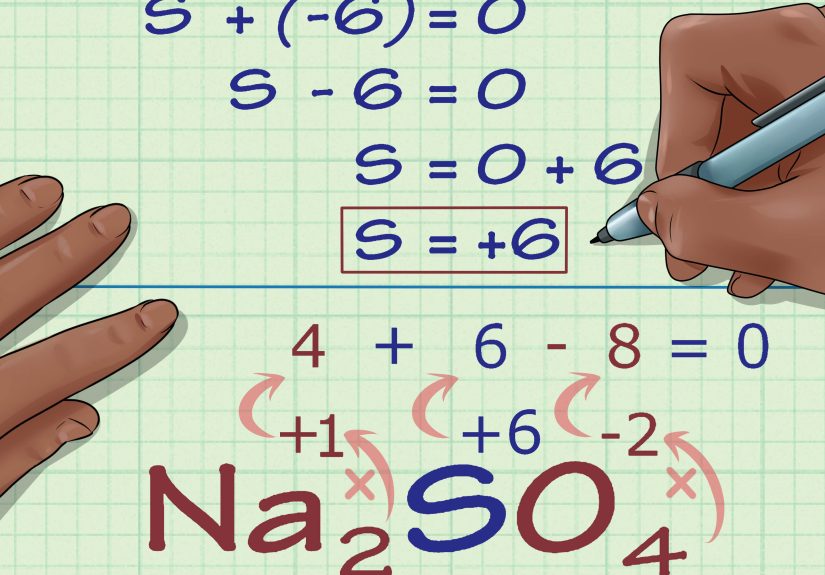
Step 10: Write the sum equation (this is the “always works” part)
Here’s the golden rule:
Sum of oxidation numbers (each multiplied by how many atoms you have) = overall charge.
Example: SO42−. Oxygen is usually −2, and there are 4 oxygens:
So sulfur is +6 in sulfate. That one shows up everywhere, so it’s a good “anchor example.”
-
Step 11: Solve for the unknown (and sanity-check it)
Always check whether the result makes chemical sense:
- Does the sum match the charge?
- Did you accidentally assign oxygen −2 in a peroxide?
- Did you make fluorine anything other than −1? (Fluorine will remember this.)
- Is the sign plausible based on electronegativity? (Oxygen usually negative; alkali metals usually positive.)
Quick example: HNO3 (nitric acid). H is +1, O is −2 (three oxygens = −6), total molecule is neutral:
Nitrogen is +5 in nitric acidclassic redox chemistry territory.
-
Step 12: Use oxidation numbers to spot oxidation/reduction (the reason you’re doing this)
Once you can assign oxidation numbers, you can identify redox reactions quickly:
- Oxidation = oxidation number increases (loss of electrons)
- Reduction = oxidation number decreases (gain of electrons)
Example: Zn + Cu2+ → Zn2+ + Cu
- Zn: 0 → +2 (oxidized)
- Cu: +2 → 0 (reduced)
Translation: zinc is the reducing agent, copper(II) is the oxidizing agent. Chemistry is basically a dramatic story about who stole electrons.
Worked Examples (With the “Tricky Parts” Explained)
Example 1: Find Mn in KMnO4
Potassium is +1. Oxygen is −2 (4 oxygens = −8). The compound is neutral:
So manganese is +7 in permanganate. That’s why KMnO4 is such a strong oxidizing agent: +7 is a “very oxidized” state.
Example 2: Find Cr in Cr2O72− (dichromate)
Oxygen: 7 × (−2) = −14. Total charge is −2:
Each chromium is +6 in dichromateanother famous oxidizer in acidic solution.
Example 3: Find O in H2O2 (hydrogen peroxide)
Peroxide alert: oxygen is −1 here (not −2). If you forget this, your answer will come out wrong and your homework will quietly judge you.
Let’s confirm:
Example 4: Find O in OF2
Fluorine is −1, two fluorines = −2. Neutral compound:
Oxygen is +2 here because fluorine is more electronegative and “wins” the electrons in the ionic approximation.
Common Mistakes (So You Don’t Fall Into the Same Trap as Everyone Else)
- Forgetting peroxides: O is −1 in peroxides, not −2.
- Ignoring ion charge: polyatomic ions don’t sum to zero unless they’re neutral.
- Over-memorizing instead of solving: use the sum equation; it’s more reliable than vibes.
- Misreading subscripts: SO3 and SO4 are different planets.
- Assuming halogens are always −1: they can be positive when bonded to oxygen (like in ClO3−).
Practice Mini-Set (Try Before You Peek)
Grab a pencil. Your brain learns chemistry with its hands, not by watching you scroll confidently.
1) Find S in SO3
Oxygen: 3 × (−2) = −6. Neutral molecule:
2) Find N in NO2−
Oxygen: 2 × (−2) = −4. Total charge −1:
3) Find Fe in FeCl3
Chlorine is usually −1 here (3 × −1 = −3), neutral compound:
Why This Skill Actually Matters (Beyond “Because the Test Says So”)
Oxidation numbers let you:
- Identify redox reactions quickly (and therefore predict electron transfer).
- Find oxidizing and reducing agents without guessing.
- Understand why certain compounds are strong oxidizers/reducers.
- Make sense of inorganic names like iron(III) oxide or chromium(VI) compounds.
Translation: oxidation numbers are the cheat codes for a big chunk of general chemistry.
Conclusion
To find oxidation numbers, you don’t need magicyou need a consistent routine: assign the reliable rules first (Group 1/2, F, O, H),
then use the sum of oxidation numbers equals the overall charge to solve what’s left. If you can do that calmly, you can handle most
oxidation-state problems you’ll meet in high school, AP, and intro college chemistry.
Bonus: Real-World Experiences & Tips (500+ Words)
The first time most people “meet” oxidation numbers, it feels like chemistry suddenly started speaking in riddles. That’s normal.
In my experience helping students (and watching a lot of otherwise-confident people get humbled by a single peroxide), the biggest
breakthrough happens when you stop treating oxidation numbers like trivia and start treating them like bookkeeping.
One student told me they kept trying to memorize oxidation states for every element like it was a periodic-table spelling bee.
It worked… until it didn’t. The moment a problem used a polyatomic ion, or tossed in something like OF2, the memorization
strategy collapsed like a cheap folding chair. We switched approaches: “Assign the predictable ones, then solve with the sum rule.”
Within a week, their accuracy jumpednot because they learned more facts, but because they finally had a process.
Another common “experience moment” shows up in labs involving redox reactionsespecially those dramatic color changes. Permanganate
solutions (MnO4−) are a classic example: that deep purple is basically chemistry announcing, “I’m in a high
oxidation state and I’m looking for electrons.” When students calculate Mn as +7, the reaction stops being random color magic and
starts looking logical: manganese really wants to get reduced to a lower oxidation state. Suddenly, balancing redox reactions feels
less like punishment and more like solving a mystery.
The funniest (and most useful) “lesson learned” usually involves oxygen. People trust oxygenuntil oxygen becomes the class comedian.
In peroxides, oxygen is −1; in superoxides it’s −1/2; and with fluorine it can even be positive. The practical tip I always give is:
if you see an O–O bond, your “oxygen is −2” autopilot should immediately shut off. Pretend your calculator flashes a warning sign.
It sounds silly, but building that reflex saves you from the most common oxidation-number mistake on homework sets and exams.
If you’re studying for a test, here’s a strategy that works better than rereading notes: do five problems in a row where you
force yourself to write the sum equation every time, even if you think you could guess it. This builds speed and consistency.
Then add in “exception problems” on purposeone peroxide, one compound with fluorine, one ion with a charge, and one transition-metal
compound that makes you solve for the metal. You’re training your brain to recognize patterns, not just answers.
Finally, don’t underestimate the confidence boost that comes from checking your work the same way every time. When you finish a
problem, take three seconds and ask: “Does the sum match the charge?” That tiny habit catches most errors instantly. Oxidation numbers
are less about being brilliant and more about being consistentlike flossing, but with electrons.