Table of Contents >> Show >> Hide
- First, What Does “Dead Battery” Actually Mean?
- 7 Classic Signs a Car Battery Is Dead (or Dying)
- 1) The engine won’t crank (or cranks painfully slow)
- 2) Clicking sounds when you try to start
- 3) Dash lights come on, but everything seems weak or glitchy
- 4) Headlights are dim or fade when you try to start
- 5) You need frequent jump-starts
- 6) The battery is old
- 7) You notice corrosion, swelling, or a bad smell under the hood
- Fast “No Tools” Checks You Can Do in 2 Minutes
- The “Real” Test: Use a Multimeter (Simple, Cheap, and Dramatically Satisfying)
- Battery vs. Alternator vs. Starter: A Quick Diagnosis Cheat Sheet
- What to Do If Your Car Battery Is Dead: The Practical Playbook
- Common Causes of a Dead Battery (So It Doesn’t Happen Again Next Tuesday)
- When to Call for Help (Because Sometimes “DIY” Means “Destroy It Yourself”)
- How to Dispose of (and Recycle) an Old Car Battery
- FAQ: Quick Answers for Real Life
- Real-World Experiences: What “Dead Battery” Looks Like Outside of a Garage (Extra )
- Conclusion
Your car has exactly two moods: “Let’s go!” and “I live here now.” And when it suddenly chooses the second oneusually
when you’re late, it’s raining, and you’re parked under a tree that drops extra sticky sapthere’s a decent chance
the car battery is the culprit.
The good news: a dead (or dying) battery usually leaves clues. The better news: most fixes are straightforward, and you
don’t need to be a wizardjust a person with eyeballs, a little patience, and possibly a friend with jumper cables.
This guide walks you through the symptoms, quick checks, safe next steps, and how to tell whether the battery is truly
deador just being framed by the starter, alternator, or a sneaky electrical drain.
First, What Does “Dead Battery” Actually Mean?
People say “dead battery” to describe a few different situations:
- Discharged battery: The battery is fine, but it’s low on charge (lights left on, short trips, cold snap).
- Weak battery: The battery is aging or damaged and can’t deliver enough power to crank the engine reliably.
- Failed battery: Internal damage (bad cell, severe sulfation, cracked case) means it won’t hold a charge anymore.
- Not the battery at all: Starter, alternator, cables, or a security/ignition issue is causing the no-start.
Your goal isn’t just “make car start once.” Your goal is “make car start tomorrow, too.” That’s the difference between
a real solution and a temporary roadside negotiation.
7 Classic Signs a Car Battery Is Dead (or Dying)
1) The engine won’t crank (or cranks painfully slow)
If you turn the key or press Start and the engine doesn’t turn overor it turns over like it’s trying to wake up from a
three-day napthat’s one of the most common battery symptoms. A healthy battery delivers a strong burst of power to the starter.
A weak one delivers… vibes.
2) Clicking sounds when you try to start
A rapid clicking (“click-click-click”) often happens when the starter motor can’t get enough current. One lonely click can
be battery-related, but it can also point to starter or connection issues. The key clue is whether a jump-start helps.
3) Dash lights come on, but everything seems weak or glitchy
You may see the dashboard light up, but the radio resets, the display flickers, the power windows crawl, or the interior
lights dim dramatically. Batteries can have enough juice to power small electronics but not enough to crank the engine.
4) Headlights are dim or fade when you try to start
Try turning on the headlights with the engine off. If they look sador get noticeably dimmer when you attempt to start
the battery may be low or the connections may be corroded/loose.
5) You need frequent jump-starts
A one-time jump after leaving a dome light on is an “oops.” Multiple jump-starts over a few weeks is a patternand patterns
are how your car politely asks for a new battery (or an alternator diagnosis) without speaking English.
6) The battery is old
Car batteries don’t live forever. Many last roughly 3–5 years, though climate and driving habits can shorten or extend that.
If your battery is past the “toddler years” and approaching the “teen years,” it’s wise to test it proactively.
7) You notice corrosion, swelling, or a bad smell under the hood
White/blue crust around terminals can interfere with charging and starting. A swollen/bulging case is a bigger red flag
it can indicate overheating or internal damage. If you see cracks, leakage, or smell something sharp/sulfur-like, skip DIY
heroics and get professional help.
Quick safety note: If the battery case is cracked, leaking, swollen, or frozendon’t attempt a jump-start. Call roadside assistance or a trusted shop.
Fast “No Tools” Checks You Can Do in 2 Minutes
Check #1: Do you get any response at all?
- Nothing happens (no click, no dash lights): possible dead battery, disconnected cable, or main fuse issue.
- Dash lights but no crank: battery may be weak, or starter/relay may be the issue.
- Cranks but won’t start: battery might be okay; fuel/ignition/sensor issues may be involved.
Check #2: Try the horn and interior lights
If the horn sounds weak and the interior lights are dim, that supports the “low battery” theory. If everything is bright
and normal but the engine won’t crank, think starter, immobilizer/security, or a bad connection.
Check #3: Look at the battery terminals
Lift the hood and look for:
- Loose clamps (they should not wiggle by hand)
- Heavy corrosion on the terminals
- Damaged cables or frayed wiring
Loose or corroded terminals can mimic a dead battery because power can’t flow properly. The battery might be fine; it’s just
not being allowed to do its job.
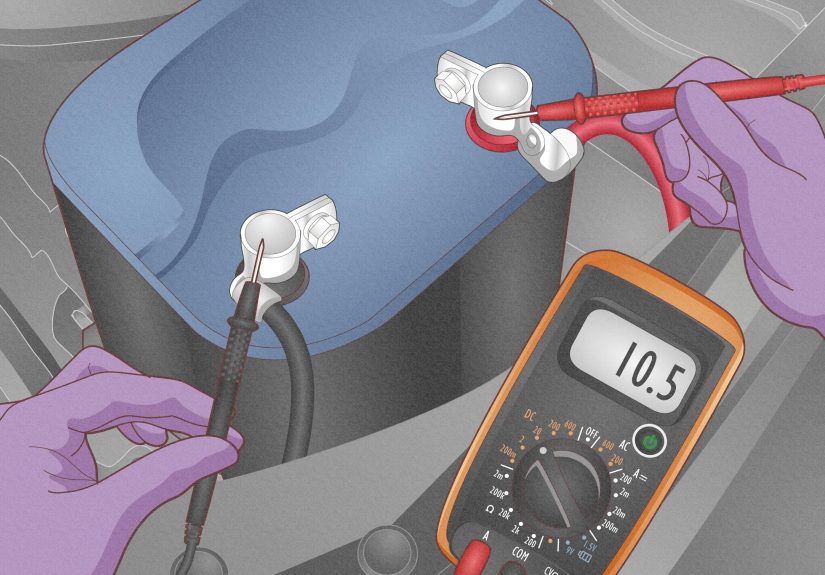
The “Real” Test: Use a Multimeter (Simple, Cheap, and Dramatically Satisfying)
If you want certainty, test battery voltage. A basic digital multimeter costs less than a tank of gas and provides more
truth than your car’s dashboard warning lights ever will.
How to test battery voltage (engine off)
- Turn the car off and make sure accessories are off (lights, radio, HVAC).
- Set the multimeter to DC volts (usually “20V” range).
- Touch the red probe to the positive (+) terminal and black probe to the negative (–) terminal.
- Read the number on the screen.
What the numbers generally mean
- ~12.6–12.8V: fully charged and likely healthy (at rest).
- ~12.4V: partially charged; may still start, especially in warm weather.
- ~12.2V or lower: low charge; starting may be unreliable.
- Below ~12.0V: strongly suggests a discharged battery; it may be “dead” in practical terms.
- ~10–11V range: can indicate a bad cell or severe discharge (needs further testing).
Voltage alone doesn’t prove capacitybatteries can show decent voltage but collapse under load. That’s why shops use a load
test (and why many auto parts stores will test your battery for free).
Test the charging system (engine running)
If you can get the car started (via jump or charger), test again with the engine running. Many vehicles typically charge
in the mid-13V to mid-14V range. If the running voltage is consistently too low (or unusually high), the alternator/charging
system may be the problemand it can kill a good battery by undercharging or overcharging it.
Battery vs. Alternator vs. Starter: A Quick Diagnosis Cheat Sheet
If jump-starting works…
That strongly points to a battery issue (discharged or failing) or a charging issue that drained the battery.
The next question: does it start again later?
If jump-starting does NOT work…
Now you’re looking harder at:
- Starter motor (especially if you hear a click but no crank)
- Bad/loose battery cables (no reliable power flow)
- Ignition switch / relay
- Security/immobilizer (some cars won’t crank if security systems are triggered)
If the car starts, but the battery light is on while driving…
The battery light often indicates the charging system isn’t charging correctly. That could be alternator, belt, wiring,
or related components. Don’t ignore itdriving on a failing charging system can eventually leave you stranded again.
What to Do If Your Car Battery Is Dead: The Practical Playbook
Step 1: Decide whether it’s safe to proceed
Do not jump-start if you see cracks, leaks, severe swelling, or other obvious damage. Also avoid sparks,
flames, and smoking near a battery. If anything looks off, call roadside assistance.
Step 2: Jump-start the car (safely)
Jump-starting is common, but treat it like you’re handling electricity and metal near a battery that can produce flammable gas.
If you’re unsure, check your owner’s manualsome vehicles have designated jump points.
- Park the helper vehicle close enough for cables to reach (don’t let vehicles touch). Turn both cars off.
- Connect red clamp to the dead battery’s positive (+) terminal.
- Connect the other red clamp to the good battery’s positive (+) terminal.
- Connect black clamp to the good battery’s negative (–) terminal.
- Connect the other black clamp to a solid, unpainted metal ground on the dead car (not the battery’s negative terminal).
- Start the helper car, let it run briefly, then try starting the dead car.
- Once started, remove cables in reverse order, keeping clamps from touching.
If the car starts, let it run and then drive long enough to replenish charge. If it dies again soon after, the battery may
not be holding charge, or the alternator may not be charging it properly.
Step 3: Recharge the battery (smart charger = less drama)
If the battery is simply discharged, a smart battery charger (or maintainer) can restore it more gently than repeated jump-starts.
Repeatedly jump-starting a deeply discharged battery can be hard on the battery and inconvenient for your dignity.
Step 4: Get a battery load test
A load test checks whether the battery can maintain voltage under demand. This is the test that answers:
“Is the battery weak?” rather than “Is the battery currently awake?”
Many auto parts stores and service centers offer battery and charging system tests. If your battery is older, or you’ve had
multiple no-start episodes, a load test is one of the fastest ways to avoid guesswork.
Step 5: Replace the battery if needed
If the battery fails a test, won’t hold charge, or is old enough to have its own back pain, replacement is often the smart move.
Make sure you get the correct battery group size and type (especially if your vehicle uses AGM, start-stop technology, or has
high electrical demands).
Common Causes of a Dead Battery (So It Doesn’t Happen Again Next Tuesday)
Short trips and long naps
Short drives may not give the alternator enough time to recharge the battery, especially in cold weather or with lots of accessories running.
On the other end, letting a car sit for weeks can allow the battery to self-discharge and power small “always on” systems.
Extreme temperatures
Cold weather reduces a battery’s ability to deliver cranking power, while heat can speed chemical wear and shorten overall battery life.
Translation: winter reveals weakness; summer creates it.
Parasitic drain
Something continues drawing power when the car is offaftermarket electronics, a glovebox light that never turns off,
a module that won’t go to sleep, or a charger left plugged in. If your battery is repeatedly dead after sitting overnight,
ask a shop to check for parasitic draw.
Corrosion and loose connections
Corrosion increases resistance and can prevent proper charging and starting. Loose clamps can cause intermittent no-starts
that feel “random” (which is the automotive version of gaslighting).
Charging system problems
A weak alternator, loose belt, or wiring issue can undercharge the battery, leaving you with a battery that never gets back to full strength.
If your battery keeps dying even after replacement, the charging system needs attention.
When to Call for Help (Because Sometimes “DIY” Means “Destroy It Yourself”)
Consider professional help if:
- The battery is swollen, leaking, cracked, or looks damaged
- Jump-starting fails repeatedly
- The battery light stays on while driving
- The car starts, then stalls quickly
- You suspect a parasitic drain or wiring issue
- You drive a hybrid/EV or a vehicle with special jump points and you’re unsure of the procedure
There’s no shame in calling roadside assistance. The shame is in replacing a perfectly good battery when the alternator was the real villain.
How to Dispose of (and Recycle) an Old Car Battery
Lead-acid car batteries are widely recycled in the U.S., and many retailers use a “core charge” system: you pay a deposit
when buying a battery and get it back when you return the old one. Don’t toss an old battery in the trashreturn it to a
retailer, service center, or local program that accepts automotive batteries.
FAQ: Quick Answers for Real Life
How can I tell if it’s the battery or the starter?
If a jump-start makes it crank and start normally, the battery (or its charge level) is the main suspect. If it won’t crank
even with a jump, look harder at the starter, cables, or connections.
How long should I drive after a jump-start?
Long enough to restore chargeoften at least 20–30 minutes of driving. If the battery is failing, driving may not “fix” it;
it’ll just buy time.
My headlights work, so my battery isn’t dead, right?
Not necessarily. Headlights require far less power than cranking the engine. A battery can power lights and still be too weak to start the car.
Should I buy a portable jump starter?
If you want independence (and fewer awkward parking-lot friendships), a portable jump starter can be a great tool. It’s also handy
if you travel or park far from helpful humans.
Real-World Experiences: What “Dead Battery” Looks Like Outside of a Garage (Extra )
If you’ve never dealt with a dead car battery, it can feel like your vehicle is being dramatic for sport. But drivers tend to
describe the same handful of “movie scenes” when it happensand recognizing the pattern can save you time, money, and a
surprising amount of emotional turbulence.
One common experience: the slow-crank morning. You turn the key and the engine sounds like it’s stirring a
thick milkshake. It eventually starts, so you assume it’s fine. Then two days later, it does the same thingonly slower.
This is the battery warning you in its most polite language. If you test it right then (or get a load test), you often catch
the problem before the full “no-start” event happens in a grocery store parking lot with melting ice cream in the trunk.
Another classic: the airport return. The car has been sitting for a week, and when you get backtired, carrying
bags, already thinking about your bednothing happens. In many cases, the battery didn’t suddenly fail; it gradually discharged
while the car was parked. Modern cars sip power even when “off” to keep modules awake and ready. If your battery was already
older or not fully charged, that slow drain can push it over the edge. Drivers who park for long stretches often find that
a battery maintainer (or simply starting and driving the car periodically) prevents the repeat performance.
Then there’s the mystery drain story: the battery tests “okay,” you replace it anyway, and the new battery
also dies. That’s when people discover the glovebox light that never turns off, the aftermarket dash cam wired to constant power,
or a charger left plugged in 24/7. These cases feel spooky because the car can start perfectly after a jumpthen be dead the
next morning. The lesson: when a battery keeps dying quickly, it’s often not a “bad battery” problem. It’s a “battery is being
emptied while you sleep” problem. A shop can measure parasitic draw and pinpoint the circuit, which is far more effective than
replacing batteries like they’re seasonal decor.
Drivers also talk about the “battery light betrayal”. They assume the battery light means “bad battery,” replace
the battery, and the light comes back. The charging system warning can point to the alternator, belt, or wiringso the battery
was never the root cause. In real life, this is why testing matters: a quick voltage check with the engine running can reveal
whether the alternator is charging properly. When people diagnose with evidence instead of vibes, they stop paying the “parts cannon”
tax (firing replacements at a problem until something works).
Finally, there’s the winter reality check. A battery that “seemed fine” all summer may fail during the first
cold snap because cold reduces available cranking power. The experience is so common that many drivers now treat battery testing
as seasonal maintenanceespecially once the battery is a few years old. That simple habittest early, replace proactively when
it’s clearly weakturns a chaotic parking-lot crisis into a scheduled errand with coffee involved. And honestly, that’s the kind
of automotive lifestyle upgrade we can all get behind.
Conclusion
A dead car battery doesn’t usually strike without warningit sends signals like slow cranking, clicking, dim lights, and
repeat jump-starts. The smartest move is to confirm the problem with a quick voltage check and a load test, then take the
right next step: recharge, repair connections, replace the battery, or diagnose the charging system. Do that, and your car
can go back to its preferred hobby: starting when you ask it to.