Table of Contents >> Show >> Hide
- What Are Athangudi Tiles?
- The Chettinad Connection: Where Beauty Met Trade
- How Athangudi Tiles Are Made: The Handmade Process
- Step 1: The Glass Plate Creates the Shine
- Step 2: The Frame Defines the Tile
- Step 3: The Pattern Mold Is Placed
- Step 4: Pigments Are Mixed by Hand
- Step 5: Colors Are Poured Into the Design
- Step 6: The Base Layer Is Added
- Step 7: The Tile Is Set and Removed
- Step 8: Curing Gives the Tile Strength
- Step 9: Drying and Sorting
- Why Athangudi Tiles Are So Special
- Popular Athangudi Tile Designs
- Where Athangudi Tiles Work Best
- Installation and Care: What Homeowners Should Know
- The Human Side of Athangudi Tile-Making
- Why Watching the Process Matters
- Experiences Inspired by Watching Athangudi Tiles Being Made
- Conclusion
Note: This article is written as an original, web-ready SEO piece based on real information about Athangudi tile-making, Chettinad craft traditions, and the handmade cement-tile process practiced in Tamil Nadu, India.
Some floors simply exist. They sit there, behave politely, and let the furniture collect all the compliments. Athangudi tiles do the exact opposite. They enter a room like a peacock with excellent posturecolorful, confident, and absolutely aware that everyone is staring.
Made in and around Athangudi, a village in the Chettinad region of Tamil Nadu, India, these legendary handmade tiles are famous for their glossy finish, jewel-like colors, and old-world patterns. They are not baked in a kiln, stamped out by machines, or produced with the emotional warmth of a spreadsheet. Instead, Athangudi tiles are created one at a time by skilled artisans using glass, cement, sand, pigments, water, and a level of patience most of us lose while waiting for a web page to load.
Watching how Athangudi tiles are made is part craft lesson, part history class, and part meditation session. Every step looks simple until you realize the artisan is doing it by instinct, memory, and muscle control built over years. A tiny slip of the hand can blur a pattern. Too much water can weaken the tile. Too little patience can ruin the finish. In other words, this is not a “five-minute DIY hack.” This is heritage with wet cement under its fingernails.
What Are Athangudi Tiles?
Athangudi tiles are handmade cement tiles traditionally produced in the Chettinad region, especially in the village of Athangudi. They are known for bold floral motifs, geometric borders, deep reds, blues, greens, yellows, and blacks, and a glassy surface that can make a hallway look like it has dressed up for a festival.
Unlike ceramic tiles, Athangudi tiles are not fired at high temperatures. Their strength comes from a carefully layered cement mixture and a slow curing process. Their shine comes from being cast on glass. Their personality comes from the hands of the maker. That last part is important: each tile may have tiny variations, which is exactly why designers, heritage lovers, and homeowners adore them. A perfectly machine-made floor can look clean. A handmade Athangudi floor looks alive.
These tiles are closely linked to Chettinad architecture, famous for large mansions, courtyards, carved wooden doors, imported materials, and dramatic interiors that politely whisper, “Yes, we had taste before Pinterest.” In those homes, Athangudi tiles often served as more than flooring. They were color, pattern, climate comfort, and cultural identity rolled into one square slab of brilliance.
The Chettinad Connection: Where Beauty Met Trade
To understand Athangudi tiles, you have to understand Chettinad. The region was shaped by the Nattukottai Chettiars, a merchant and banking community known for trade across South and Southeast Asia. Their homes reflected global exposure and local craftsmanship: Burmese teak, Italian marble, Belgian glass, intricate woodwork, lime plaster, and handmade tiles all found their way into Chettinad design.
Imported patterned tiles once inspired local craftsmen. Over time, artisans in Athangudi developed their own version using available materials and techniques suited to the hot climate. The result was a tile that felt luxurious but was deeply local. Instead of copying foreign designs forever, the community created a distinct craft identity. That is the design-world equivalent of hearing a remix and then writing the better song.
Today, Athangudi tiles remain popular in heritage homes, boutique hotels, restaurants, villas, and modern interiors that want character without looking like a museum gift shop exploded. They can be used as full flooring, borders, accent panels, stair risers, wall features, or courtyard highlights.
How Athangudi Tiles Are Made: The Handmade Process
The making of Athangudi tiles is mesmerizing because the tools are humble but the result looks extravagant. The process involves no roaring furnace or futuristic robot arm. Instead, the workshop is usually filled with molds, glass plates, cement mixtures, color pigments, water tanks, drying racks, and artisans moving with the calm focus of people who know the floor is about to become art.
Step 1: The Glass Plate Creates the Shine
The process begins with a clean glass plate placed inside a metal frame. This glass plate is not just a support surface; it is the secret behind the tile’s smooth, glossy face. The colored design is created face-down on the glass. When the tile is later removed, the side that touched the glass becomes the visible top surface.
That is why the finish looks polished without needing a machine polish at the beginning. The glass gives the tile its signature sheen, almost like the tile has been born with good lighting.
Step 2: The Frame Defines the Tile
A metal frame is fixed around the glass plate to define the tile’s shape and size. Athangudi tiles are commonly square, but the visual possibilities are nearly endless. The frame acts like a tiny stage, and everything that happens next must stay within its borders. No pressurejust centuries of craft heritage depending on a few inches of accuracy.
Step 3: The Pattern Mold Is Placed
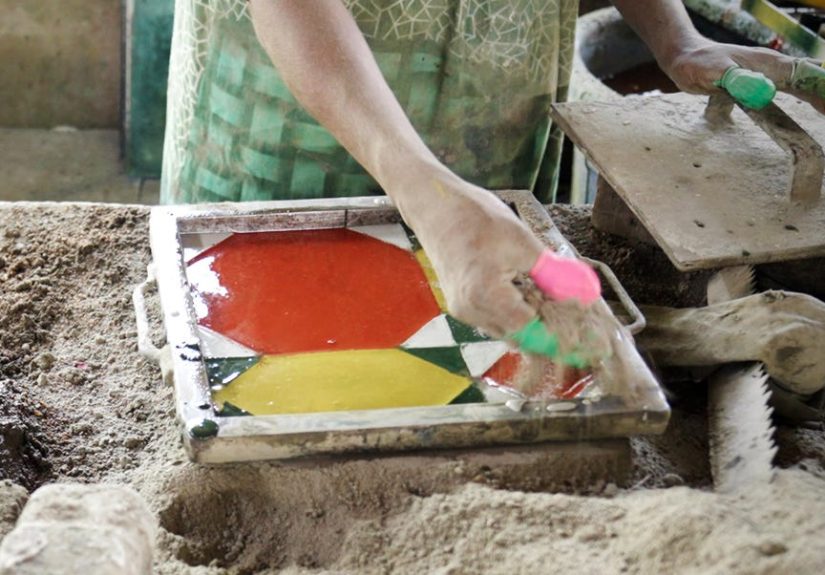
For patterned tiles, artisans place a stencil or pattern mold inside the frame. This mold divides the design into compartments. Floral petals, diamond shapes, curved borders, and geometric segments are all separated so different colors can be poured neatly.
The stencil is removed after the colored mix is poured, so timing matters. Remove it too carelessly and the design can bleed. Remove it with skill and the colors sit beside each other like well-behaved guests at a wedding dinner.
Step 4: Pigments Are Mixed by Hand
The colored layer is made from cement, fine sand or local materials, water, and pigments. Traditional makers are known for rich, earthy, and vibrant colors. The exact recipes can vary by workshop, and many artisans guard their formulas carefully. That secrecy is part chemistry, part family inheritance, and part “nice try, competitor.”
Color mixing is not random. The mixture must be fluid enough to spread into the design but stable enough to hold its shape. A watery mix can weaken the design. A thick mix can refuse to flow properly. The artisan’s judgment decides when the texture is right.
Step 5: Colors Are Poured Into the Design
Using small cups or ladles, the artisan pours colored cement into the compartments of the stencil. This is one of the most satisfying parts to watch. The colors glide into place, forming the face of the tile before your eyes. Red fills a petal. Blue settles into a border. White creates contrast. Black sharpens the geometry.
There is no undo button. If the color spills into the wrong section, the tile may need to be remade. The artisan’s hand has to be steady, but not stiff; quick, but not rushed. It is the kind of skill that looks easy only because the person doing it is very, very good.
Step 6: The Base Layer Is Added
After the decorative layer is completed, the artisan adds a backing mixture, usually involving cement and sand. This forms the body of the tile. The base must be strong enough to support foot traffic and installation, while the top layer must preserve the design.
The mixture is spread and leveled carefully. In handmade tile-making, even pressure matters. Too much force can disturb the design underneath; too little can create weak spots. This is where beauty meets engineering, and both politely ask the artisan not to mess things up.
Step 7: The Tile Is Set and Removed
Once the layers are placed, the tile begins to set. The artisan removes the frame and separates the tile from the glass at the right time. When the tile is lifted, the design appears on the glossy side. It is a satisfying reveallike flipping a pancake, except the pancake is architectural heritage and you probably should not eat it.
Step 8: Curing Gives the Tile Strength
Athangudi tiles gain durability through curing. The tiles are kept in water or a moist curing environment for several days, allowing the cement to hydrate properly. This step is not glamorous, but it is essential. Without proper curing, the tile may not develop the strength and stability it needs.
This is also where handmade production differs from instant manufacturing. Athangudi tiles take time. The craft refuses to sprint. It prefers to age into strength, which is annoying for impatient people but excellent for floors.
Step 9: Drying and Sorting
After curing, tiles are dried and sorted. Artisans check the surface, color clarity, edges, thickness, and pattern quality. Handmade variation is expected, but cracks, weak edges, or major defects are rejected. The best tiles move forward for packing, transport, and installation.
By the time an Athangudi tile reaches a home, it has been handled many times. It has been poured, layered, cured, dried, inspected, and moved with care. That is why it carries a human story in a way factory-made flooring rarely does.
Why Athangudi Tiles Are So Special
They Are Handmade, Not Mass-Produced
Every Athangudi tile is made individually. This gives the final floor subtle variation and warmth. A machine-made tile can repeat a pattern endlessly with perfect uniformity. Athangudi tiles repeat a pattern with personality. The difference is like hearing a live musician instead of a ringtone.
They Stay Cool Underfoot
In hot climates, flooring matters. Athangudi tiles are valued because they feel naturally cool underfoot, making them suitable for warm regions. This is one reason they work beautifully in courtyards, verandas, living rooms, and traditional homes in South India.
They Offer Bold Design Without Looking Trendy
Trends come and go. One year everyone wants gray minimalism; the next year gray minimalism looks like a sad office printer. Athangudi tiles have survived because they are rooted in craft, not trend cycles. Their patterns can feel vintage, festive, elegant, or contemporary depending on how they are used.
They Are Eco-Conscious by Nature
Because Athangudi tiles are handmade, sun-dried or air-dried, and not fired in energy-heavy kilns, they are often described as a more sustainable flooring choice than many industrial tiles. Their production relies heavily on manual skill rather than large-scale mechanized firing. For homeowners interested in natural materials and traditional craftsmanship, this is a major advantage.
Popular Athangudi Tile Designs
Athangudi tile designs often include floral patterns, checkerboard layouts, star motifs, borders, vines, diamonds, and repeating geometric forms. Some designs are delicate and traditional, while others are bold enough to wake up a sleepy hallway.
Classic color combinations include deep red and cream, blue and white, green and yellow, black and white, and multicolor floral palettes. In modern interiors, designers often use Athangudi tiles in smaller doses: an entryway rug effect, a kitchen backsplash, a bathroom floor, or a decorative border around plain stone or cement flooring.
The real trick is balance. A full Athangudi floor can look magnificent in a large room, especially when the furniture is simple. In smaller rooms, one patterned section may be enough. Think of Athangudi tiles like spices: used thoughtfully, they make the whole dish sing; used wildly, your living room may start auditioning for a festival parade.
Where Athangudi Tiles Work Best
Athangudi tiles are especially effective in spaces that benefit from color and character. Entryways are perfect because the floor creates an immediate first impression. Courtyards and verandas suit the tile’s heritage feel. Dining rooms gain warmth. Boutique hotels and cafés use them to create a memorable atmosphere. Even modern apartments can use Athangudi tiles as accent flooring to break up plain surfaces.
They also pair beautifully with wood, lime plaster, brass, cane furniture, white walls, and traditional Indian textiles. In contemporary design, Athangudi tiles can soften modern architecture by adding craft and color. A minimalist room with one Athangudi tile panel suddenly looks less like a showroom and more like a home with a passport.
Installation and Care: What Homeowners Should Know
Because Athangudi tiles are handmade, installation requires experienced workers. The tiles may have slight differences in thickness or edge finish, so careful leveling is important. Many experts recommend using installers familiar with handmade cement tiles rather than treating them like standard factory-made ceramic tiles.
Once installed, the tiles should be cleaned with mild products. Harsh acids and aggressive chemicals can damage the surface. Regular sweeping and gentle mopping are usually enough. Over time, Athangudi tiles can develop a richer character, especially when maintained properly.
It is also smart to order extra tiles for future repairs. Handmade batches can vary, and finding an exact match years later may be difficult. Future-you will appreciate the backup. Future-you is already dealing with enough problems, probably including forgotten passwords.
The Human Side of Athangudi Tile-Making
The beauty of Athangudi tiles is not only in the product but in the people who make it. Many artisans inherit the skill from previous generations. Their knowledge lives in practice: how thick the color mix should feel, when to lift the stencil, how long to cure, how to correct a small flaw, how to judge a tile by touch and sound.
This kind of knowledge is difficult to preserve if younger generations leave the craft. Handmade traditions often face pressure from cheaper industrial alternatives, changing tastes, inconsistent demand, and the challenge of fair wages. When buyers choose authentic Athangudi tiles, they are not just buying flooring. They are helping keep a regional craft economy alive.
Why Watching the Process Matters
Watching Athangudi tiles being made changes how you see them. Before watching, you might think, “Nice tile.” After watching, you think, “Someone poured that petal by hand, waited for it to cure, checked it, carried it, and somehow did not spill coffee on it, which is more than I can say for myself.”
The process reveals the value hidden behind the surface. A handmade tile is not expensive only because it is decorative. It carries time, labor, training, local material knowledge, design memory, and cultural meaning. The finished floor is not just a design choice; it is a quiet archive under your feet.
Experiences Inspired by Watching Athangudi Tiles Being Made
There is something unexpectedly calming about watching Athangudi tile-making. At first, you notice the colors. Then you notice the hands. Then you notice the rhythm: place the glass, fix the frame, set the stencil, pour the pigment, lift carefully, layer the base, cure, dry, repeat. It feels almost musical. No dramatic soundtrack is needed. The small scrape of tools and the soft movement of wet cement do all the work.
One of the most memorable experiences related to Athangudi tiles is visiting a small workshop where the floor is not just the final product but part of the working environment. Tiles may be stacked along walls, curing in water, drying in rows, or waiting to be inspected. The workshop does not need fancy lighting to impress you. The colors do that by themselves. A red tile catches the sun. A blue border looks freshly painted. A floral pattern seems too neat to have come from a hand-poured process, yet there it is, proving that patience can be more precise than machinery.
For travelers interested in craft, watching Athangudi tiles being made can be more rewarding than simply buying them from a catalog. A catalog shows the result. A workshop shows the decisions. You see how fast the artisan works, but also how carefully. You see the tiny pauses before a stencil is lifted. You see that “handmade” is not a marketing word tossed onto a product tag; it is a real sequence of practiced actions.
Another powerful experience is seeing Athangudi tiles inside old Chettinad homes. In a workshop, they are individual pieces. In a mansion or heritage hotel, they become atmosphere. A patterned floor can guide you through a corridor, frame a courtyard, or turn a simple room into a story. The tiles interact with carved doors, high ceilings, columns, antique furniture, and filtered sunlight. Suddenly the tile is not just a tile. It is part of an architectural conversation that has been going on for generations.
Interior designers often describe Athangudi tiles as statement flooring, but that phrase feels a little too small. A statement can be loud and temporary. Athangudi tiles feel more like memory made visible. They remind us that homes do not have to be plain to be elegant. They can be colorful, regional, handmade, and still completely livable.
For homeowners, the experience of choosing Athangudi tiles can be both exciting and mildly dangerous to decision-making skills. There are so many patterns that “I’ll just pick one quickly” can become a two-hour debate involving family members, screenshots, and someone saying, “What about the blue one?” for the seventeenth time. The best approach is to consider the room size, wall color, furniture style, and how much visual energy you want. A bold pattern in a small entryway can feel charming. The same pattern across a giant open-plan room may need careful balancing with simpler decor.
Living with Athangudi tiles also creates a different relationship with a home. You notice the floor more. You may find yourself looking down, not because you dropped something, but because the pattern deserves attention. Guests notice too. Athangudi tiles are excellent conversation starters, which is helpful if your small talk usually begins and ends with the weather.
Perhaps the best experience of all is realizing that traditional craft is not frozen in the past. Athangudi tiles are still being made, still being installed, and still being adapted for modern spaces. They can belong in a heritage mansion, a city apartment, a boutique café, or a contemporary villa. Their survival depends not on nostalgia alone but on people continuing to value the slow, skilled, human process behind them.
Watching how the legendary Athangudi tiles are made is a reminder that beauty does not always need speed. Sometimes it needs a glass plate, a metal frame, colored cement, water, sunlight, and an artisan who has done the same movement so many times that it looks like magic. And honestly, that is better than magic. Magic disappears after the trick. Athangudi tiles stay on the floor, shining quietly, decade after decade.
Conclusion
Athangudi tiles are more than colorful handmade flooring. They are a living craft from Chettinad, shaped by trade, architecture, climate, material knowledge, and generations of artisans. Their making process is slow, precise, and deeply human. From the glass plate that creates the shine to the hand-poured pigments that form each pattern, every tile carries a story of patience and skill.
For homeowners, designers, travelers, and craft lovers, watching Athangudi tiles being made offers a rare look at beauty before it becomes polished and installed. It shows why authentic handmade materials matter in a world full of fast production. A floor made with Athangudi tiles does not merely cover space. It gives the space a voice, a rhythm, and a little bit of Chettinad sunshine.