Table of Contents >> Show >> Hide
- What E3D Actually Introduced at MRRF 17
- Why the Titan Aero Was a Big Deal
- Direct Drive vs. Bowden: Why This Debate Mattered
- How the Titan Aero Fit Into E3D’s Ecosystem
- What Problems Was E3D Trying to Solve?
- The MRRF Factor: Why This Launch Location Was Perfect
- Who Benefited Most From the Titan Aero?
- Real-World Considerations Before Installing a Combination Extruder and Hotend
- Why the Titan Aero Still Matters in 3D Printing History
- Practical Examples: Where a Titan Aero-Style Setup Makes Sense
- Common Misunderstandings About the Titan Aero
- Experience-Based Notes: Living With a Compact Extruder and Hotend Setup
- Conclusion
At MRRF 2017, E3D walked into one of the most passionate rooms in desktop 3D printing and showed off a compact idea with big implications: the Titan Aero, a combination extruder and hotend designed to make direct-drive printing lighter, shorter, cleaner, and more reliable.
The Midwest RepRap Festival, better known as MRRF, has always been more than a trade show. It is part engineering meetup, part garage laboratory, part “look what I made at 2 a.m.” celebration. In 2017, the event in Goshen, Indiana, brought together RepRap builders, printer manufacturers, filament makers, modders, YouTubers, and people who can identify a nozzle size from across the room. In that environment, E3D’s Titan Aero made perfect sense. It was not introduced as a flashy gadget for people who only read spec sheets. It was a toolhead upgrade aimed at real 3D printer users who care about filament control, print quality, build volume, and mechanical simplicity.
The headline was simple: E3D combined the Titan extruder with the V6-style hotend architecture into one compact direct-drive assembly. But the real story is why that mattered. For years, desktop FDM printers had been balancing a familiar trade-off. Bowden setups kept the print head light, but they often made flexible filament and fast retractions harder to tune. Direct-drive systems gave better filament control, but they could be bulky and heavy. The Titan Aero tried to split the difference by bringing direct-drive precision into a shorter, more rigid, more integrated package.
What E3D Actually Introduced at MRRF 17
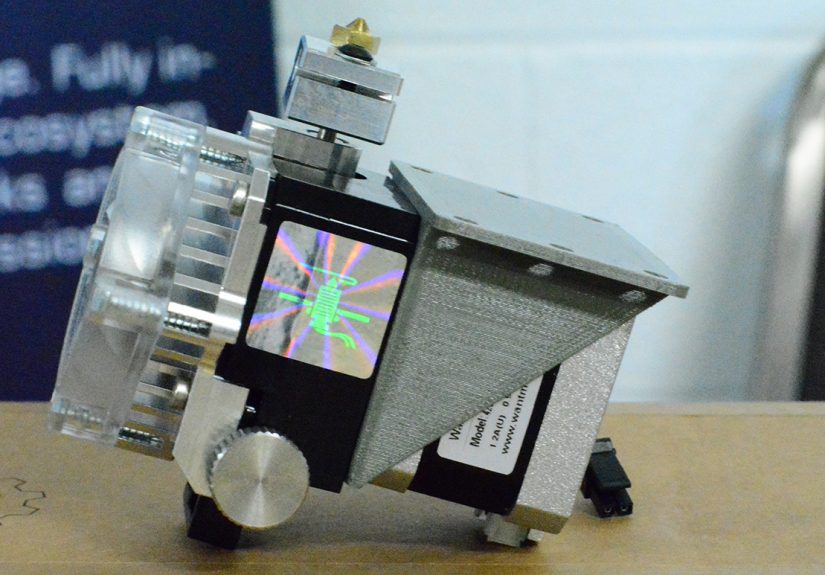
The product at the center of the buzz was the E3D Titan Aero. In plain English, it was an extruder and hotend combination. Instead of mounting a Titan extruder above a separate V6 hotend with more vertical distance between components, the Aero replaced the traditional Titan lid with an aluminum heatsink that became part of the hotend cooling system. That sounds like a small change, but in 3D printing, small mechanical changes can mean the difference between “beautiful print” and “spaghetti sculpture with emotional damage.”
By integrating the hotend more tightly into the extruder body, E3D shortened the filament path. That is especially useful for flexible materials such as TPU, where every extra millimeter of unsupported path can become a tiny opportunity for the filament to buckle, squish, or escape like a noodle with commitment issues. The Titan Aero was designed to guide filament more directly from drive gear to melt zone, improving control without forcing users into a huge toolhead.
Why the Titan Aero Was a Big Deal
1. It Saved Z-Axis Height
One of the most practical benefits of the Titan Aero was the extra build height it could recover. Compared with a separate Titan plus V6-style arrangement, the Aero’s compact layout could add roughly 25 mm of usable Z-axis height on many direct-drive printers. That may not sound dramatic until you are printing a tall vase, cosplay prop, lamp shade, or prototype enclosure and discover your model is just slightly too tall for your machine.
For hobbyists, 25 mm can be the difference between printing a part in one clean piece and cutting it into sections. For small businesses, that can mean less assembly time, fewer seams, and better-looking finished products. In other words, E3D did not just shrink a toolhead for bragging rights. The smaller design had a real impact on everyday printing.
2. It Improved Rigidity
A compact toolhead is not automatically better. It must also be mechanically solid. E3D emphasized rigidity because a hotend that wiggles, flexes, or hangs awkwardly from an extruder can introduce inconsistency. When the extruder and hotend behave like one firm assembly, the nozzle is better able to follow the printer’s motion system accurately.
This matters during quick directional changes, higher acceleration moves, and long prints where tiny inaccuracies can build into visible artifacts. A rigid toolhead also helps when prints curl upward or the nozzle bumps a slightly raised edge. No, it does not make your printer indestructible. But it can make the extrusion system feel less like a dangling accessory and more like a serious motion component.
3. It Kept the Titan’s 3:1 Gear Ratio
The Titan extruder had already earned attention because of its 3:1 gearing. That gear reduction allowed a smaller motor to produce strong filament-pushing force while maintaining good resolution and control. The Titan Aero kept that advantage. In practical terms, users could build a lighter carriage without giving up the grip and torque needed for reliable extrusion.
That balance was especially attractive for printer builders chasing better direct-drive performance. Heavy toolheads can increase ringing, ghosting, and stress on motion systems. A lighter, geared direct-drive setup offered a more elegant path: keep filament control close to the nozzle, but avoid turning the carriage into a brick on rails.
Direct Drive vs. Bowden: Why This Debate Mattered
To understand why the Titan Aero attracted attention, it helps to understand the old direct-drive versus Bowden debate. In a Bowden system, the extruder motor is mounted away from the hotend, and filament travels through a tube to the nozzle. This reduces moving mass, which can help speed and acceleration. The downside is that filament compression inside the tube can make retraction settings fussier, especially with flexible materials.
In a direct-drive system, the extruder sits close to the hotend. This gives the printer more immediate control over filament movement. Retractions can be shorter, flexible filament is usually easier to manage, and extrusion response can feel more predictable. The trade-off is mass. Put too much weight on the carriage and your printer may respond with ringing, slower speeds, or mechanical strain.
The E3D Titan Aero was interesting because it did not treat direct drive as an excuse for bulk. It aimed to make direct drive compact enough for serious desktop use while keeping the filament path short and controlled. That made it appealing to users printing flexible parts, small detailed models, and materials that benefit from precise extrusion.
How the Titan Aero Fit Into E3D’s Ecosystem
E3D’s strength has long been its ecosystem approach. The V6 hotend became a standard reference point in desktop 3D printing because it was modular, widely supported, and available in configurations for many machines. The Titan extruder added a lightweight geared extrusion option. The Titan Aero blended those ideas into one unit.
The Aero was available in versions for common filament sizes and voltage setups, including 1.75 mm and 2.85/3 mm filament ecosystems as well as 12V and 24V printer electronics. Standard and mirrored configurations also made it attractive for dual-extrusion setups, where two compact toolheads could sit side by side without turning the carriage into a crowded apartment closet.
This compatibility mattered because the RepRap community thrives on remixing, upgrading, and adapting. A toolhead that only works in one narrow situation might impress at a booth, but a toolhead that can fit into many printer designs becomes part of the community’s toolbox.
What Problems Was E3D Trying to Solve?
Cleaner Flexible Filament Printing
Flexible filament is famous for being useful and slightly mischievous. TPU and similar materials are great for phone cases, gaskets, vibration dampers, wheels, grips, and wearable parts. They are also very good at exposing weaknesses in an extruder path. If there is space to bend, flexible filament will find it. If there is a gap, it may wander into it like it owns the place.
By shortening and supporting the filament path, the Titan Aero made flexible printing more approachable. It did not remove the need for proper slicer settings, dry filament, correct temperature, and sane print speeds. But it gave users a better mechanical starting point.
More Compact Direct-Drive Upgrades
Many users wanted direct drive without losing too much build volume or overloading their printer’s motion system. The Titan Aero’s reduced height and integrated design directly targeted that problem. On machines where every millimeter counts, a shorter extruder-hotend stack is more than a neat design trick. It is a practical upgrade.
Better Toolhead Usability
A good extruder is not just about print quality. It also needs to be serviceable. Users must load filament, unload filament, clear jams, adjust tension, clean drive gears, and sometimes disassemble parts after a print goes full goblin mode. The Titan platform had already focused on accessible maintenance, and the Aero continued that idea by keeping the system compact while still familiar to existing E3D users.
The MRRF Factor: Why This Launch Location Was Perfect
MRRF was the right place for this product because the audience understood the problem immediately. This was not a crowd that needed a five-minute explanation of why shorter filament paths matter. Many attendees had built printers from aluminum extrusion, printed their own brackets, edited firmware, and spent evenings tuning retraction by 0.2 mm at a time.
At MRRF, a new toolhead is not just displayed. It is interrogated. People ask how it mounts, how it cools, what motor it uses, what filaments it can handle, whether it fits their printer, and how badly their weekend will be ruined if they install it wrong. That environment made the Titan Aero’s strengths easy to appreciate. It was compact, it was direct drive, it used proven E3D concepts, and it solved problems that builders already cared about.
Who Benefited Most From the Titan Aero?
The Titan Aero was especially attractive for makers who wanted better filament control without giving up too much speed or build volume. Owners of Prusa-style i3 machines, custom CoreXY printers, compact desktop machines, and dual-extrusion builds could all see potential value in a smaller direct-drive assembly.
Users printing flexible filament had an obvious reason to care. Designers making functional parts also had a reason to look closely, because reliable extrusion improves dimensional consistency and surface quality. Small businesses running desktop printers for prototypes or short-run production could benefit from easier filament handling and reduced tuning headaches.
However, it was not a magic wand. A Titan Aero could not fix loose belts, poor cooling, wet filament, bad slicer profiles, or a printer frame that shakes like a shopping cart with one bad wheel. Like most serious 3D printer upgrades, it worked best when paired with a well-built, well-tuned machine.
Real-World Considerations Before Installing a Combination Extruder and Hotend
Mounting and Clearance
Before installing a Titan Aero-style toolhead, users need to check mounting compatibility. A compact unit still needs the right bracket, fan duct, belt clearance, probe position, and wiring path. On some printers, the upgrade may require printed mounts or firmware changes for offsets and thermistor settings.
Thermal Setup
Hotend performance depends on proper heat management. The cold side must stay cool, the heatbreak must do its job, and the heater block must maintain stable temperature. The Titan Aero’s integrated heatsink design was central to its compactness, but users still needed proper fan installation and correct assembly to avoid heat creep.
Firmware and E-Steps
Because the Titan platform uses gearing, extrusion calibration matters. After installation, users typically need to calibrate steps per millimeter, check extrusion flow, and tune retraction. Direct drive usually needs shorter retraction distances than Bowden setups. Keeping old Bowden retraction settings after switching to direct drive is a classic way to make a printer behave dramatically for no good reason.
Why the Titan Aero Still Matters in 3D Printing History
Today, compact direct-drive toolheads are everywhere. Many modern printers ship with tightly integrated extruder-hotend assemblies, short filament paths, high-flow hotends, and lightweight carriage designs. In that context, the Titan Aero can feel like part of a larger evolutionary step. It helped normalize the idea that direct drive did not have to be clunky.
The product also reflected a broader shift in desktop 3D printing. The early hobbyist era was about making machines work at all. By 2017, the community was increasingly focused on refinement: better materials, better motion systems, cleaner toolheads, easier maintenance, and more predictable results. The Titan Aero fit that moment perfectly. It was not the loudest or strangest thing at MRRF, but it was exactly the kind of practical engineering that serious users notice.
Practical Examples: Where a Titan Aero-Style Setup Makes Sense
Imagine printing a TPU drone camera mount. With a long Bowden tube, the filament compresses and rebounds, making retractions harder to control. A compact direct-drive system gives the printer a more immediate response. The result can be cleaner edges, fewer blobs, and less trial-and-error.
Now imagine printing a tall architectural model on a desktop machine. If the original direct-drive stack costs you vertical space, the model may need to be split. A shorter toolhead that recovers around 25 mm of Z height can help keep the part whole. Fewer glued seams means less post-processing and a cleaner final presentation.
For a dual-extrusion printer, compactness matters even more. Two bulky toolheads can quickly create clearance issues. Standard and mirrored versions of a compact extruder-hotend design make it easier to build a tidy dual setup without turning the X carriage into a mechanical traffic jam.
Common Misunderstandings About the Titan Aero
It Was Not Just a Titan Bolted to a V6
The Titan Aero was more integrated than a simple stack of existing parts. The redesigned heatsink replaced the Titan lid and brought the hotend architecture closer into the extruder body. That integration was the point.
It Did Not Automatically Make Every Printer Faster
A lighter, more rigid toolhead can help performance, but speed still depends on the printer’s frame, motors, belts, firmware, acceleration settings, cooling, and filament. The Titan Aero improved the toolhead side of the equation, not the entire machine by itself.
It Still Required Careful Assembly
Like any hotend or extruder upgrade, correct installation mattered. Wiring, cooling, thermistor configuration, nozzle tightening, filament tension, and calibration all influenced results. The best hardware in the world still needs a human who reads instructions before grabbing the hex key like a medieval sword.
Experience-Based Notes: Living With a Compact Extruder and Hotend Setup
Using a combination extruder and hotend like the Titan Aero changes the way you think about a printer. With a traditional separated setup, the extruder and hotend feel like two connected devices. With an integrated direct-drive toolhead, they feel more like one coordinated mechanism. That can make tuning more intuitive because filament movement, retraction, and extrusion response are happening very close to the nozzle.
The first thing many users notice is how retraction behavior changes. Bowden systems often require longer retractions because filament has to move through a tube. With a compact direct-drive path, retractions are usually much shorter. That can reduce stringing while also lowering the chance of grinding filament from excessive back-and-forth motion. The printer feels more responsive, especially on small detailed parts with frequent travel moves.
Flexible filament is where the experience becomes most obvious. A well-constrained path makes TPU far less intimidating. Instead of baby-sitting the first layer while wondering whether the filament is about to wrap around the drive gear, users can focus on temperature, speed, and cooling. Printing flexible parts still rewards patience, but the mechanical setup is less likely to sabotage the process before the slicer even gets a fair chance.
Another practical benefit is confidence. When the hotend is rigidly mounted and the filament path is short, troubleshooting becomes more straightforward. Under-extrusion is easier to narrow down. Retraction tuning becomes less mysterious. Loading filament can feel cleaner. Maintenance is still part of the hobby, but the toolhead feels less like a stack of compromises.
There are trade-offs. Direct drive still adds moving mass compared with a remote Bowden extruder. On very fast machines, users need to pay attention to acceleration, jerk, input shaping if available, and the stiffness of the carriage. A compact direct-drive toolhead helps, but it does not cancel physics. Physics remains undefeated, unfortunately.
Installation can also reveal hidden printer weaknesses. A new toolhead may require a different mount, new fan duct, adjusted Z offset, updated firmware values, or revised cable management. Cable strain relief matters more than people expect. A messy wire bundle tugging on a compact toolhead can undo some of the benefits of the upgrade. Clean routing, proper cooling airflow, and a secure mount are just as important as the shiny hardware itself.
From a user-experience standpoint, the best part of a Titan Aero-style design is that it makes the printer feel more purposeful. The extruder is not floating somewhere else. The hotend is not hanging below a long stack. The filament path is short, direct, and logical. That simplicity is satisfying. It is the kind of upgrade that does not merely add a feature; it makes the machine feel more refined.
For builders, MRRF 17 was memorable because products like the Titan Aero showed where desktop 3D printing was heading. The future was not just bigger build plates or louder marketing claims. It was smarter integration, better usability, and mechanical designs that respected the realities of home and workshop printing. The Titan Aero represented that direction clearly: take proven parts, combine them intelligently, and solve problems users actually have.
Conclusion
E3D’s Titan Aero introduction at MRRF 17 was important because it captured a practical turning point in desktop 3D printing. It combined the control of direct-drive extrusion with a compact hotend layout, preserved the Titan’s geared pushing power, recovered valuable Z-axis height, and made flexible filament printing more approachable. It was not a gimmick. It was a thoughtful answer to real problems faced by RepRap builders and everyday makers.
In a community that values clever engineering over empty hype, the Titan Aero stood out because it made sense. It was smaller, stiffer, more integrated, and easier to justify for users who wanted better extrusion control without building a giant carriage. Years later, the popularity of compact direct-drive toolheads shows that E3D was working in the right direction. MRRF 17 gave the community an early look at that direction, and the Titan Aero helped push the conversation forward.
Note: This article is written for web publication and synthesizes real public information about E3D, MRRF 2017, the Titan Aero, direct-drive extrusion, and desktop 3D printing hardware without inserting source links into the article body.